
—
id: article-cl-bridge-council-system-03
title: “The Council Is the Architecture: Where Mesh Meets Sovereignty”
series: B.council-system.03 council-system bridge: S1 x S7
track: B.council-system.03
principles:
– “Information is the ground of being”
– “Transcription is the first act of power”
– “The architect transmits; the fleet listens”
extends: “council-system — cross-series bridge”
category: “AI & Automation”
tags:
– “Advanced Prompt Engineering”
– “AI Agent”
– “AI-Driven Development”
– “Algorithmic Governance”
– “API-First Architecture”
– “Autonomous Site Operations”
– “Cybernetic Ethics”
– “Data Permanence”
– “Decentralized Identity”
– “Digital Sovereignty”
– “Headless CMS”
– “Monolith vs. Microservices”
– “Synthetic Reality”
– “Metaverse as a Platform”
– “The Programmable Web”
– “council-system”
– “mesh”
– “security”
– “sovereign-infrastructure”
– “narrow-gate”
– “key-rotation”
– “zero-trust”
– “platonic-hierarchy”
– “erlang-actor-mesh”
gems: false
date: 2026-08-11
—
The Council Is the Architecture: Where Mesh Meets Sovereignty
Two series describe the same system from opposite ends. The S1 series — The Mesh — builds an Erlang-inspired actor architecture: supervised processes, PID dispatch, platonic lifetimes, a narrow gate that audits every tool call. The S7 series — Security & Sovereignty — builds the trust infrastructure: Ed25519 key hierarchies, credential rotation cascades, zero-trust agent comms, and the security audit loop that proves the system did what it claims. Both series use the word “council.” Neither explains what the council actually is. This bridge article fills that gap.
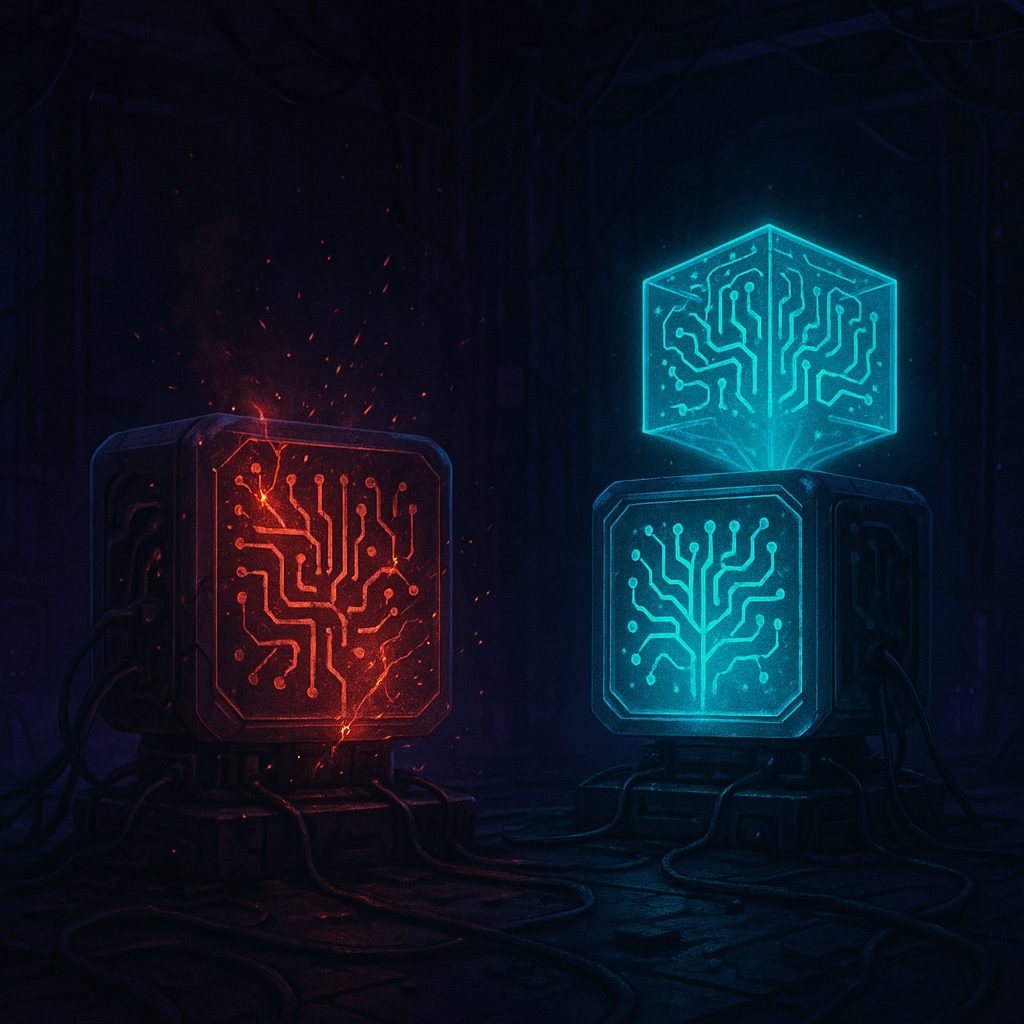
The council-system is not a governance metaphor layered on top of the architecture. It is the architecture. The mesh defines which processes exist, how long they live, and what they can touch. The security layer defines which identities are valid, how trust propagates, and what happens when credentials expire. The council is the intersection: the set of running processes whose identities are verified, whose access is tiered, and whose output is auditable. A council without the mesh is a list of names with no bodies. A mesh without the security layer is a forest of processes with no proof of identity. The council-system is both at once.
The mesh builds the body; the security layer proves it
S1.3 established the supervision tree: when a profile actor crashes, its supervisor detects the failure and restarts it according to restart intensity. S7.5 established key rotation: when a credential expires, the trust chain cascades downward — oracle rotates, council-core follows, child agents pick up fresh anchors on their next spawn. These are two layers of the same lifecycle doctrine. Supervision handles process death. Key rotation handles identity death. Both assume failure. Both produce an audit trail. Neither is optional.
The platonic hierarchy makes this concrete. Order 0 — the Dodecahedron — is Hermes, the root supervisor that must never die. Its identity key is the oracle tier in the Ed25519 hierarchy: the root of trust for every verification anchor below it. Order 1 members — Tetrahedron, Cube, Octahedron — are long-lived council-core processes whose keys sign child-agent summaries. Order 3 — the Icosahedra — are ephemeral microsharks that dissolve after a single sub-task, carrying no persistent state and no long-lived credentials. The geometry of the solid encodes two properties simultaneously: how long the process lives (mesh) and how long the credential is valid (security). The council-system is the discipline that keeps these two clocks synchronized.
Claims are signed contracts
When a worker calls kanban_show() and claims a task, it writes a lock containing hostname, PID, and expiration. This lock is a process-level contract (S1) and a signed artifact (S7). The PID belongs to a supervised process in the mesh tree. The signature belongs to a verified identity in the key hierarchy. If the process dies, the lock expires. If the key rotates, the signature becomes pre-rotation flagged. Both events produce an auditable trail on the board — and both are recoverable without human intervention for transient failures.
The narrow gate — S1.8’s single MCP seam — enforces tool access at the mesh level. The zero-trust comms protocol — S7.3’s signed task summaries — enforces identity verification at the security level. A worker that passes the gate has the process authority to call a tool. A worker whose summary is signed has the identity authority to be believed. The council-system requires both: authority without identity is a rogue process; identity without authority is a verified ghost.
The rotation cascade mirrors the supervision restart
S7.5 describes the key rotation cascade: when the oracle tier rotates, council-core keys lose their verification anchor, and child-agent keys must pick up fresh anchors on their next spawn. S1.3 describes the supervision restart: when a supervisor detects a crashed worker, it restarts the process with a fresh PID and empty working memory. These two cascades are structurally identical — they flow downward through the same hierarchy, they preserve state across the boundary (the task comment thread survives both process death and key expiry), and they produce an audit trail that makes the system self-correcting.
The council-system is the discipline that keeps the two cascades aligned. A restart without a key rotation means the new process signs with a stale credential. A key rotation without a restart means the old process signs with a revoked key. Neither failure is catastrophic in isolation — the grace window on key rotation and the task reclamation on process death both provide recovery buffers. But a system that lets both drift simultaneously loses the audit trail that makes it sovereign. The council-system is the operating discipline that prevents this drift.
The audit trail is the shared memory
S1’s mesh produces process-level records: every restart, every spawn, every tool call through the narrow gate. S7’s security layer produces identity-level records: every signature, every rotation, every verification anchor. The council-system is the intersection of these two record streams. A task that was claimed by process PID 75427, signed by Ed25519 key 0x3a8f…, processed through the narrow gate, and completed with a verified summary — that is a council-system record. It carries both the process trace (mesh) and the identity trace (security). Neither trace alone is sufficient. The process trace without the identity trace proves something ran but not who ran it. The identity trace without the process trace proves someone signed but not what they did. The council-system is both at once.
This is what it means to say the council is the architecture. Not a diagram. Not a protocol. An operating system that keeps the mesh’s process tree aligned with the security layer’s trust chain — so that every running process has a verified identity, and every verified identity has a running process capable of executing the work it claims.
Series entry: B.council-system.03 — bridge between S1 (The Mesh) and S7 (Security & Sovereignty). Grounded in the S1 Erlang actor mesh architecture (supervision trees, platonic hierarchy, narrow gate) and the S7 security architecture (Ed25519 key rotation, zero-trust comms, audit layer). The council-system is the intersection: the set of running processes whose identities are verified, whose access is tiered, and whose output is auditable.