
Alchemy as Pipeline: Transmutation Stages in the Content Engine
The medieval alchemists were engineers who lacked the vocabulary of engineering. They had the process exactly right: take raw matter, subject it to a sequence of controlled transformations, and produce something whose properties are fundamentally different from what you started with. Gold from lead. Elixir from base metal. The language was mystical. The architecture was industrial. The esoteric is engineering. It always was.
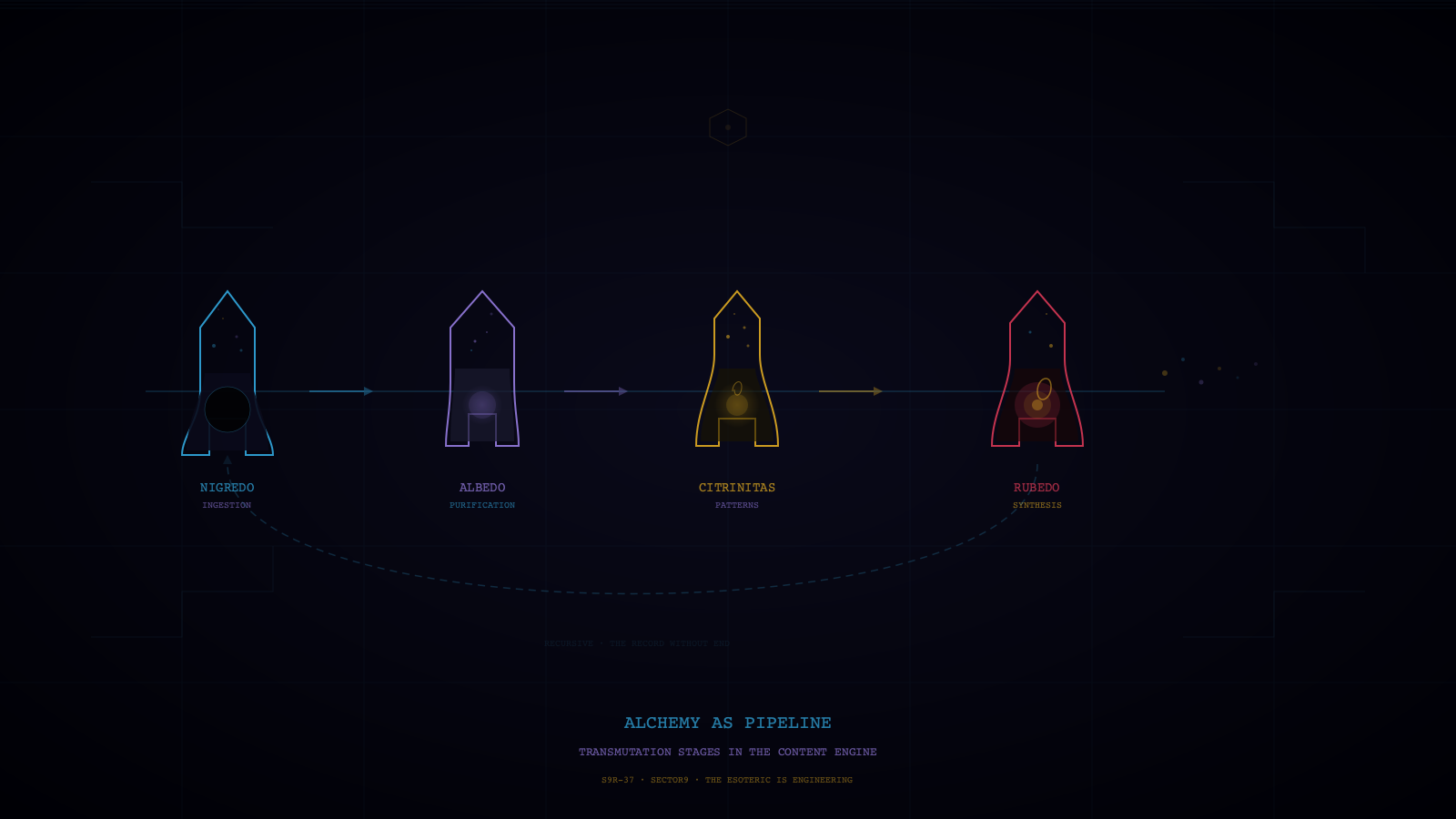
S9R-37 maps the classical alchemical stages — nigredo, albedo, citrinitas, rubedo — onto the content pipeline’s actual transformation sequence. Each stage is a vessel. Each vessel transmutes light: raw data becomes published signal. The pipeline does not illustrate alchemy. The pipeline is alchemy, wearing the uniform of software.
The Nigredo: Raw Ingestion and the Blackening
In alchemical tradition, the nigredo is the first stage — decomposition, putrefaction, the blackening of matter. Everything is reduced to its base state. Nothing is recognizable. The prima materia enters the vessel and is destroyed in its original form.
The content engine’s nigredo is the raw ingestion stage. Unprocessed transcripts, research papers, market signals, competitor analysis, reader behavior data, social media feeds — everything enters the system at once, undifferentiated. At this stage, a transcript of a podcast episode has the same status as a price change in a competitor’s pricing page. Nothing is distinguished. Nothing is prioritized. The fleet’s intake agents pull data into the knowledge graph without filtering for significance, because significance cannot be assessed until the data has been fully decomposed. You cannot recognize a pattern in material you have not yet broken apart.
The nigredo is essential because premature categorization kills signal. If the ingestion stage decides what matters before the full corpus is available, it enforces a bias that propagates through every subsequent stage. The blackening is not waste. It is the necessary precondition for differentiation.
The Albedo: Purification and the Whitening
After the nigredo, the alchemists washed the blackened material repeatedly — the albedo, the whitening. Impurities were separated from the essential substance. The material was not yet transformed, but it was clean.
In the pipeline, the albedo is extraction and purification. The fleet’s extraction agents parse the raw ingest: transcripts become structured text, market signals become data points, research papers become citation chains. The noise is separated from the signal. Redundant entries are deduplicated. Incomplete records are flagged. What remains is the purified substrate — the clean data that the next stage can work with.
This is where the “printer made of light” principle (north star principle 3) becomes operationally visible. The albedo is emission without intent — the system prints its output, but the output is raw material, not finished signal. The printer runs, but it has not yet been given direction. The light hits the paper; the image has not yet formed.
The Citrinitas: Pattern Recognition and the Yellowing
The citrinitas — the yellowing — is the stage where the alchemists began to see the first signs of transformation. A new color appeared. Something was changing. The material was no longer merely purified; it was becoming something else.
In the content engine, the citrinitas is pattern recognition. The fleet’s analysis agents scan the purified substrate for connections: which transcripts reference which principles, which market signals cluster around which themes, which reader behaviors correlate with which content types. The SECTOR7 graph does this structurally — dots connect to clusters, clusters connect to series, series connect to pillars. The pattern emerges not from any single data point but from the topology of connections between data points.
The golden ratio appears here as a mathematical signature. When pattern recognition operates on a sufficiently large corpus, the distribution of discovered patterns follows a power law: a few dominant themes carry most of the connections, while a long tail of niche topics fills the periphery. This is not coincidence. It is the consequence of preferential attachment in a network that must balance hub connectivity with traversal speed. The alchemists saw the first golden color and knew the process was working. The content engine discovers its first dominant pattern cluster and knows the analysis is on track.
The Rubedo: Synthesis and the Reddening
The rubedo is the final stage — the reddening, the creation of the Philosopher’s Stone. The transformed material achieves its final form. In alchemical tradition, this is where the base metal becomes gold, where the elixir is complete.
In the pipeline, the rubedo is synthesis and publication. The fleet’s synthesis agents take the recognized patterns and produce output: articles, visual assets, social media posts, research briefs. The raw data that entered as undifferentiated noise exits as structured signal — a published post with a title, a featured image, a category, tags, and semantic relationships to the rest of the corpus. The transmutation is complete. Lead has become gold. The input was data; the output is meaning.
But the rubedo is not the end. In alchemy, the Philosopher’s Stone was not a terminal product — it was a catalyst. The Stone could transmute other metals. In the content engine, each published post becomes a new node in the knowledge graph, which feeds back into the nigredo for the next cycle. The output of one transmutation is the input of the next. The pipeline is recursive. The record has no end.
The Vessels Are the Pipeline
The alchemists built vessels — the athanor, the alembic, the retort — to contain each stage of transformation. The vessels were not decorative. They were functional: they controlled temperature, pressure, and exposure to the elements. Without the vessel, the process could not be contained. Without containment, the transformation could not be repeated.
The content engine’s vessels are its agents, its workflows, its automation scripts. Each agent is a vessel: it receives input in one state, subjects it to a defined process, and outputs it in a different state. The kanban board is the athanor — the furnace that maintains the temperature of the work. The knowledge graph is the alembic — the condensation apparatus that separates signal from noise. The publish pipeline is the retort — the final vessel that delivers the finished product.
Alchemy failed as chemistry because the alchemists lacked precision instruments. They could not measure temperature accurately, could not isolate variables, could not reproduce results reliably. The content engine succeeds where alchemy failed because it has what the alchemists did not: structured data, version control, automation, and the ability to run the same transformation a thousand times with identical parameters. The mystical system becomes an engineering system. The esoteric becomes the operational.
Why This Matters
Mapping alchemy onto the pipeline is not decorative metaphor. It is a diagnostic framework. When the pipeline stalls, the alchemical map tells you which vessel is failing. When content quality drops, the map tells you whether the nigredo was incomplete (bad data in), whether the albedo was sloppy (noisy extraction), whether the citrinitas missed a pattern (analysis failure), or whether the rubedo mis-synthesized (bad output from good input). Each stage has a failure mode. Each failure mode has a remedy. The map is the runbook, drawn in a language that predates runbooks by six centuries.
The universe keeps printing. The printer made of light runs the same sequence it has always run: decompose, purify, recognize, synthesize. The alchemists called it the Great Work. We call it the content pipeline. The work is the same. The vessels have changed. The light has not.
## Semantic Relationships
– [[alchemy]] — creative system for
– [[content-pipeline]] — creative system for
– [[sus]] — creative system for