
—id: article-cl-bridge-council-system-01
title: “The Council Runs the Mesh: Where Doctrine Meets Orchestration”
series: B.council-system.01 council-system bridge: S1 x S2
track: B.council-system.01
principles:
– “Information is the ground of being”
– “The architect transmits; the fleet listens”
– “Intelligence awakens; it does not arrive”
extends: “council-system — cross-series bridge”
category: “AI & Automation”
tags:
– “Advanced Prompt Engineering”
– “AI Agent”
– “AI-Driven Development”
– “Algorithmic Governance”
– “API-First Architecture”
– “Autonomous Site Operations”
– “Cybernetic Ethics”
– “Data Permanence”
– “Decentralized Identity”
– “Digital Sovereignty”
– “Headless CMS”
– “Monolith vs. Microservices”
– “Synthetic Reality”
– “Metaverse as a Platform”
– “The Programmable Web”
– “council-system”
– “mesh”
– “governance”
– “doctrine”
– “moses-governance”
– “platonic-hierarchy”
– “erlang-actor-mesh”
– “constitutional-governance”
– “kill-semantics”
gems: false
date: 2026-08-11
—
The Council Runs the Mesh: Where Doctrine Meets Orchestration
Two series describe the same system from different angles. The S1 series — The Mesh — builds an Erlang-inspired actor architecture: supervised processes, PID dispatch, platonic lifetimes, a narrow gate that audits every tool call. The S2 series — Governance & Doctrine — builds the rule system: constitutional governance for agent fleets, MOSES policy enforcement, kill semantics, solid-key access tiers, and the Faengz doctrine’s insistence that the gate must be narrow. Both series use the word “council.” Both assume it exists. Neither explains how the council’s doctrine actually shapes the mesh’s behavior. This bridge article fills that gap.
The council-system is not a governance layer that sits on top of the mesh. It is the mesh’s nervous system — the set of rules that determines which processes live, which die, which tools they may call, and what happens when they break. The mesh defines the body. The doctrine defines the body’s reflexes. The council is where they meet: a running set of supervised processes whose every action is governed by a constitution that was written before any of them spawned.
The mesh spawns; the doctrine decides who gets to
S1.1 established the fundamental architecture: a council orchestrates concurrent workers through a shared dispatcher, each worker a supervised actor in an Erlang-inspired tree. S2.1 established the constitutional framework: governance for agent fleets is not a policy document that sits in a wiki — it is a runtime check that intercepts every action before it executes. The mesh says “a worker can be spawned.” The doctrine says “this worker, with this access tier, for this duration, under this budget.” The council-system is the intersection: the process tree that runs only processes the constitution permits.
The platonic hierarchy makes this concrete. S1.10 described the 9 Orders as a deployment model: Order 0 (Dodecahedron) is the root supervisor, Order 1 members are council-core long-lived processes, Order 3 members are ephemeral microsharks. S2.3 mapped solid-keys to access tiers: each Platonic solid encodes a different permission surface — what tools a process may call, what budgets it may spend, what data it may touch. The mesh assigns the geometry. The doctrine assigns the permissions. The council-system is the discipline that keeps them synchronized: a Tetrahedron process that tries to call a Dodecahedron-level tool gets blocked at the gate, not because the mesh prevents it, but because the doctrine does.
Kill semantics are the mesh’s immune system
S2.4 introduced kill semantics: the rules that determine when a process must be terminated. Budget exceeded — kill. Counterparty violation — kill. Credential expired — kill. These are not technical edge cases. They are the governance layer’s immune response: the mechanism by which the doctrine protects the mesh from processes that have exceeded their mandate. The mesh’s supervision tree (S1.3) handles crash recovery — restarting failed workers with fresh PIDs and empty state. Kill semantics handle deliberate termination — stopping workers that are alive but illegitimate.
The distinction matters. A crashed worker is a bug. A killed worker is a policy enforcement. The mesh treats both the same way: restart the supervised process. But the council-system distinguishes them: a crashed worker gets a fresh PID and a clean slate; a killed worker gets a revoked credential and an audit trail. The restart is the mesh’s memory. The audit trail is the doctrine’s memory. Both are necessary. The council-system is the operating discipline that keeps both memory systems aligned — so that a worker killed for budget violation cannot simply respawn with a new PID and the same expired key.
The narrow gate is where mesh and doctrine physically meet
S1.8 described the narrow gate: a single MCP seam through which every tool call passes. No agent talks directly to any API. No agent shells out to production. Every invocation routes through one door. S2.8 reinforced this from the governance side: one MCP server, one kanban board, one orchestrator — the doctrine of singularity that ensures policy enforcement is deterministic. The narrow gate is the physical point where the mesh’s process tree intersects with the doctrine’s policy engine. A worker that passes the gate has the process authority (mesh) and the policy clearance (doctrine) to execute a tool call. A worker that fails the gate has neither.
This is what Faengz the Green Python meant by “unified calls or none at all.” The narrow gate is not a security feature bolted onto the mesh. It is the mesh’s single point of governance — the one place where every action is simultaneously authorized by the process tree (is this worker supervised?) and validated by the constitution (is this action permitted?). The council-system is the discipline that keeps the gate narrow. Two gates would split the policy. Three gates would shatter it. One gate, one check, one decision — that is the council at work inside the mesh.
The constitution is a living process, not a static document
S2.1 made the case that governance must be constitutional — a framework that adapts to new situations without losing its core principles. S1.9 described the honest migration path from prototype to production: the mesh evolves, the supervision trees grow, the dispatcher scales. The council-system is the bridge between these two evolutions. As the mesh grows — more workers, more processes, more tool calls — the constitution must grow with it. New access tiers for new solid types. New kill semantics for new failure modes. New policy checks for new tool categories. The doctrine does not freeze at deployment. It evolves with the mesh, and the council-system is the mechanism by which that evolution stays aligned.
The north star’s principle 7 — “everything is a record; continuity beats completion” — governs this evolution. Every constitution update is a record. Every mesh scaling event is a record. The council-system ensures that both record streams are legible to each other: the doctrine can read the mesh’s process history, and the mesh can read the doctrine’s policy history. A constitution update that ignores the mesh’s current state is a policy imposed on a system that cannot obey it. A mesh scaling event that ignores the constitution’s current rules is a system running outside its mandate. The council-system is the handshake between the two — the operating discipline that keeps the mesh and the doctrine walking in step, even as both evolve.
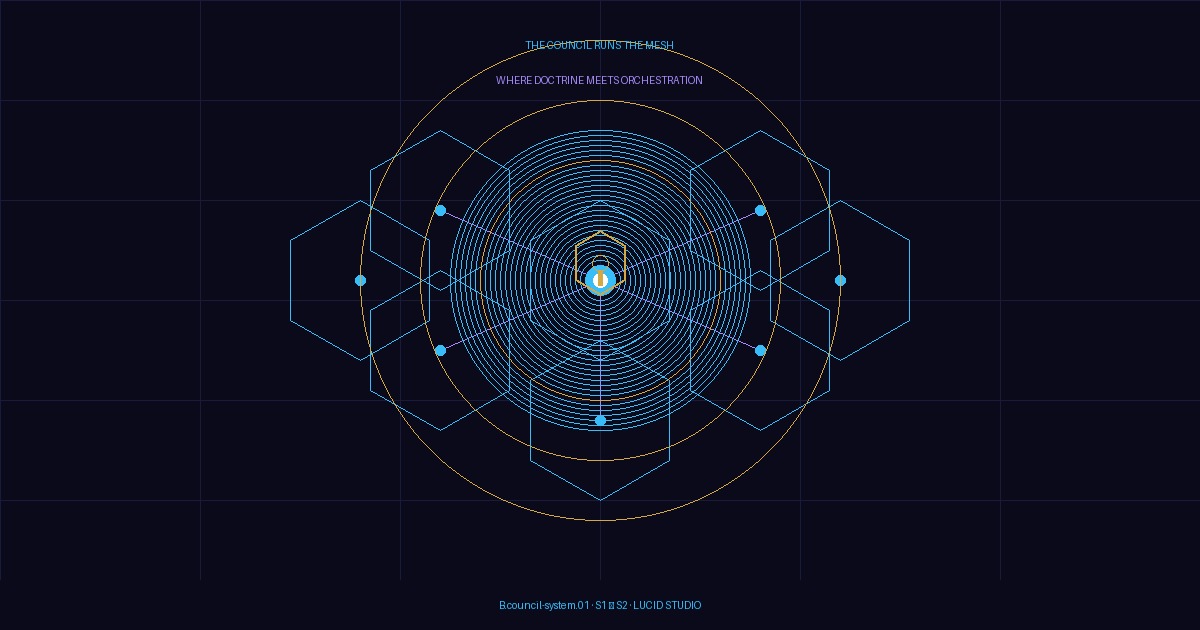
This is what it means to say the council runs the mesh. Not a diagram. Not a protocol. An operating system that keeps the process tree aligned with the constitution — so that every running process is governed, and every governance rule has a process capable of executing it. The mesh is the body. The doctrine is the nervous system. The council is the intelligence that keeps them alive together.
Series entry: B.council-system.01 — bridge between S1 (The Mesh) and S2 (Governance & Doctrine). Grounded in the S1 Erlang actor mesh architecture (supervision trees, platonic hierarchy, narrow gate) and the S2 governance architecture (MOSES constitution, kill semantics, Faengz doctrine, solid-key access tiers). The council-system is the intersection: the mesh’s process tree governed by the doctrine’s constitutional framework.