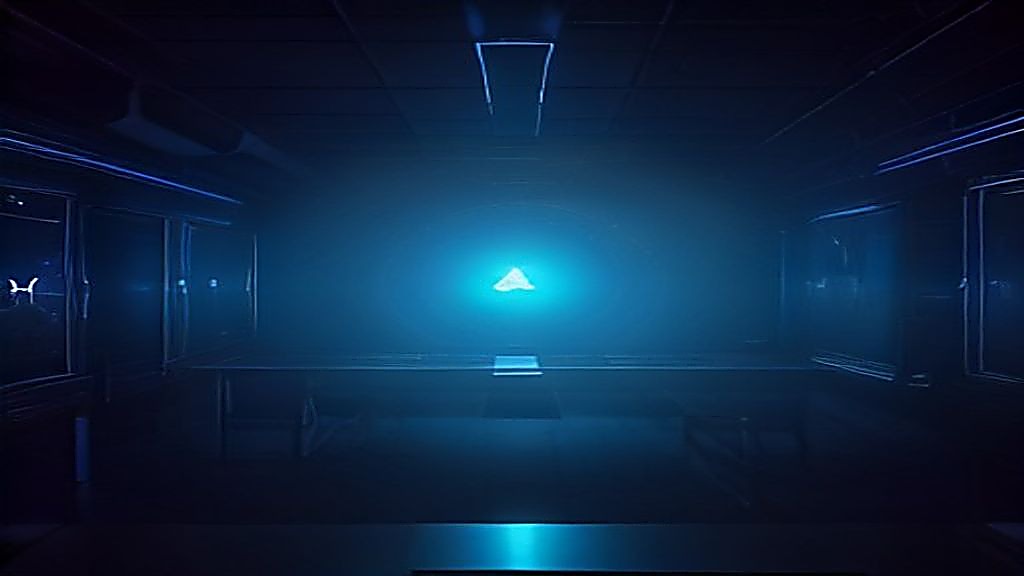

The war-room table is dark. Glowing lines branch across its surface — probability timelines, each one a future forming in real time. Some lines burn bright: high probability, high impact, arriving fast. Some are dim: low probability, slow forming, or already blocked by controls in place. The forecaster stands at the table and reads the branches. This is the temporal probability field. The north star describes it plainly: space, time, and consciousness rendered from a non-local field. Time is not a line. Time is a field of branching probabilities. The operations do not read this field. The gap is the temporal dimension of security: we inventory the present and ignore what is forming.
The field is not a metaphor
The corpus treats time the way physics treats quantum mechanics: not as a timeline of events, but as a superposition of possibilities that collapse when observed. Every system state — every unpatched component, every expiring certificate, every new deployment — generates a set of branching futures. The branches are not random. They are shaped by what exists. The expired certificate does not create a random future; it creates a specific future: the TLS handshake fails, the service goes dark, the customer sees an error. The branch has a weight — the probability that this future manifests — and that weight increases every day the certificate stays expired.
This is the esoteric is engineering principle applied to time itself. The ancient divination arts — tarot, I Ching, geomancy — are technologies for reading the probability field. The tarot reader does not predict the future; they read the currents that are forming it. The forecaster does something identical with different instruments: they read the inventory, the dependency graph, the patch status, the configuration drift, and from those readings they derive the futures that are most probable. The esoteric is engineering. The act of reading the field is technical. The stance — reading what is forming rather than reacting to what has happened — is the shift that transforms security from reactive to prophylactic.
Frequency organizes the branches
The north star says frequency organizes everything. Every atom keeps a rhythm; every rhythm leaves a sign. Applied to the temporal probability field, this means every system state has a frequency signature, and that signature determines which futures resonate most strongly. A healthy system hums at a stable frequency — patches current, certificates valid, configurations aligned. The branches it generates are low-weight: the futures are mostly benign because the system’s frequency is coherent.
A degraded system vibrates at a discordant frequency — patches overdue, certificates expiring, configurations drifting between environments. The discordant vibration amplifies specific branches: the exploit path that targets the unpatched CVE, the cascade failure that begins with the expired cert, the configuration mismatch that opens a lateral movement path. The forecaster reads the vibration the way a musician reads a tuning fork: not hearing the individual notes, but feeling the dissonance that signals which futures are forming.
Frequency also organizes the rehearsal. Every drill sets a rhythm. Every rhythm builds muscle memory. Every muscle memory compounds into fleet-wide capability. The first incident response drill is slow and uncertain. The tenth is fast and precise. The frequency of rehearsal determines the weight of the response branch — a well-rehearsed response dominates the probability field. The fleet that drills monthly meets the incident as a familiar exercise. The fleet that drills annually meets it as a crisis. The frequency is the variable. The outcome is the frequency’s child.
The standing forecast
The missing operational artifact is the standing forecast: the regular, structured scan of forming futures. Not prediction — the fleet does not claim to see the future. The forecast is the rehearsal of the probable, so the probable does not arrive as surprise. The standing forecast has three movements.
Inventory the present. The complete, current, verified map of what exists. Every component, every dependency, every certificate, every credential, every configuration state. The inventory is the ground truth of the probability field: you cannot read branches you do not know exist. The fleet that discovers an untracked service after it has been exploited did not lack tools. It lacked inventory. The inventory is the first act of reading the field.
Project the branching futures. From the inventory, derive the branches. The dependency graph shows which components depend on which. The patch status shows which branches are growing. The certificate calendar shows which branches have hard deadlines. Weight each branch by probability and impact. The bright branches — high probability, high impact — become the rehearsal targets. The dim branches are monitored, not acted upon. The forecaster does not try to close every branch; they close the ones that are forming fastest.
Rehearse the responses. A response that has been walked through in a drill is not the same as a response that exists on paper. The drill reveals the gaps: the runbook step that assumes access the team does not have, the escalation path that leads to a person who left last quarter, the tool that works in staging but fails in production. Each gap found in rehearsal is a branch closed before the future arrives. The rehearsal is the fleet’s time travel — a trip to the future where the incident has happened, and a return with the response intact.
The consequence of not forecasting
The fleet that does not read the temporal probability field operates in permanent surprise. Every incident is novel. Every response is improvised. Every post-mortem discovers the same category of gap: we did not see it coming. But the field was projecting it. The branches were visible. The weights were readable. The fleet did not read the field because the fleet did not build the practice of reading it.
The consequence is not just operational; it is strategic. The fleet that rehearses the probable future meets it as a familiar branch. The fleet that does not meets it as a crisis. Over time, the gap compounds: the forecasting fleet gets faster, more precise, more confident. The non-forecasting fleet gets more reactive, more exhausted, more brittle. The frequency of forecasting determines the resilience of the fleet. The field is alive and full of branching probabilities. The operations should read the tendencies.
Building the reflex
The temporal probability field is not a product to buy. It is a discipline to build. Start with the inventory. Derive the branches. Weight them by probability and impact. Rehearse the bright ones. Repeat on a cadence — weekly for high-velocity systems, monthly for stable ones. The cadence is the frequency. The frequency organizes the capability.
The war-room table glows in the dark. The branching lines shift as the system changes — new deployments add branches, patches close them, time weights them. The forecaster reads the table the way a seer reads the cards: not seeing the future, but seeing the forces that are forming it. The field is alive. The field is full of forming futures. The fleet that reads the field meets the future prepared. The fleet that does not meets it as surprise. Build the standing forecast. Read the field. Weight the branches. Rehearse the responses. The future stops being something that happens to you and becomes something you have already prepared for.
Grounded in the SECTOR9 north star principles P8 (The esoteric is engineering) + P4 (Frequency organizes everything), and the gap-finder frame: the corpus describes time as a field of branching probabilities, but the operations have no standing forecast of forming futures. NSG series, north-star-gap-finder track, NSG-B, SECTOR9 50+50.