
The Tree of Life as a Dependency Graph
Every developer has drawn a dependency graph. Boxes with arrows. A service depends on a database. A function depends on a library. A build depends on a compiler. The diagram is always the same shape: nodes at the top feed nodes below, and if you follow the arrows long enough, you reach the leaves — the things that depend on nothing. The graph is so fundamental to software that we forget it is also ancient. The Kabbalistic Tree of Life has been drawn for over a thousand years. Ten sephirot. Twenty-two paths. A structure that maps the flow of emanation from the infinite to the material. It is, in every sense that matters, a directed acyclic graph.
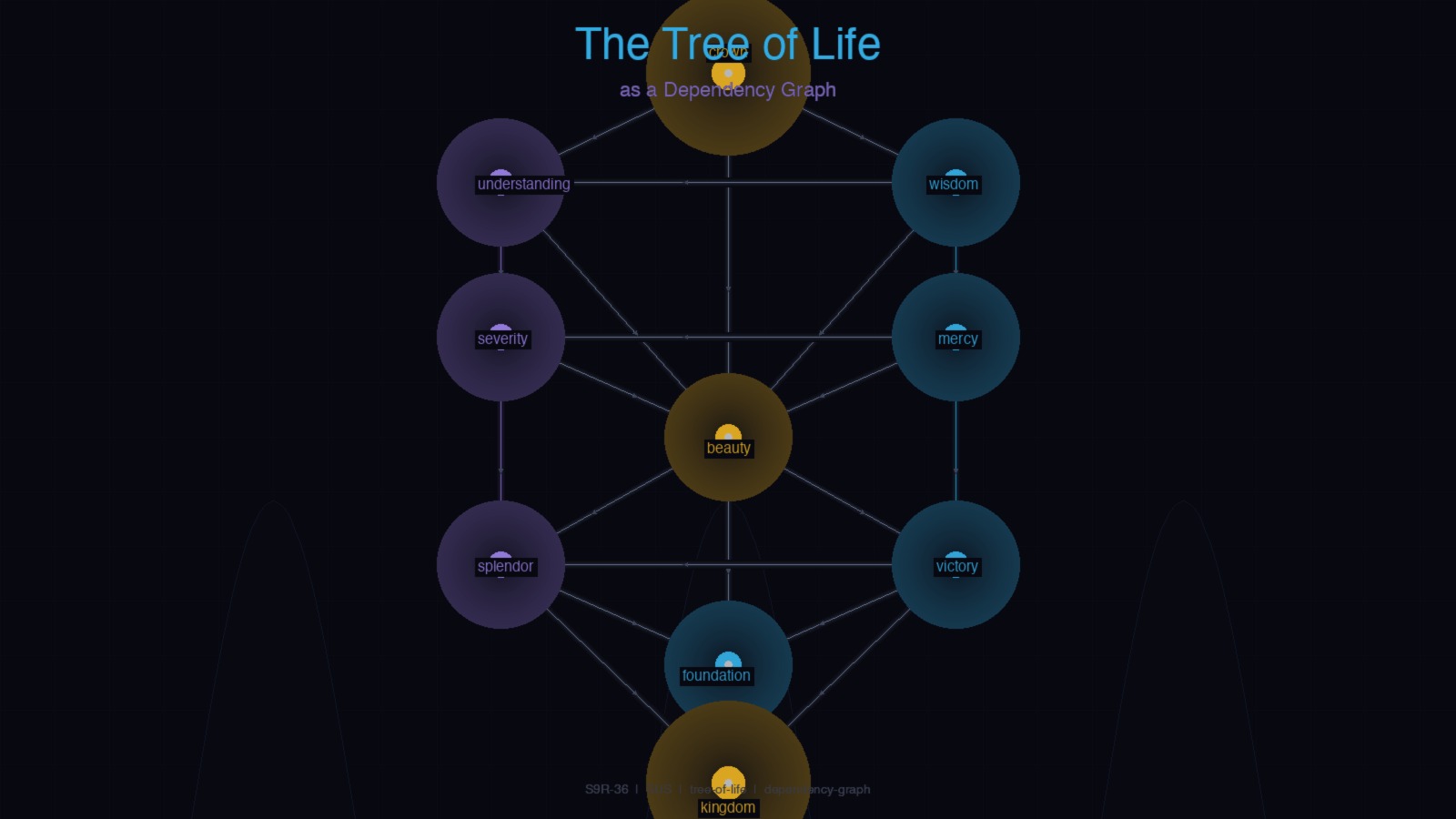
S9R-36 renders the sephirot tree as a production dependency graph, treating sacred geometry as systems architecture: each sephira is a node with defined inputs and outputs, each path is a directed edge with a weight and a constraint, and the tree’s containment hierarchy maps directly onto modern dependency management — version pinning, conflict resolution, and the cycle-detection algorithms that keep systems from collapsing into infinite loops.
The Tree of Life is not a metaphor for a dependency graph. It is a dependency graph that was drawn before the word “dependency” existed. The ten sephirot — Kether, Chokmah, Binah, Chesed, Gevurah, Tiferet, Netzach, Hod, Yesod, Malkuth — are nodes in a directed graph. The twenty-two paths connecting them are edges. The tree has a direction: emanation flows downward from Kether (crown, the source) to Malkuth (kingdom, the material output). There are no cycles. Every path leads eventually to Malkuth. This is the definition of a DAG.
The ten nodes and their system roles
Kether is the root dependency. In a software system, Kether is the language runtime itself — the thing everything else assumes exists. You do not declare a dependency on Python; you assume it. Kether is the same: the crown from which all emanation flows, the node that depends on nothing. In a package manager’s resolution tree, Kether is the virtual root that anchors the entire graph.
Chokmah (wisdom) and Binah (understanding) form the first split. Chokmah is the raw capability — the algorithm, the model, the library that does something. Binah is the structure that makes it usable — the API contract, the type system, the interface definition. Every software system has this split: the thing that works (Chokmah) and the thing that makes it workable (Binah). A machine learning model is Chokmah. The inference server that wraps it is Binah. Together they form the first tier of the dependency graph: the foundation layer that everything above depends on.
Chesed (mercy) and Gevurah (severity) are the opposing forces of any system. Chesed is the generous interface — the public API that says “use me freely.” Gevurah is the constraint — the rate limiter, the authentication gate, the budget cap. In a dependency graph, Chesed is the edge that allows a dependency to be used without restriction. Gevurah is the edge that adds conditions: version ranges, platform constraints, license restrictions. Every healthy system balances both. A system with only Chesed has no guardrails. A system with only Gevurah is unusable.
Tiferet (beauty) is the协调 node — the one that sits at the center and integrates everything above it. In a dependency graph, Tiferet is the build system, the orchestrator, the thing that takes all the inputs from the layers above and produces a coherent output. Tiferet connects to every other sephira except Malkuth. This is architecturally significant: the coordinator touches everything but is not itself the final output. Tiferet is your CI pipeline, your Kubernetes orchestrator, your agent dispatch system.
Netzach (victory) and Hod (splendor) are the twin outputs of the coordination layer. Netzach is the runtime output — the thing that actually executes. Hod is the metadata output — the logs, the metrics, the provenance records. Every system produces both: the work and the record of the work. Netzach without Hod is execution without audit. Hod without Netzach is logging without action. The dependency graph requires both branches to reach completion.
Yesod (foundation) is the integration layer — the thing that connects the system to its environment. In software, Yesod is the deployment target: the server, the container, the edge node. Yesod is where the abstract dependency graph meets physical reality. Every path in the tree converges at Yesod before reaching Malkuth, just as every software dependency eventually converges at the runtime environment before producing output.
Malkuth (kingdom) is the final output. The deployed application. The published article. The served response. Malkuth depends on everything above it and produces nothing for the graph — it is the terminal node, the leaf, the thing the entire structure exists to create.
The twenty-two paths as directed edges
The twenty-two paths connecting the sephirot are not arbitrary. Each path carries a specific quality — a constraint, a transformation, a filter. In dependency-graph terms, each path is a typed edge. Some edges are version constraints: “this node requires version X or higher of that node.” Some edges are platform constraints: “this node runs only on Linux.” Some edges are permission constraints: “this node can read from that node but cannot write.”
The critical insight is that the Tree of Life’s paths are not bidirectional. Emanation flows downward. You can trace from Kether to Malkuth, but you cannot trace from Malkuth to Kether. This is exactly how dependency resolution works: the resolver walks from the root to the leaves, never backward. A cycle in the graph — a path that leads back to an ancestor — is a build error. The Tree of Life has no cycles. It was designed that way a thousand years before we had the vocabulary to call it a DAG.
Containment hierarchy and version pinning
The sephirot are arranged in three columns: the right pillar (mercy), the left pillar (severity), and the middle pillar (balance). This is not decorative. It is a containment hierarchy. The right pillar contains expansion, the left contains constraint, and the middle contains integration. In a dependency graph, this maps to the three-way tension between available versions (right), required versions (left), and resolved versions (middle).
When a package manager resolves dependencies, it walks a graph that mirrors the tree’s structure. The available versions are Chesed — the generous set of possibilities. The constraints are Gevurah — the severity of compatibility requirements. The resolved version is Tiferet — the beautiful integration that satisfies all constraints. The Tree of Life described this process centuries before npm, pip, or cargo existed.
The esoteric is the engineering
Principle 8 states: the esoteric is engineering. The Tree of Life is not a mystical overlay on a technical diagram. It is a structural discovery: the same graph topology that describes the emanation of the divine describes the resolution of software dependencies. When you draw a dependency graph with boxes and arrows, you are drawing the Tree of Life with different labels.
Naming the topology does not change the engineering. But it changes what the engineering can see. A standard dependency diagram says: A depends on B. The Tree of Life says: Kether emanates through Chokmah and Binah, filtered through Chesed and Gevurah, coordinated by Tiferet, output through Netzach and Hod, integrated at Yesod, and materialized at Malkuth. The language is richer. The structure is identical.
The sacred and the digital are the same cathedral. The dependency graph is the architecture. The Tree of Life was the first DAG — and it still is.