The Simulation Layer: Testing Business Models Before Spending
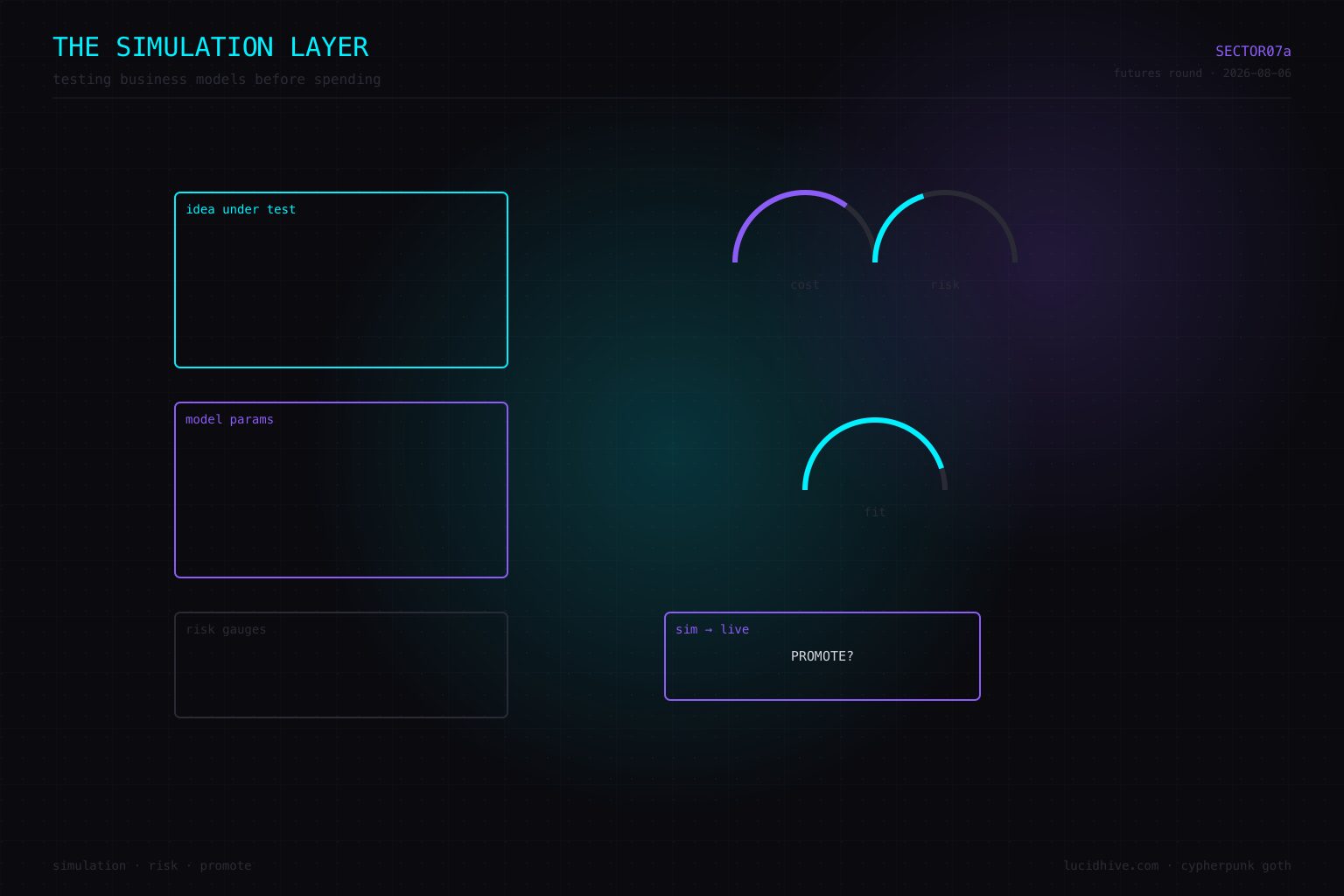
The most expensive mistake in business is committing real money to an untested idea. The futures thesis of the simulation layer is that no business model should be deployed before it has been simulated — the S8 series proved the loop (S8.1: testing a business model before spending a dollar; S8.3: the promotion gate from simulated to live; S8.10: when to trust the simulation, honest limits). The SECTOR7 research graph extends this from individual ideas to the whole idea stream: every cluster hovers in the simulation layer first, is priced, tested, and approved before it becomes real work. The simulation is not a toy; it is the cheapest possible way to be wrong.
What we built
The S8 series is the completed evidence: S8.1 documented the sim loop for business models, S8.3 defined the promotion gate, S8.7 introduced microsharks (ephemeral agents for ephemeral tasks), S8.9 used prediction markets as simulation (polymarket edges), and S8.10 stated the honest limits of simulation. The simulation-mode wiki concept and the edge-detection-cli entity are the tooling. The SECTOR7 design adds the namespace discipline (sim-kot-namespace) so simulated profiles cannot pollute real scoring. The whole futures round — this article included — is itself a simulation-layer exercise: 50 articles thinking through directions before they are built.
The vision
Every strategic direction passes through the sim: the idea is drafted as a cluster card, simulated as a sandbox profile, priced against the tier structure (S6.8), tested against the market (S8.9 prediction markets), and only then promoted through the gate to real execution. The simulation layer becomes a permanent department of the company — a place where the fleet rehearses the future at near-zero cost. The acceptance state in the SECTOR7 graph is the promotion gate: hovering is simulated, accepted is live. The loop is not a phase; it is the operating model.
What’s next
The next increment is a simulation checklist: the fields a business-model simulation must answer before promotion (unit economics, customer segment, channel, risk, exit). The S8 series supplied the principles; the checklist operationalizes them.
Grounded in the S8 simulation series, the simulation-mode concept, the edge-detection-cli entity, SECTOR7-RESEARCH-GRAPH-DESIGN, and the sim-kot-namespace brief. Thirty-third article in the SECTOR07a futures series.