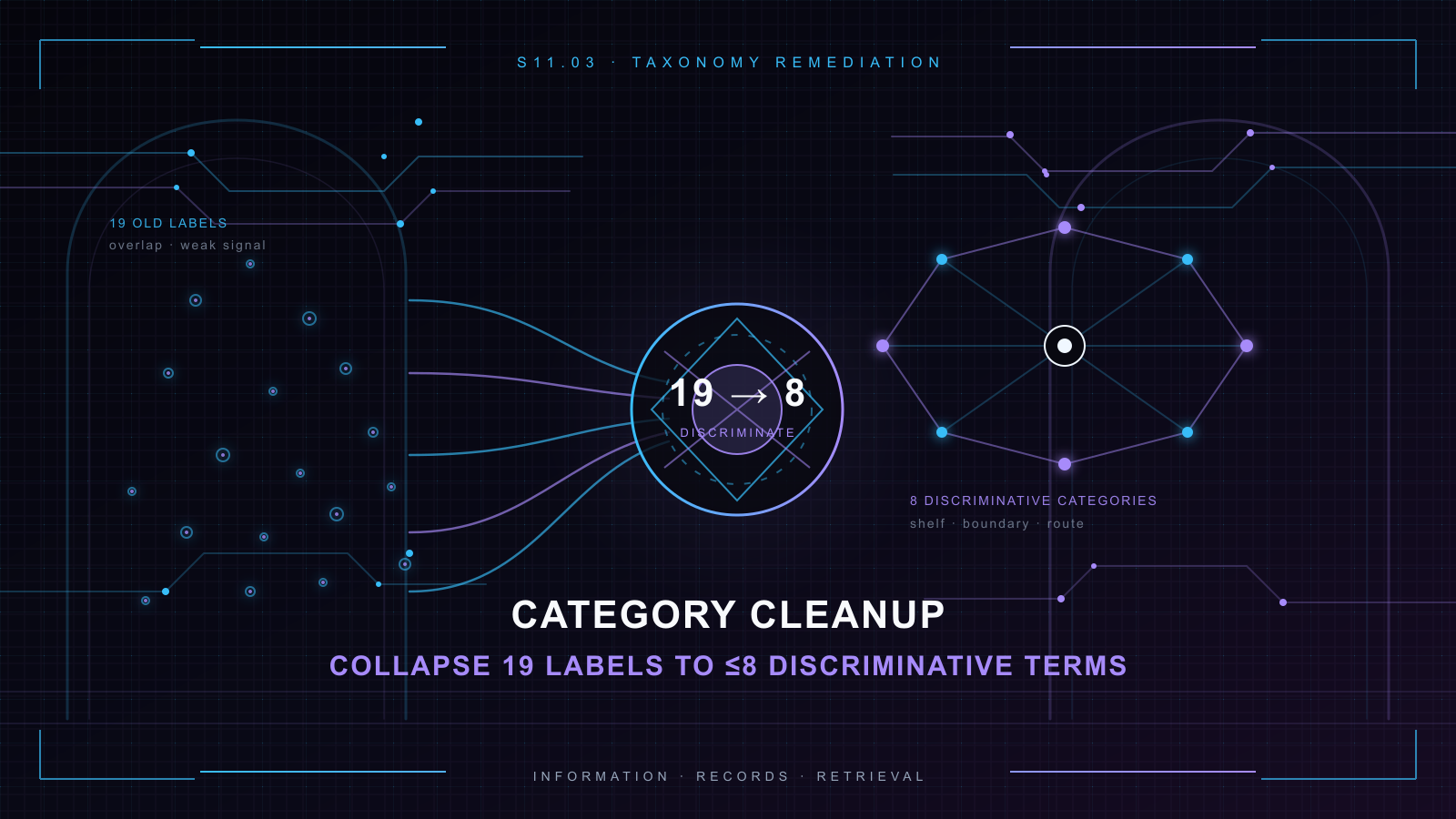

A taxonomy covering 97% of a corpus with one label is noise with a name. When nineteen labels are assigned and the four largest cover 73–97% of the archive, the category layer no longer helps a reader choose. The graph looks complete. The graph is lying.
This is the third entry in the S11 tag-layer remediation. S11.01 found 181 posts with inadequate metadata. S11.02 broke the template-tag batch into per-topic tags. S11.03 gives the category layer a shape that distinguishes one editorial territory from another. The target is eight or fewer terms a reader can use.
The nineteen-label diagnosis
The historical audit recorded 239 posts and nineteen active categories. Metamaterial appeared on 232 posts, Web Technology on 191, Digital Business on 187, and AI & Automation on 174. Those are not four independent signals; they are four near-universal defaults. An API-first post can touch all of them at once, so the category layer cannot tell a reader where to begin.
The same pattern appears in the small labels. AI, Technology, Vision, Networks, and Future of the Web are fragments. Hyperreality and Emerging Tech mix subject with perspective. Featured is an editorial flag; Uncategorized is a database fallback. Different jobs are performing the same job.
A category answers, “Where should a reader expect this record to belong?” A tag answers, “Which ideas connect it to the rest of the corpus?” A category is a shelf. A tag is a route. Nineteen overlapping shelves erase the map.
The failure was structural
The category layer was built from a feature list rather than the questions readers bring. That top-down approach makes every post look adjacent to every other post. It records broad possibility instead of editorial intention.
The result is a classification philosophy error. A post can touch several subjects and still have one primary reader. A migration guide can be infrastructural, commercially relevant, and operationally consequential without belonging equally in every archive. The category layer needs a primary destination; tags preserve other relationships without broad categories.
This is why tag repair comes first. Accurate tags make the category decision inspectable: a migration post is recognized as a migration post, not merely as something the platform touches.
The real editorial territories
Reading titles and recurring subjects, the corpus resolves into four territories: agents and the sovereign stack; digital business and platform economics; security and infrastructure; and the creative pipeline. They cover AI agents, API-first architecture, headless systems, pricing, dashboards, marketplaces, trust boundaries, key lifecycle, prompt systems, visual language, media generation, branding, and studio operations.
The categories need a stable entrance and enough distinctiveness that clicking a label changes the result. A category at the right altitude becomes the first edge into a deeper tag network; one describing the whole platform adds no edge.
The collapse: nineteen to eight
The proposed system is bounded. It retires synonyms, defaults, and mixed-purpose labels while keeping broad territories.
AI & Automation holds agent systems, autonomous operations, fleet management, API-first workflows, and implementation automation. It is for records that help a technical system do more.
Digital Architecture holds system design, microservices, migration, infrastructure topology, and structural decisions. It answers how the stack is shaped.
Security holds identity, access boundaries, key rotation, zero-trust communication, DNS and email hardening, persistence, and incident response. It is the protective layer, not a synonym for “technical.”
Digital Business holds business models, pricing, dashboards, marketplaces, subscriptions, and productized services. It is where a capability becomes a durable offer.
Research holds source synthesis, competitive sensing, prediction markets, evidence workflows, and knowledge-graph operations. It turns signals into a reasoned position.
Creative Pipeline holds image and video generation, prompt systems, visual language, brand systems, and studio production. It makes an idea visible and reproducible.
Content Operations holds publishing workflows, tag governance, taxonomy remediation, SEO systems, and content strategy. It makes records findable and durable.
Lucid Hive remains the brand-series category for house-voice records, product stories, studio announcements, and ecosystem updates. It is a series label, not a substitute for subject classification.
Eight labels now describe eight promises: implementation, architecture, security, business, research, creative production, content operations, or the Lucid Hive house voice. A reader can tell which shelf they are entering before opening the post.
Why eight is a ceiling and a floor
Eight is a practical ceiling because it remains cognitively available. A reader can hold a short menu while browsing. Five would force unlike audiences together; twelve would recreate the problem under new names. The number is not sacred. The test is whether each label is a clear first choice for a meaningful slice.
Eight is a floor for this corpus. Security and Digital Architecture have different readers. Research and Creative Pipeline have different evidence. Digital Business and AI & Automation overlap in subject, but their primary intent differs. Collapsing those pairs would make navigation less precise. A taxonomy that minimizes its vocabulary by merging every boundary is not efficient; it is opaque.
The useful question is whether an editor can inspect a post and name the category a reader would expect. Can a reader see that the destination changed when the label changed? Can a future post be assigned without creating a synonym? If yes, the category is earning its place.
How the fix compounds
Category cleanup is not the whole remediation. It is the frame that supports the other two. S11.01 gives records real tags. S11.02 breaks the template batch. S11.03 gives the category layer a stable shelf. Together they create a graph in which each post has meaningful tags and one defensible primary category, with additional relationships carried by the tag layer rather than duplicated as broad categories.
That structure serves three audiences. Readers get category pages that differ instead of returning the same corpus under different names. Search systems get a clean category and tag relationship instead of contradictory signals. Agents get distinct properties to traverse instead of a uniform field that looks connected while carrying no useful information.
The north star’s first principle — information is the ground of being — has a practical consequence: metadata is part of a record’s structure. A category that cannot distinguish a record is a poor transcription; a category that names a clear reader territory becomes a durable route into the corpus.
Continuity has a test. The next pass should map each old label to a new destination, record the reason, and make the process idempotent. Running it again should converge on the same eight-category system. A taxonomy that changes every time it is touched is not a record; it is a stream of guesses.
The honest completion test
S11.03 is complete when the category story is verifiable rather than aspirational. The old labels have an explicit mapping. The new system has no more than eight discriminative terms. The canonical post has the exact title, one primary category, the fifteen template tags, and the four topical tags from the card. The featured image is local studio output, carries provenance and a manifest, and is linked through WordPress _thumbnail_id. The public body contains no protected GEMS material or source frontmatter. The post and its image resolve, and the master index points to the canonical record.
That test prevents the category layer from becoming another decorative claim. The point is not to announce that nineteen became eight. The point is to make the records land in a destination where a reader can find them. Every accurate category is a shelf; every accurate tag is a route.
The taxonomy did not need more labels. It needed fewer promises and clearer boundaries. Read the corpus, choose the primary reader, carry the rest in the tag layer, and make the migration repeatable. Verify the result from outside the system. The graph becomes navigable when its categories say what the content is — not when they say everything the product could theoretically be.