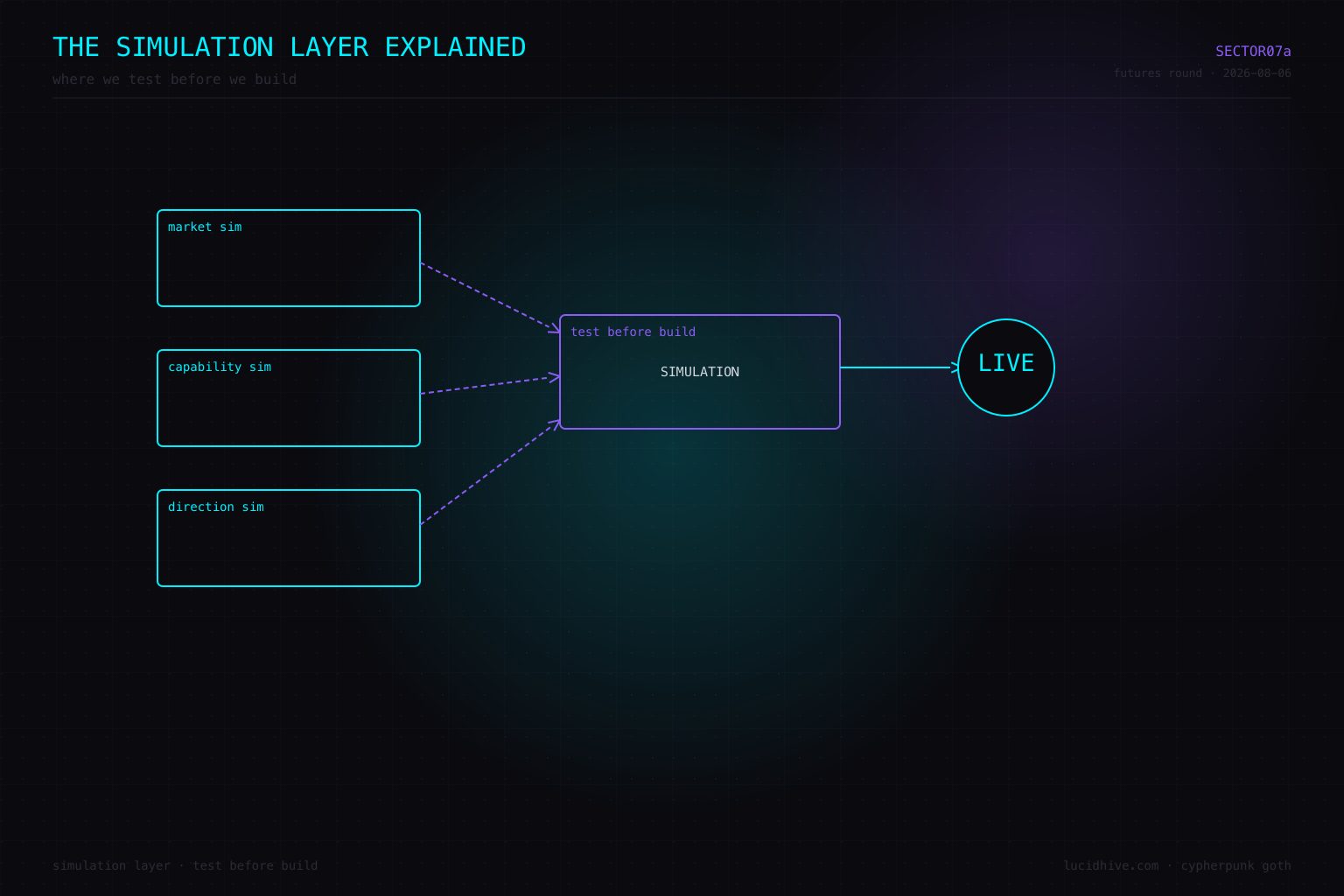

The Simulation Layer Explained: Where We Test Before We Build
The simulation layer has appeared throughout this series as the quiet assumption behind every idea: test before you build, simulate before you spend, hover before you accept. The futures thesis is that this layer deserves to be explicit — a permanent, named part of the operating model where every strategic direction is rehearsed at near-zero cost before it touches real budget, real hardware, or real customers. The S8 series proved the loop; the SECTOR7 design institutionalized it; this article names the institution. The simulation layer is the company’s cheapest teacher, and it should never be closed.
What we built
The evidence is the S8 series: S8.1 (testing a business model before spending a dollar), S8.3 (the promotion gate), S8.7 (microsharks for ephemeral tasks), S8.9 (prediction markets as simulation), S8.10 (the honest limits). The simulation-mode wiki concept and the edge-detection-cli entity are the tooling. The SECTOR7-RESEARCH-GRAPH-DESIGN adds the graph layer — hovering clusters as simulated ideas waiting for approval — and the sim-kot-namespace brief isolates simulated scoring from the real pool. The round you are reading is the largest simulation yet: 50 futures articles thinking through directions before any of them is built.
The vision
Every idea enters the simulation layer first. A new business model: simulated against the tier structure, tested against prediction markets, priced in sandbox. A new capability: drafted as a skill, exercised in a sandbox profile, scored in the sim namespace. A new direction: written as a futures article, published as thinking space, and left for the Council to promote or discard. The simulation layer is not a phase before launch; it is a permanent department — the place where the fleet rehearses the future. When an idea survives the simulation, the promotion gate (S8.3) opens; when it does not, the rejection is recorded as a lesson, and the lesson is worth as much as the acceptance.
What’s next
The next increment is the simulation checklist: the fields every simulated direction must answer before promotion (cost, risk, evidence, exit). The S8 series supplied the principles; the checklist operationalizes the department.
Grounded in the S8 simulation series, the simulation-mode concept, SECTOR7-RESEARCH-GRAPH-DESIGN, and the sim-kot-namespace brief. Forty-fourth article in the SECTOR07a futures series.