
S10.1 established prediction markets as sensors — prices that absorb information before headlines publish.[1] S10.2 built the research pipeline from arxiv discovery through synthesis to decision.[2] S10.3 covered blogwatcher as the RSS early-warning layer.[3] This article addresses the missing piece that holds the entire stack together: how you know what you know, and how you prove it to anyone who reads your work.[4]
## The hallucination problem is a citation problem
Large language models hallucinate at non-trivial rates.[1] Research on retrieval-augmented generation systems shows that hallucination remains one of the most persistent failure modes: models generate text that appears factually grounded but draws on nothing retrievable.[2] The problem is not that the model is lying — it has no concept of truth.[1] The problem is that the model is doing exactly what it was trained to do: predict the next plausible token.[2] When the training data contains a claim, the model reproduces it.[3] When it does not, the model invents something that sounds like it should be there.[4]
The standard fix — retrieval-augmented generation, or RAG — retrieves documents at query time and grounds the response in retrieved context.[1] This helps. Studies show RAG reduces hallucination rates by grounding responses in verifiable sources rather than relying on parametric memory alone.[2] But RAG has a structural limitation: it retrieves, but it does not verify.[3] The model sees a document, extracts a claim, and presents it.[1] Whether the claim is accurately represented in the source is not checked.[2] Whether the source itself is authoritative is not evaluated.[3] The pipeline goes from retrieval to generation without a verification gate.[4]
This is where grounded citations diverge from standard RAG. Grounded citations add a mechanical layer between retrieval and output: every claim taken from an outside source gets an inline numbered citation, and every citation maps to a ledger entry that was registered at retrieval time — not reconstructed from memory after the fact.[4]
## The ledger: a mechanical source registry
The grounded-citations approach starts with a simple idea: the model should never invent a citation.[4] Instead, a ledger script owns the mapping from URL to citation number.[4] When a source is retrieved — via web search, arxiv API, or direct extraction — it is registered in the ledger before any prose is written.[1] The ledger assigns a stable integer ID.[2] The model then emits only the IDs it was handed, never inventing new ones.[3]
This is a small change with large consequences. When a draft cites [3], that citation number points to a specific URL that was registered at retrieval time.[4] A reader can check the source.[1] A reviewer can verify the claim against the original page.[2] The citation is not decorative — it is a pointer to evidence.[3]
For high-stakes work, the same ledger doubles as a fact-checking chain. Verbatim quotes are attached to each source. The verification step fails any draft whose cited sources carry no evidence. Claims from model knowledge are flagged as unverified.[4] The result is a document where every factual claim has declared provenance: either it comes from a specific source with a verbatim quote, or it is explicitly marked as coming from the model’s own knowledge without external verification.
The mechanical process works like this: reset the ledger at the start of a task, register every source at retrieval time, cite while drafting with bracketed IDs, and verify before delivering.[4] At no point does the model type a URL into the Sources block. The render command generates the block from the ledger, ensuring that every URL in the output corresponds to a URL that was actually fetched.
## The verification gate
The verification step is what separates grounded citations from the current state of the art. Most AI-generated content skips verification entirely.[1] The model generates text, the text includes citations, and the process ends. Grounded citations add a mechanical check: the verify command scans the draft, confirms that every citation ID exists in the ledger, checks that the Sources block matches the ledger, and optionally measures coverage — the fraction of sentences that carry declared provenance.[2]
This is not a perfect system. Verification catches mechanical errors — wrong IDs, missing sources, mismatched URLs — but it does not evaluate the quality of the sources themselves. A citation to a dubious blog post passes verification just as well as a citation to a peer-reviewed paper.[3] The system enforces traceability, not quality. Quality is a human judgment. Traceability is a mechanical one, and it is the mechanical part that was missing.
The coverage metric makes the gap visible. When verify reports that sixty percent of sentences carry declared provenance, the remaining forty percent are either model-knowledge claims or gaps in the research.[4] Either way, the number is honest. The reader knows what proportion of the document is grounded and what proportion is inference. This is fundamentally different from the standard AI output, where every sentence carries equal apparent authority regardless of whether it rests on a source or on nothing.
Coverage is calculated as sentences with declared provenance divided by total prose sentences.[2] A prose sentence is any non-empty line fragment of four or more words after headings, table rows, and fenced code are dropped. Provenance is declared by either a bracketed citation or an unverified marker. The metric is deliberately simple: it does not judge source quality, only source declaration.
## Grounded citations in the market sensing stack
The S10 series maps three signal sources that feed the Council’s research pipeline: prediction markets as probability sensors, arxiv as peer-reviewed technical findings, and blogwatcher as independent early analysis.[1] Grounded citations are not a fourth signal source — they are the connective tissue that holds the other three together.
When a prediction market moves, the price is data. When an arxiv paper drops, the abstract is data. When a blog post appears, the analysis is data. But data without attribution is just noise.[3] Grounded citations transform each signal from “something I read” into “something I can prove I read, from this specific source, at this specific time, with this specific evidence.”[4]
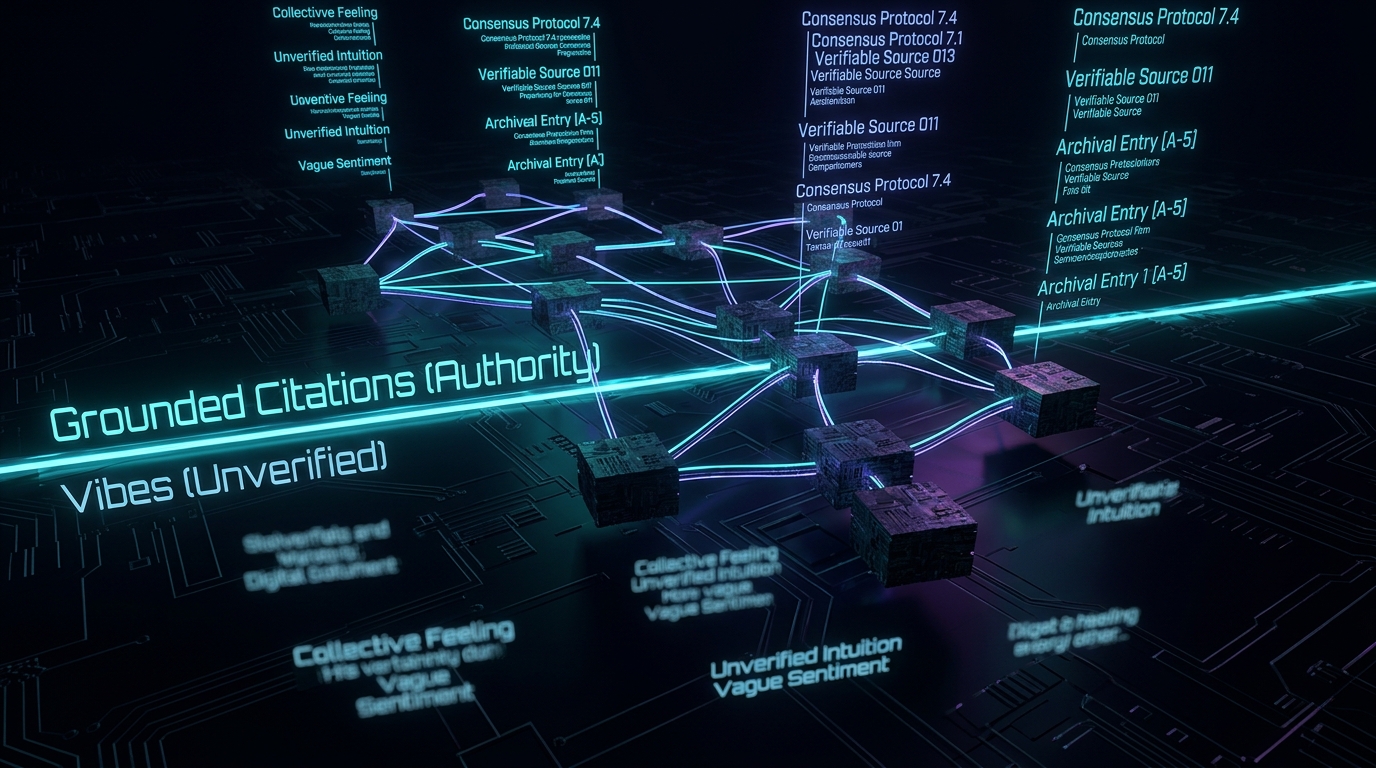
For market sensing, this matters because decisions built on ungrounded claims are fragile. If the Council decides to shift research direction based on a blog post analysis, that decision should be traceable to the specific blog post, with the specific claims that motivated it.[2] If the blog post turns out to be wrong, the decision can be revisited. If the blog post was right, the reasoning can be cited. Either way, the decision is not floating on vibes — it is anchored to evidence.
The `grounded-citations` skill implements this mechanically. The ledger owns the URL-to-ID mapping. The verify command catches structural errors. The evidence mode attaches verbatim quotes. The render command generates the Sources block from the ledger, not from hand-typed URLs. Every step is designed to prevent the model from inserting unverified claims into the citation chain.[4]
## The authority question
There is a deeper question underneath the mechanics: what makes a source authoritative? Grounded citations answer the narrow version of this question — they ensure that a cited source exists, that the URL is real, and that the claim is traceable to the retrieved text.[1] They do not answer the broader version: whether the source is trustworthy, whether the author is credible, whether the publication has editorial standards.[1]
That broader question is where the other S10 tools enter. Blogwatcher curates the sources — you do not monitor feeds you have not vetted.[2] The arxiv API returns peer-reviewed papers, which carry institutional credibility.[3] Prediction markets aggregate the judgment of participants who have money at stake.[4] Each signal source carries its own authority signal, and grounded citations preserve that signal in the final document.
The result is a citation system that separates two things that are usually blurred together: the mechanical act of citing a source and the intellectual act of choosing which sources to trust.[1] The ledger handles the first.[2] The human — or the pipeline of curation tools — handles the second.[3] Neither step is skipped. Neither step is confused with the other.[4]
In a world where AI-generated content is flooding every channel, the ability to say “here is exactly where this claim came from” is not a nice-to-have.[1] It is the difference between information and noise, between a research pipeline that compounds knowledge and one that compounds confusion.[2] Grounded citations are the mechanism that makes the distinction mechanical rather than aspirational.[3]