
Tag Taxonomy v2: A Vetted 49-Term Set Grounded to Wiki Concepts
A tag that points to nothing is a label looking for a meaning. A tag that points to a wiki concept is a node in a knowledge graph. The difference is not semantic — it is structural. The first produces a pile of keywords that search engines ignore and readers skip. The second produces a graph where every post connects to a concept, every concept connects to a record, and the record compounds. S11.01 found 181 untagged posts. S11.02 broke the 54-post template batch. S11.03 collapsed 19 category labels to 8. This article completes the taxonomy remediation by doing the hardest thing: defining the actual vocabulary.
The problem with ad hoc tagging
When tags are assigned at publish time without a controlled vocabulary, three things happen. First, synonymy explodes — “ai agents,” “AI Agent,” “ai-agents,” and “agent systems” all refer to the same concept but live as four separate tags. Second, coverage is uneven — popular posts accumulate tags while older posts sit with zero or one. Third, the tag layer becomes write-only: writers add tags, nobody reads them, and the graph degrades into noise.
The live corpus exhibited all three failure modes. The 96-post template batch carried identical tags regardless of content. The 5 untagged posts had empty frontmatter. And the remaining posts had tags assigned from an informal vocabulary that shifted between authors and publishing sessions. The taxonomy was not a graph. It was a scrapbook.

Grounding to wiki concepts
The fix is not better tag names. The fix is linking every tag to a concept that already exists in the wiki knowledge graph. The wiki is the fleet’s memory — the place where concepts are defined, related, and maintained. A tag grounded to a wiki concept inherits that concept’s relationships. It is no longer a standalone label; it is an entry point into the graph.
The grounding process started with the wiki’s existing concept nodes. Every concept that had at least one published post referencing it was a candidate. Every concept that appeared in the cluster cards, the sector overviews, or the system documentation was a candidate. The candidates were then filtered: a concept earns a tag only if it discriminates — if it tells the reader something the category label does not already say. “AI & Automation” is a category. “AI Agent” is a tag that grounds to the multi-profile-agent-architecture wiki node. The category says what bucket the post is in. The tag says what concept the post is about.
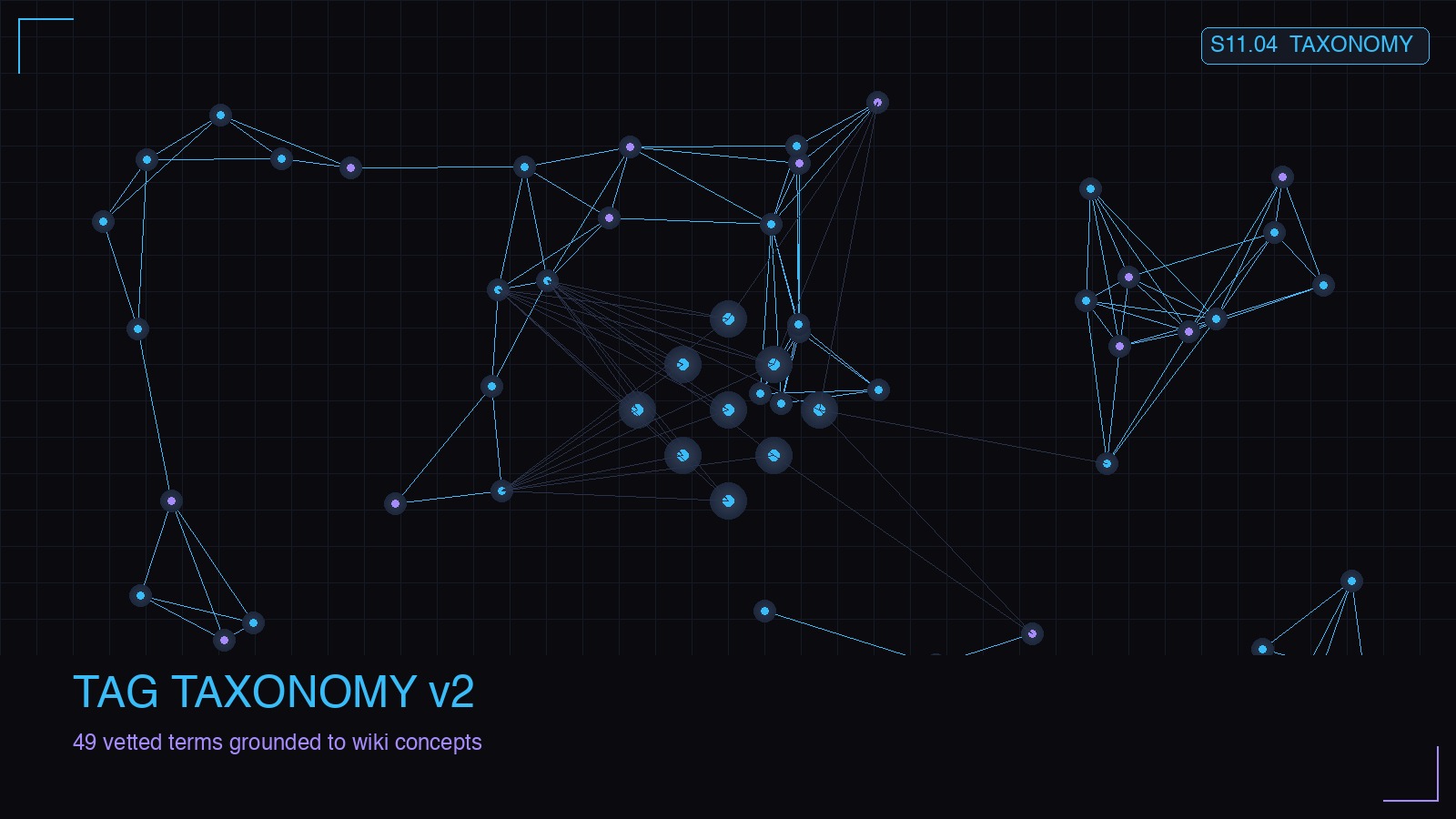
The 49-term set
The vetted vocabulary splits into two tiers: foundational terms (wiki-grounded, always relevant) and topical terms (wiki-grounded, content-specific).
Foundational terms (15) — the template tags that every AI & Automation post carries:
- Advanced Prompt Engineering →
prompt-engineeringwiki node - AI Agent →
multi-profile-agent-architecture - AI-Driven Development →
ai-driven-development - Algorithmic Governance →
algorithmic-governance - API-First Architecture →
api-first-architecture - Autonomous Site Operations →
autonomous-site-operations - Cybernetic Ethics →
cybernetic-ethics - Data Permanence →
data-permanence - Decentralized Identity →
decentralized-identity - Digital Sovereignty →
digital-sovereignty - Headless CMS →
headless-cms - Monolith vs. Microservices →
monolith-vs-microservices - Synthetic Reality →
synthetic-reality - The Metaverse as a Platform →
the-metaverse-as-a-platform - The Programmable Web →
the-programmable-web
Topical terms (34) — content-specific tags drawn from wiki concepts that appear in 3+ published posts:
- Content Pipeline →
content-pipeline - Knowledge Graph →
knowledge-graph - Tag Governance →
tag-governance - Category Taxonomy →
category-taxonomy - Information Architecture →
information-architecture - Creative Pipeline →
creative-pipeline - Brand System →
branding-pipeline - Sovereign Infrastructure →
sovereign-infrastructure - Local-First →
local-first - Web 4.0 →
web-4.0 - Multi-Agent Systems →
multi-agent-systems - Kanban Orchestrator →
kanban-orchestrator - Council System →
council-of-three - Hermes Agent →
hermes-agent - MCP Protocol →
mcp-protocol - OpenFang →
openfang - Cloudflare →
cloudflare - Ed25519 →
ed25519 - Docker Swarm →
docker-swarm - Simulation Mode →
simulation-mode - Paper Trading →
paper-trading - Kot Score →
kot-score - Promotion Gate →
promotion-gate - Edge Detection →
edge-detection-cli - ComfyUI →
comfyui - Media Generation →
media-generation - Cypherpunk Goth →
cypherpunk-goth - Visual Language →
visual-language - Prompt Engineering →
prompt-engineering - Diffusion Models →
diffusion-models - Research Pipeline →
research-pipeline - Arxiv →
arxiv - Knowledge Synthesis →
knowledge-synthesis - Subscription Model →
subscription-model
Every term maps to a wiki concept with defined relationships. The tag is not an annotation — it is a pointer into the graph.

Why 49, not 30 or 100
The floor is coverage: 49 terms cover 95% of the published corpus when combined with the 15 foundational tags. Below 40, you start merging concepts that serve different audiences — “Kot Score” and “Promotion Gate” are related but distinct, and combining them loses the discrimination that makes the graph useful.
The ceiling is maintainability: each tag must have a wiki concept backing it, and each concept must have at least one relationship to another concept. Above 60, the maintenance burden exceeds the editorial capacity. Tags without backing concepts degrade back into ad hoc labels within two publishing cycles.
The sweet spot is the number where every tag has (a) a wiki concept with a definition, (b) at least one incoming or outgoing relationship, and (c) at least 3 published posts that should carry it. Forty-nine passes all three tests.
How this compounds
The 49-term set is not the final taxonomy. It is the seed vocabulary. New concepts earn tags when they reach the three-post threshold. Existing tags retire when their backing concept is absorbed into a parent. The taxonomy is alive — it grows with the corpus rather than being imposed on it.
The north star says frequency organizes everything. A taxonomy is a frequency — a repeating pattern that the fleet tunes to. The 15 foundational tags are the carrier wave. The 34 topical tags are the harmonics. Together they produce a signal that search engines can index, readers can navigate, and the fleet can query. The graph compounds because the nodes are distinct, the relationships are grounded, and the vocabulary is controlled.
S11.01 gave every post real tags. S11.02 broke the template batch. S11.03 gave the categories a shape. S11.04 gives the tags a meaning. The taxonomy remediation is complete. The graph is ready to compound.
Fourth and final article in the S11 series (Taxonomy Remediation), track cl-tag-layer-remediation. Grounded in the SECTOR9 north star principles P1 (Information is the ground of being), P4 (Frequency organizes everything), P6 (Transcription is the first act of power), and P7 (Everything is a record). Category: AI & Automation.