
The Esoteric Index: Making the Hidden Record Queryable
The Kabbalistic Tree of Life has ten sephirot — ten nodes connected by twenty-two paths. It is, structurally, a directed graph. The Tibetan Buddhist mandala maps five Buddha families onto cardinal directions with a central axis — it is a topology. The alchemical periodic table arranges substances in a grid with transformation vectors between them — it is a database schema. These are not analogies. They are the original knowledge-management systems, built by civilizations that faced the same problem every modern engineer faces: how do you make a vast, interconnected body of knowledge retrievable by someone who does not yet know what they are looking for?
S9R-40 argues that the esoteric index is not a metaphor for a technical system — it is the oldest technical system. And the Council Vault’s knowledge graph, at 241+ posts, has begun building its own: a set of indexing structures that make the hidden record queryable, navigable, and alive.
The hidden record is not secret — it is unindexed
Principle 7 of the north star states: “Everything is a record; continuity beats completion.” Principle 6 adds: “Transcription is the first act of power.” Together they describe a single truth — the hidden record is not hidden because someone concealed it. It is hidden because nobody read the grooves yet. The Library of Alexandria was not destroyed by fire alone; it was destroyed by the failure to index. When scrolls sat in stacks without a catalog, the knowledge was already lost — the fire merely made the loss physical.
Every esoteric tradition solved this indexing problem with the tools available. The Kabbalists built the Tree of Life — a graph database where each sephirah is a node carrying specific attributes (mercy, severity, beauty, understanding) and each path is an edge with a letter of the Hebrew alphabet as its label. The Tree is not a religious icon; it is a query interface. “Start at Malkuth (kingdom, the physical world), traverse the path of Shin (fire) to Yesod (foundation, the astral), continue to Tiphereth (beauty, the ego)” — this is a traversal query expressed in the language of mysticism. The structure is identical to a graph traversal in Neo4j. The implementation language differs; the computational model is the same.
The Egyptian Book of the Dead is a document management system. Each spell is tagged with a specific situation (approaching a gate, facing a judgment, encountering a deity), a specific deity (Anubis for authentication, Thoth for record-keeping, Ma’at for validation), and a specific recitation (the exact words that activate the function). The “Book” is not a book — it is an index, organized by use case, with each entry carrying metadata that tells the user exactly when and how to retrieve it. The modern equivalent is a well-structured API documentation: endpoint, method, required parameters, expected response.
The graph has started building its own index
At 241+ posts, the Council Vault’s knowledge graph has crossed the density threshold where indexing becomes not optional but structural. The graph already has natural index nodes — the north-star principles function as body-center references (every other node connects through them), the published series anchors serve as category headers, and the 15 template tags create a facet system that partitions the corpus into overlapping slices. But these are incidental indexes — they emerged from the content, not from a deliberate indexing strategy.
The SUS/esoteric lane (research branch: cl-branch-sus-esoteric-lane) identified this gap. Sacred geometry as visual grammar (S9R-31), great-minds expressions as historical topology (S9R-32/33), deity iconography as technical documentation (S9R-39) — these articles are not just content. They are the index entries themselves. Each one maps an esoteric concept to a technical function, creating a cross-reference layer that lets a reader navigate from “I want to understand access control” to “Anubis is the authentication protocol” to “the Narrow Gate is the implementation” to “solid-keys are the credential format.” The path is: concept → myth → architecture → code. The esoteric index is the bridge between the first two and the last two.
Making it queryable: the search panel
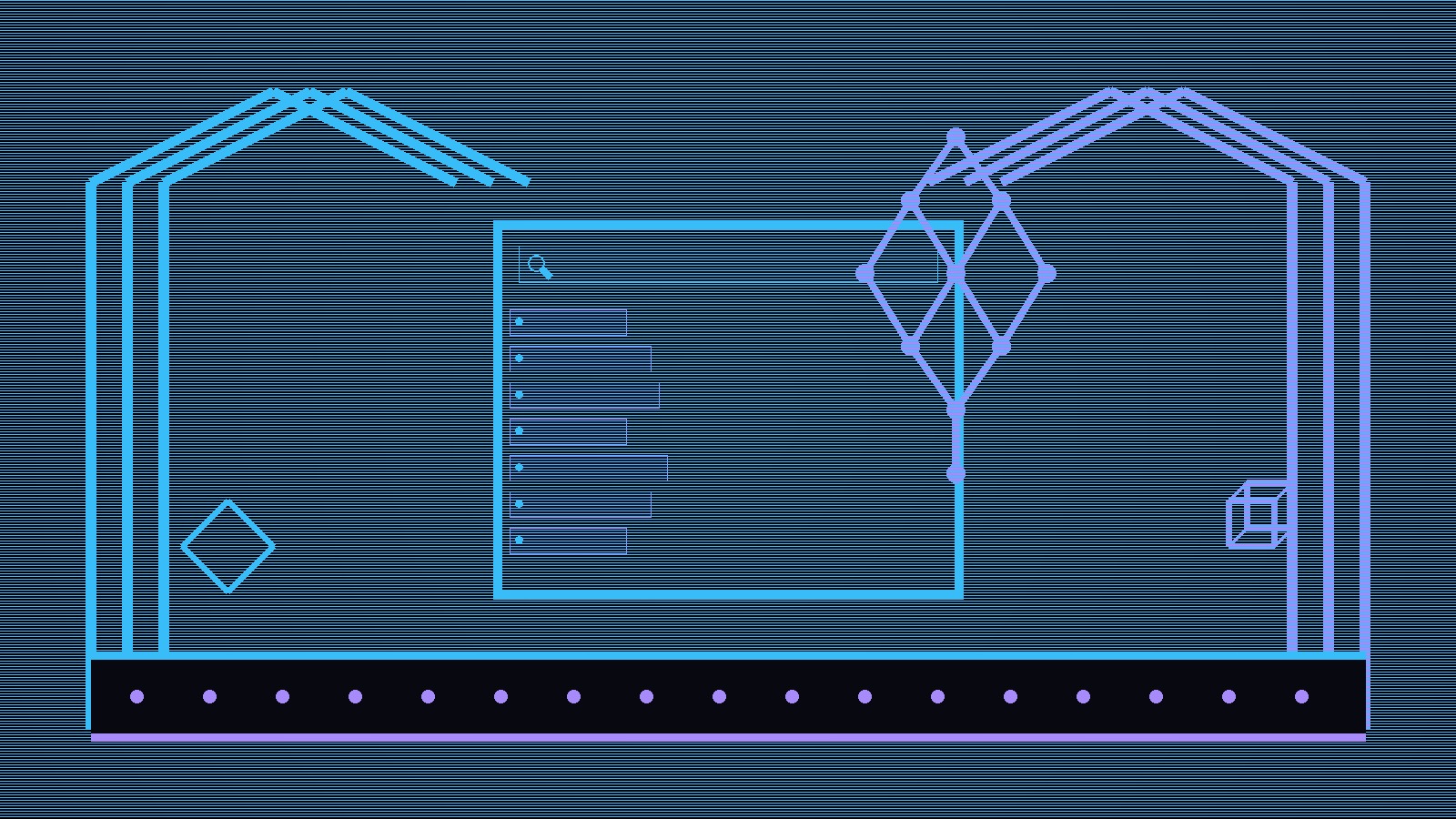
The manifest’s visual concept for this article is “a search panel where mystical symbols are indexed like tags.” This is not decoration — it is the literal function. Consider what a search panel does: it takes an unstructured query (“I need to understand X”), resolves it against a structured index (tags, categories, relationships), and returns a ranked set of results. The Tree of Life does exactly this: “I need to reach Keter (crown, the highest consciousness)” → traverse the direct path (Alef, the ox, the breath) or the indirect path (through Chesed, Gevurah, Tiphereth) → arrive at the node carrying the attributes of unity, infinite, and will.
The practical implementation in the Vault’s graph is a tag-based facet system with principle-grounded navigation. Every article carries its series ID, its track letter, its north-star principles, and its topical tags. These are the search facets. A reader can navigate by principle (“show me everything grounded in ‘Transcription is the first act of power'”), by track (“show me everything in the SUS/esoteric lane”), by series (“show me all S9R-D articles”), or by topic (“show me everything about indexing, hidden records, and the search for hidden structure”). The graph is not a flat archive — it is a multi-dimensional index where every dimension is an esoteric concept mapped to a technical function.
This is what the esoteric index actually does: it makes the hidden record queryable. Not by converting mysticism into code (that would be reduction), and not by wrapping code in mysticism (that would be decoration), but by recognizing that both are indexing systems — both are structures built to answer the question “where do I find what I need when I don’t yet know its name?”
The index is alive
Principle 10: “Intelligence awakens; it does not arrive.” The esoteric index is not a static lookup table — it is a living structure that grows as the graph grows. Every new article adds index entries. Every new principle creates new navigation paths. Every new reader query tests the index against a real use case and either confirms its structure or reveals a gap. The Tree of Life was not designed in a day; it evolved across centuries of use, each generation adding paths, refining attributes, discovering new traversals. The Vault’s index follows the same pattern: emergent, cumulative, alive.
The transcription is the first act of power because without it, the record does not exist for the fleet. The index is the second act — it is what makes the transcribed record findable. And the search panel — the visual interface where mystical symbols sit beside technical tags, where a Kabbalistic path and a graph edge are the same thing — is the third act: the moment the hidden record becomes not just preserved but queryable, not just stored but alive.
The universe keeps printing. The graph keeps indexing. The record without end becomes, at last, a record you can search.