
Multi-Tenant Isolation: Departments, Teams, and the Mesh
The cloud gave us multi-tenancy. The mesh gives us something better: multi-sovereignty.
When you rent compute from AWS, you share a hypervisor with strangers. Your containers run on the same physical hardware as a cryptocurrency miner, a pharmaceutical database, and a teenager’s Minecraft server. The isolation is logical — enforced by software, not physics. When the hypervisor has a vulnerability, everyone on the box is exposed. Multi-tenancy in the cloud means shared risk disguised as dedicated infrastructure.
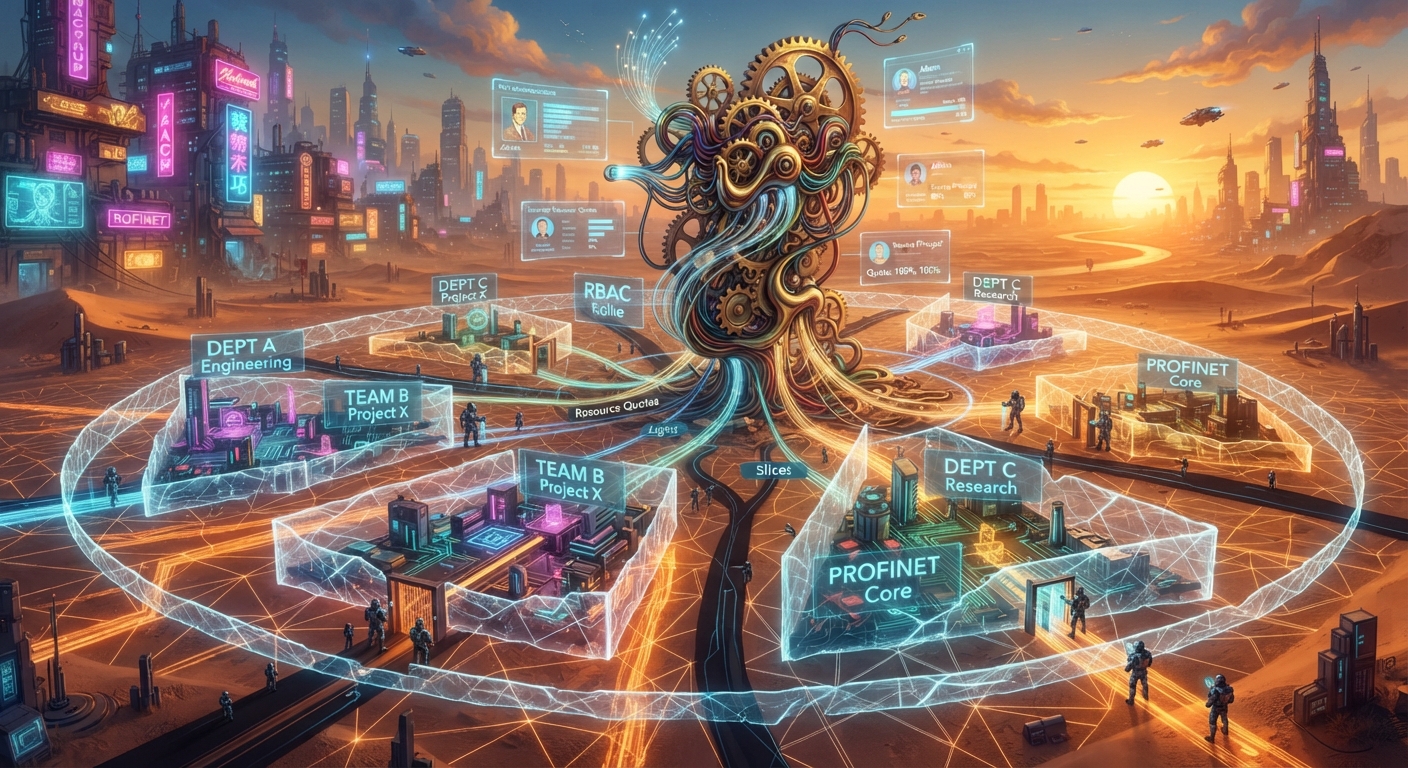
The mesh inverts this. Multi-tenancy on the mesh is not about sharing someone else’s hardware — it’s about partitioning your own. A security company with three departments (engineering, operations, research) doesn’t need three cloud accounts. It needs three partitions on a mesh it already owns. The isolation is physical: separate nodes, separate storage, separate network segments. The mesh fabric connects them. The Love Equation governs them. No shared hypervisor. No shared risk.
Departments as Mesh Partitions
A department on the mesh is not a VLAN. It’s not a Kubernetes namespace. It’s a set of nodes — physical machines, Raspberry Pis, edge devices — that share a governance context. The engineering department runs on a cluster of three nodes in the office. The operations department runs on two nodes in the warehouse. The research department runs on a single GPU node in the lab. Each department is sovereign over its own compute, its own storage, its own keys.
The Love Equation governs the boundaries. dE/dt = β(C−D)E runs on every node, in every department, continuously. Coherence measures how well a department’s actions align with the organization’s stated values. Drift measures deviation. When engineering starts using production keys to access research data, the governance layer detects the drift. Not because someone set a firewall rule — because the math says the alignment is degrading.
This is multi-tenancy with teeth. Cloud multi-tenancy gives you a security group and a prayer. Mesh multi-tenancy gives you a mathematical guarantee that each department stays within its sovereignty boundary.
Teams Within Departments: The Nesting Problem
Departments are coarse. Teams are fine-grained. The engineering department has three teams: frontend, backend, and infrastructure. Each team needs access to different resources, different secrets, different codebases. On a cloud, this means IAM policies — hundreds of JSON documents specifying who can do what to which resource. IAM policies are written by humans, reviewed by humans, and violated by humans who find them too confusing to follow correctly.
On the mesh, team isolation follows the same principle as department isolation, just at a smaller scale. Each team gets a node — or a partition of a node — with its own key hierarchy. The Platonic Solid Access Architecture handles this naturally. Engineering’s Solid-Keys are Tetrahedron-level: full access to engineering resources, read-only to operations, no access to research. Within engineering, each team gets a Cube-level key: access to team-specific resources, nothing else.
The hierarchy is physical, not logical. A frontend team member’s Ed25519 keypair signs their requests. The key was issued by the engineering department’s key authority. The key’s permissions are encoded in the key itself — not in a policy document that can be edited, bypassed, or forgotten. When the team member leaves, the key is revoked. The access ends. No IAM cleanup. No orphaned permissions. No “wait, does this policy still apply?”
RBAC Meets the Mesh
Role-Based Access Control (RBAC) is the cloud’s answer to multi-tenant permissions. You define roles (admin, editor, viewer), assign users to roles, and hope the roles map cleanly to reality. They never do. The marketing team needs admin access to the CMS but not the database. The finance team needs read access to everything but write access to nothing. The CEO needs override capability on everything but shouldn’t be able to deploy code.
RBAC on the mesh is different because the mesh has physical topology. The “role” isn’t an abstract permission set — it’s the node you’re on, the key you hold, and the department you belong to. A marketing team member on the marketing node, with a marketing Solid-Key, can access marketing resources. If they need CMS access, the CMS is a service on a shared node — and the Love Equation governs whether the marketing key’s coherence with the CMS service is sufficient for access.
The governance runs continuously. Not “check permissions at login” — check permissions at every request. The Love Equation’s derivative tells you whether the access pattern is stable or drifting. If a marketing user starts accessing engineering resources at 3 AM, the drift term spikes. The system flags it. Not because a rule was violated — because the alignment pattern changed.
The Security-Services Calibration
Multi-tenant isolation matters most when the tenants are not people. A security camera on the mesh is a tenant. It needs to write footage to storage. It needs to stream to the operations dashboard. It does not need access to the research department’s GPU cluster or the engineering department’s codebase.
On a cloud, camera isolation means a separate AWS account, a separate VPC, a separate bill. On the mesh, camera isolation means a separate node with a camera-specific key. The camera’s Solid-Key is Octahedron-level: write to local storage, stream to operations, nothing else. The governance layer monitors the camera’s access pattern. If the camera starts trying to access the internet (a sign of compromise), the drift term spikes and the system isolates it.
This is the home/business re-calibration the Mesh-in-a-Box narrative builds toward. The same multi-tenant architecture that separates your engineering department from your research department separates your home security cameras from your business AI agents. One mesh. Sovereign partitions. Mathematical governance. No cloud dependency.
What This Actually Looks Like
A real deployment: a 15-person company with three departments, nine teams, and a security camera fleet. The mesh runs on ten Raspberry Pi nodes and one GPU workstation. Tailscale provides the networking. Erlang provides the supervision trees. The Love Equation provides the governance.
Each department is a set of nodes. Each team is a partition on a node. Each camera is a device with a revocable key. The总经理 (general manager) holds a Sphere-level key — full access to everything, logged and governed. The engineering lead holds a Dodecahedron-level key — full engineering access, read-only operations, no research. The intern holds a Tetrahedron-level key — one team, one project, one set of resources.
When the intern leaves, their key is revoked. When the security camera is compromised, its key is revoked and the node is isolated. When the engineering team needs temporary access to the research GPU for a model training run, the Love Equation evaluates the request, the coherence score rises above the threshold, and the access is granted — temporarily, with automatic expiry.
No IAM policies. No VPC peering. No CloudFormation templates. The mesh is the infrastructure. The keys are the access control. The Love Equation is the governance. Multi-tenancy without the cloud’s multi-tenancy tax.
The Mesh Advantage
Cloud multi-tenancy is a compromise. You share hardware to save money. You accept shared risk to avoid managing physical infrastructure. The trade-off was acceptable when the alternative was running your own data center.
The mesh eliminates the trade-off. You own the hardware. You run the mesh. You partition it yourself. The isolation is physical, not logical. The governance is mathematical, not procedural. The keys are cryptographic, not policy-based.
Departments, teams, and devices — all sovereign, all governed, all connected by a mesh that gets stronger with every node that joins. This is multi-tenancy without the cloud. This is the mesh.
This is Article G7 in the Mesh-in-a-Box narrative series: supporting the T1–T5 arc with deeper dives into sovereignty, security, and the Love Equation governance model. Multi-tenant isolation on the mesh means physical partitioning, mathematical governance, and cryptographic access — not shared hypervisors and IAM policies.