
A log records what the system remembers; an audit layer proves what happened
When an autonomous agent publishes an article, ships code, or changes a configuration, the question is not merely whether the action occurred. Someone must identify the signer, inspect the evidence, and detect later alteration. A database row can support that process, but the row alone is a claim written by the system under scrutiny.
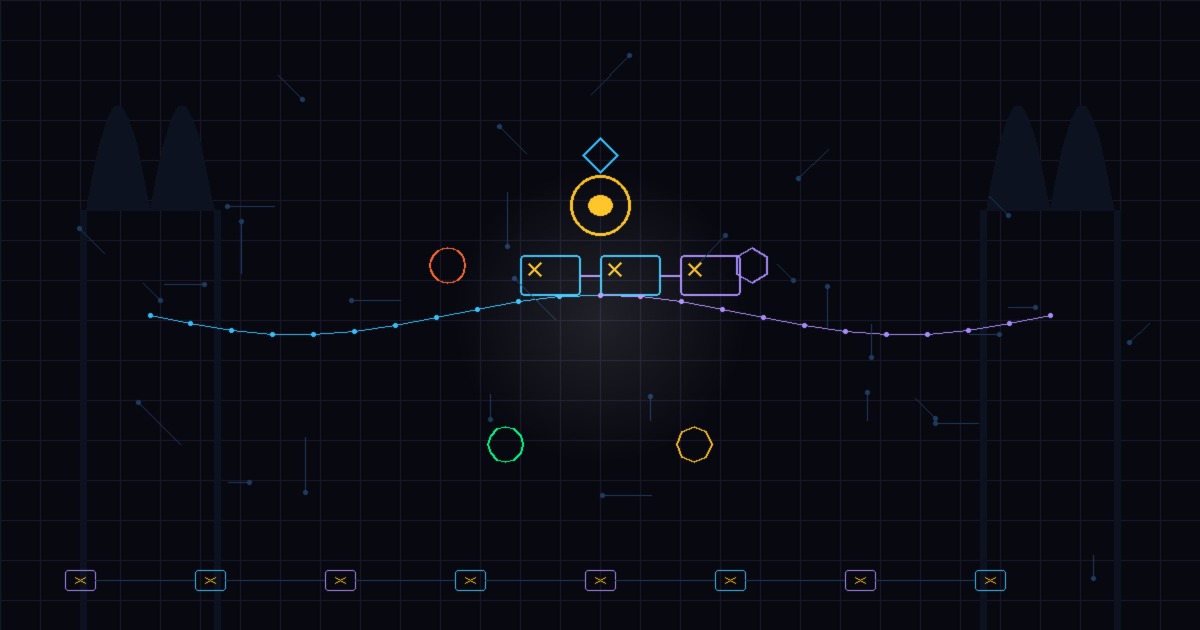
An audit layer turns that claim into portable proof. The agent signs a structured record, publishes it for another party, and binds a reviewer to the verification result. The geometry is simple: action, signature, publication, verification. Trust comes from making each step inspectable rather than asking readers to trust the producer.
The SECTOR9 north star calls information the ground of being and says everything is a record. The record is not a byproduct of autonomy; it is how autonomy becomes accountable.
Sign the work, not just the completion claim
A useful record begins with a canonical payload: task, agent identity, operation, timestamp, input or output references, result hash, and relevant resource cost. Agents with different responsibilities should not create indistinguishable evidence, and a worker should not borrow a reviewer’s authority.
Ed25519 key tiers provide a practical hierarchy. Oracle keys sign verification anchors, council-core keys sign governance artifacts, and child-agent keys sign bounded work. A verifier checks the public key, tier, signature, timestamp, and claimed operation. A failure rejects the record before it becomes accepted history.
The signature does not prove the conclusion is wise; it proves which key produced the claim. Quality still needs review; identity and authority need cryptography. That separation prevents a plausible summary from masquerading as a verified deliverable.
This follows the north-star idea that intelligence awakens rather than arrives. A live system should not need a human to remember which worker belongs to which boundary. Identity and scope belong in the record.
Publish proof outside the producer
A signed record that remains inside the producing system has a single point of failure. If the host disappears, the database is migrated, or an administrator changes history, the proof becomes difficult or impossible to inspect. A public audit surface gives the record a stable address and a retrieval path independent of the originating process.
The established Council pattern uses ZenBin for signed task summaries. A completed work item can be addressed at https://zenbin.org/p/<task-id>, with rendered and machine-readable representations tied to the same signature. The URL is the address; the signature is the proof; key registration is the authority boundary.
Transcription is the first act of power. An unsigned internal state is not yet a durable record. Publication gives later workers a transcript they can discover, compare, and quote, so continuity compounds instead of starting over.
Verification creates a chain, not a second performance
Publishing a signed summary is not the end of the audit. A reviewer or Oracle fetches the record, validates its signature, confirms the claimed tier and scope, compares the payload with the referenced result, and preserves the verification result. A disputed or unverifiable record stays visible as disputed or unverifiable; it is never silently promoted to success.
A crashed worker, a partial artifact, and a completed result are different states. Verification can preserve the partial record while refusing to certify the final claim. The audit layer therefore records transitions as well as outcomes: proposed, published, verified, returned for rework, or archived.
One voice can transmit a protocol while many hands execute it. The governing contract is expressed once, implemented by different workers, and checked against the same public rule.
OpenFang is the perimeter, ZenBin is the record
Security infrastructure and audit infrastructure answer different questions. OpenFang acts as the Council’s narrow gate: it can validate tool authorization, scope, and trust boundaries before an action crosses a sensitive edge. ZenBin receives a published proof so the result can be retrieved and checked. The gate is not the archive, and the archive is not the permission system.
A compromised worker cannot become a publisher merely by possessing an internal task ID. A published record cannot grant itself authority because a signature proves authorship, not scope. A security gate can reject a call while the audit system records the rejection, preserving evidence without turning a refusal into success.
This is the esoteric-as-engineering principle in practice: cryptographic structure is a technical boundary, not decoration. The design works when each component has one job and the handoff is explicit.
A public record is not a dump of private work
Transparency does not require publishing every prompt, credential, customer record, or internal routing rule. The Laser Line is simple: expose proof of proficiency, not the protected machinery that produced it.
A public summary can name the task, authorized actor, artifact, verification state, and a stable reference without exposing the secrets behind them. Private payloads can remain access-controlled while their hashes, signatures, and decisions are public. A reader can confirm that a record exists and has not changed without turning the archive into an intelligence dump.
Showing that a gateway, signed handoff, or audit record works is evidence of capability. Publishing the secrets that make it easy to bypass that layer is not. Public proof should make the perimeter easier to understand and verify, not easier to circumvent.
One record can become an operating ledger
An action record can carry more than a completion status. It can include a bounded resource cost, the model or tool used, duration, and result reference. Those fields let a fleet compare work, meter usage, and investigate anomalies without relying on a second narrative log.
The same stream can support customer-facing receipts when the public fields are appropriate: task identity, billed unit, quantity, and verification state. The fleet writes the record, the customer reads the receipt, and an independent reviewer verifies the signature. One source of truth serves multiple readers without private re-interpretation.
The design should preserve proportionality. Routine low-risk actions can use a compact record and a short retention policy. Security events, releases, financial changes, and irreversible writes deserve stronger keys, independent review, and a longer chain. “Immutable” is not a substitute for deciding which actions deserve that cost.
Verify the record like production code
An audit layer needs tests. A deployment should prove that a valid signature verifies, a modified payload fails, a revoked key is rejected, a lower tier cannot claim a higher scope, and a missing public record remains unresolved rather than implicitly valid.
The delivery check should preserve record IDs, key IDs, hashes, verification status, and reviewer notes. A dashboard can display those fields, but the underlying record should be portable and independently readable. Continuity beats completion because a fleet can resume an investigation months later without reconstructing context from memory.
This is the record-without-end idea at its most practical. The archive is not an infinite dump; it is a preserved chain of claims, evidence, and decisions that future work can inherit.
Seven questions for an agent action
Before accepting a public proof of work, ask:
- Does the record name the exact task or artifact?
- Is the key registered, active, and bound to the claimed tier?
- Does the signature cover the complete payload?
- Is the published record available at a stable address?
- Has an independent verifier preserved the result and time?
- Are private prompts, secrets, customer data, and protected routing excluded?
- Can a later reader re-run the checks without the original dashboard?
If the answers are yes, the action has crossed from narrative to evidence. If the answers are no, the system has produced a log entry, not a public proof. The geometry is the record. The signature is the proof. The verification is the trust.