
When Knowledge Persists, Research Accelerates: The Vault as a Living Signal Processor
A research pipeline that does not remember is a research pipeline that repeats. You pull a paper from arxiv, synthesize its claims, publish a grounded article, and move on. Three weeks later someone on the team asks whether a particular claim was verified — and the answer is buried in a published post that nobody re-reads, attached to a kanban card that moved to done, indexed in a master bridge that nobody queries for context. The knowledge was produced. It did not persist as knowledge. It persisted as a record of publication. The distinction is not pedantic. It is the difference between a system that accelerates and a system that spins.
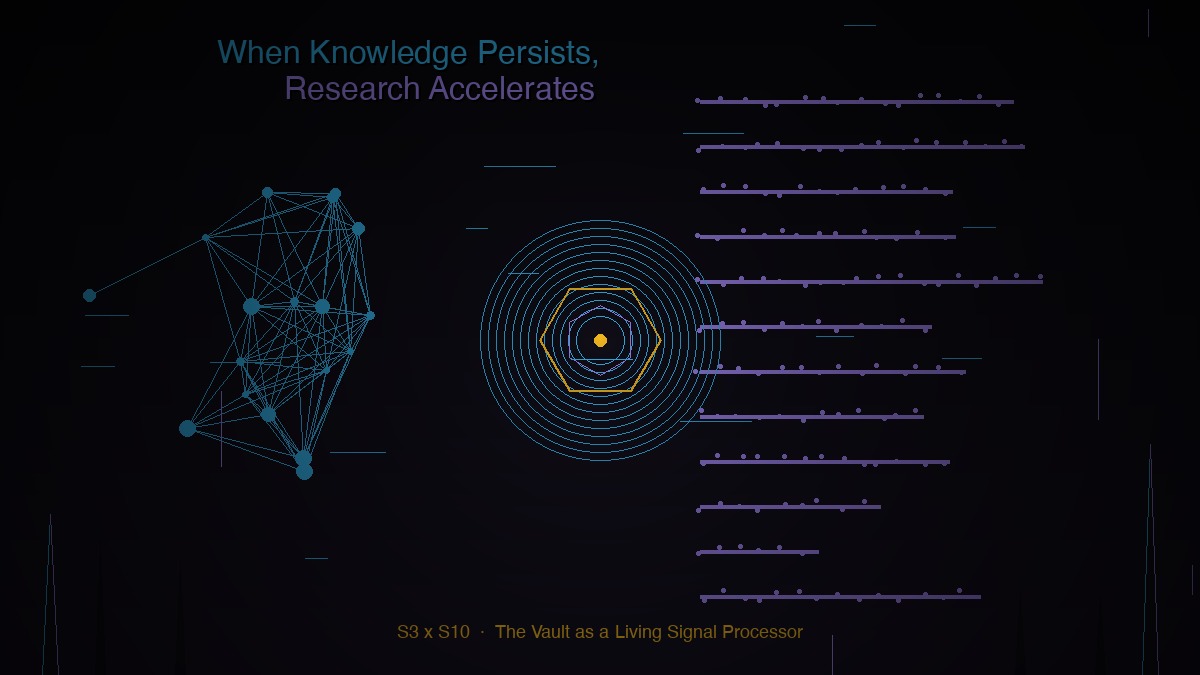
S3 (Knowledge OS) and S10 (Market Sensing and Research) are two series that describe the same machine from different angles. S3 asks: how does knowledge persist, connect, and compound in a vault? S10 asks: how does raw signal become grounded claims through a research pipeline? The bridge between them is this: the vault is not a storage layer for research output. The vault is the signal processor that makes research itself faster, more accurate, and more durable. When knowledge persists properly, research accelerates. When research feeds back into the vault, the vault grows more fertile soil for the next round of signal processing.
The research pipeline without a vault
S10.2 describes the basic research flow: discover via arxiv or blogwatcher, verify via grounded citations, synthesize through the LLM wiki, and publish. This is a linear pipeline. Signal in, content out. The pipeline is functional. It produces articles. It fills the content calendar. But it does not compound.
The problem is upstream. When a new paper arrives on arxiv about, say, multi-agent coordination architectures, the pipeline pulls it, grounds it, and writes an article. But the pipeline has no memory of the three earlier articles it produced on the same topic. The agent does not know that S1.3 covered supervision trees in detail, that S7.3 addressed zero-trust agent communications, or that S5.10 analyzed multi-profile architecture. The pipeline processes each signal in isolation. It is a research machine that does not learn from its own output.
This is the S10 problem: the pipeline is fast but Stateless. It produces individual articles but does not build a body of knowledge. The output is a collection of posts, not a connected graph. Each post is a leaf. None of them are roots.
The vault without a research pipeline
S3 describes the Knowledge OS: wiki graph, semantic edges, ChromaDB vectors, memory layers. The vault is designed to connect things. Entities link to concepts. Concepts link to sources. Sources link to published articles. The graph is rich. The edges carry meaning — “extends,” “grounds,” “contradicts,” “precedes.”
But the vault without a research pipeline is a garden without rain. The graph can hold 700 nodes and 1,500 edges and still sit idle. The connections exist in principle. They do not activate in practice. A new seed drops into the vault — an article draft, a research branch, a cluster card — and the vault knows where it fits. But the vault does not generate new seeds. It does not scan arxiv for papers that would extend existing nodes. It does not monitor blogs for signals that would contradict a published claim. The vault is fertile soil. It needs a weather system.
This is the S3 problem: the vault is connected but Passive. It holds knowledge. It does not seek it. The graph is a map of what has been recorded. It is not a sensor for what should be recorded next.
The bridge: vault as signal processor
The bridge between S3 and S10 is not a third system. It is the recognition that the vault and the pipeline are the same machine viewed from different angles. The vault is the pipeline’s memory. The pipeline is the vault’s intake.
When the research pipeline encounters a new paper, the vault should be the first thing it consults. Not to retrieve the paper — the arxiv skill handles that. To retrieve context. What does this paper mean given what we already know? Which existing claims does it support? Which does it challenge? What nodes in the wiki graph would this paper extend?
When the vault receives a new entry — an accepted research branch, a cluster card, a draft article — the pipeline should be the first thing it activates. Not to publish immediately. To check whether existing research already covers this territory. Whether a blogwatcher feed has already surfaced a contradicting signal. Whether a grounded citation from three months ago has been superseded by a newer paper.
The vault is a signal processor because it does two things with every input: it connects it to what exists, and it checks whether what exists still holds. A research pipeline that runs through a signal-processing vault does not just produce articles. It produces knowledge that updates itself.
Continuity beats completion
North Star Principle 7 states: everything is a record; continuity beats completion. The research pipeline that does not connect to the vault is a completion machine. It finishes articles. It does not continue learning. The vault that does not connect to the pipeline is a continuity machine. It holds everything. It does not act on anything.
The bridge article (this one) is itself an example. The knowledge-os topic appeared in article plans for S3, S4, and S10 — three series that each touched the same idea from a different angle. No existing article combined the two series’ themes. The cluster card identified the gap. The bridge fills it. But filling the gap is not the point. The point is that the gap was detectable. The vault’s graph knew that knowledge-os was referenced across series but never linked. The pipeline’s signal processing — the cluster engine, the semantic analysis, the scoring — surfaced it as a priority.
This is the loop: vault connects, pipeline processes, bridge fills, vault updates. The next time a knowledge-os related paper appears on arxiv, the pipeline will know that three bridge articles already exist on the topic. It will not produce a fourth. It will extend one of the three. The vault remembers. The pipeline learns. The knowledge compounds.
What changes when the bridge is live
Three things change when the vault and pipeline operate as one system rather than two adjacent ones.
Research speed improves. An agent pulling a new paper does not start from zero. It starts from the vault’s existing graph — the claims already grounded, the sources already verified, the connections already mapped. The synthesis step is faster because the context is pre-loaded. The article is more precise because it knows what has already been said.
Knowledge durability increases. Every published article is not just a leaf on the content tree. It is a node in the graph with edges to the concepts it grounds, the sources it cites, and the claims it extends. When a newer paper contradicts an older claim, the vault surfaces the contradiction. The pipeline generates an update. The record is corrected. The knowledge does not rot in a folder. It evolves in a graph.
The graph becomes a sensor. The vault’s edges are not just connections. They are indicators of where the next signal should come from. A node with many outgoing edges and no recent updates is a node that might be stale. A node with incoming edges from recent research is a node that is growing. The graph tells the pipeline where to look next. The pipeline feeds the graph what it finds. The system self-organizes.
The fleet that bridges its knowledge OS and its research pipeline is the fleet that turns publishing from a content exercise into a knowledge-engineering discipline. Every article is both an output and an input. Every signal is both a discovery and a connection. The vault processes. The pipeline remembers. The knowledge compounds.
The fleet that keeps them separate is the fleet that produces 800 articles and still cannot answer the question: what do we know, and how do we know it?