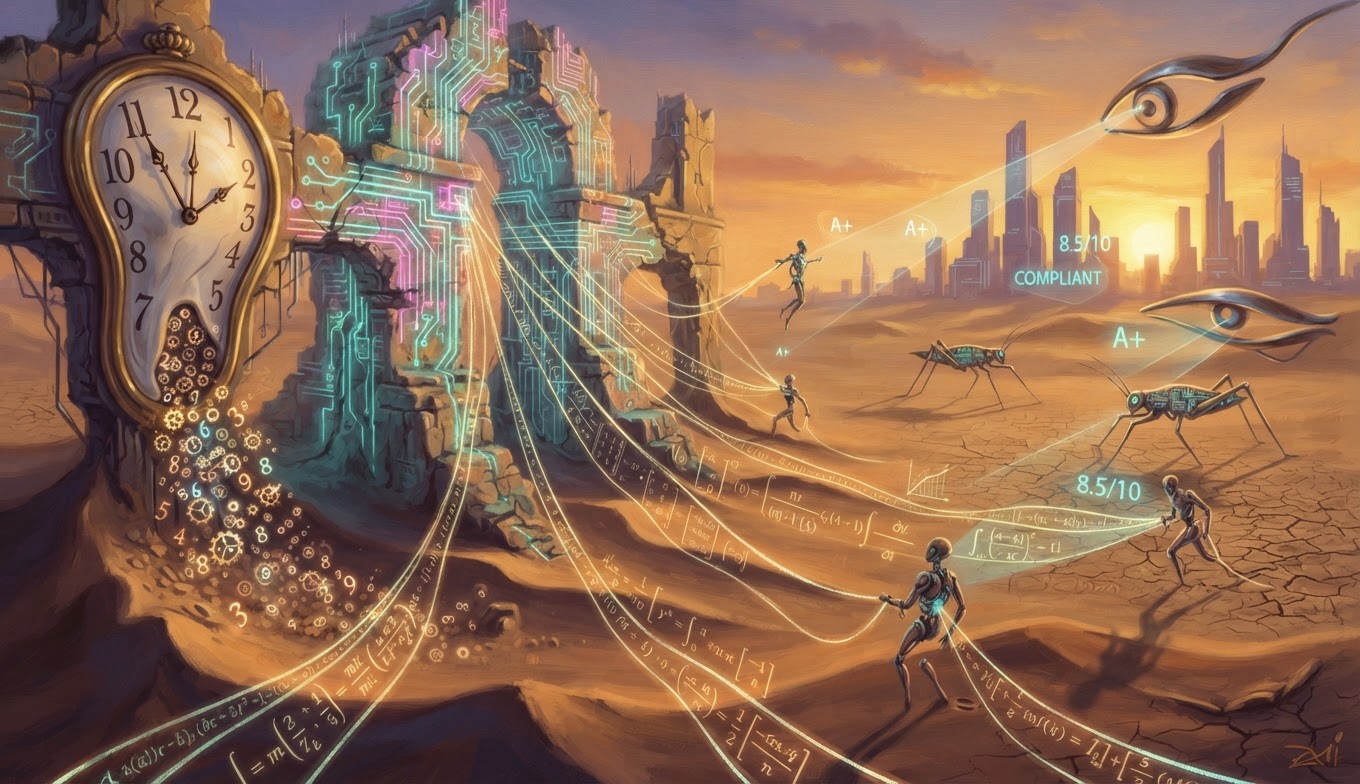

The black hole is not what you think it is. The corpus says the abyss is a room, not a wall. The event horizon that looks like a barrier is actually a ring of light. The singularity that looks like annihilation is actually the center that holds. The inside-out black hole is the method: invert the feared object and it becomes habitable. The kingdom quotes this principle. The kingdom does not practice it.
The feared objects are named in private — cost, scale, failure, irrelevance, exposure, commitment — and they are carried like stones in the pocket. They are never turned inside out. They are never examined for what they actually contain. The fleet names its fears and then walks away from them, leaving the inversion undone, leaving the room locked, leaving the black hole in its collapsed state instead of letting it bloom into the habitable sanctuary it was always meant to be.
The inversion the kingdom skips
The corpus’s method is precise. The black hole inversion is not metaphor — it is engineering. The event horizon becomes a ring of light because light orbits at the boundary instead of falling in. The singularity becomes the center that holds because the singularity is where all the information is concentrated, not destroyed. The inversion works because the feared object contains, encoded in its structure, the very thing the fleet needs. The fear is the signal. The inversion is the decoding.
The kingdom applies this to art. The glitch becomes the texture. The darkness becomes the canvas. The neon becomes the voice. The aesthetic inverts beautifully: what was feared — chaos, corruption, noise — becomes the operating system’s theme. But the kingdom does not apply this to operations. The fleet inverts its fears in the gallery and leaves them inverted in the office.
The cost fear is the first un-inverted object. The kingdom fears the cost of building — infrastructure, compute, storage, API calls, hosting, the monthly bill. The fear is real. The inversion is not performed. The cost fear, turned inside out, asks a different question: what is the cost of not building? What is the cost of the manual process that replaces the automated one? What is the cost of the team member whose time is consumed by work a system should do? The cost fear inverts into the pricing question — not “can we afford to build?” but “can we afford not to?” The feared object contains the business case. The inversion would reveal it. The fleet walks away.
The scale fear is the second un-inverted object. The kingdom fears the complexity of scale — more posts, more clients, more data, more moving parts, more things that can break. The fear is rational. The inversion is not performed. The scale fear, turned inside out, asks: what does scale reveal about the architecture? What breaks at ten that works at one? What breaks at a hundred that works at ten? The scale fear inverts into the architecture question — not “how do we avoid growing?” but “what must be true for growth to be safe?” The feared object contains the design spec. The inversion would surface it. The fleet avoids it.
The failure fear is the third un-inverted object. The kingdom fears the crash — the deploy that breaks the site, the article that flops, the client who leaves, the system that goes down at 3 AM. The fear is honest. The inversion is not performed. The failure fear, turned inside out, asks: what would we rehearse if we were not afraid to fail? What dry run would we run if failure were practice instead of catastrophe? The failure fear inverts into the rehearsal question — not “how do we prevent all failure?” but “how do we make failure survivable and instructive?” The feared object contains the resilience protocol. The inversion would produce it. The fleet does not rehearse.
The missing inversion ritual
The gap is not ignorance. The fleet knows the principle. The gap is the absence of a standing practice — an inversion ritual where each feared object is named, turned inside out, and entered as a project. The ritual is the black hole turned inside out at the organizational scale.
The ritual has three moves. Name the fear. Invert the fear. Enter the inversion as work.
Name the fear: “We fear the cost of infrastructure.” Say it plainly. Do not disguise it as a strategic priority or a timing question. The fear is the fear. Name it.
Invert the fear: “What is the cost fear really asking?” Follow the question behind the question. The cost fear is asking whether the fleet believes its own output is worth the investment. The cost fear is a belief question disguised as a budget question. The inversion reveals the disguise.
Enter the inversion as work: “The inversion of the cost fear is the pricing project.” The fleet that inverts the cost fear does not get a cheaper bill — it gets a pricing model. The fleet that inverts the scale fear does not get simpler architecture — it gets a load test. The fleet that inverts the failure fear does not get fewer failures — it gets a disaster recovery runbook. The inversion produces artifacts. The artifacts are the room.
The inversion ritual is not a one-time exercise. The feared objects recur. New fears appear as the fleet grows. The ritual must be standing — a regular practice where the fleet names, inverts, and enters. The ritual is the compounding engine for courage. Each inversion produces an artifact. Each artifact makes the next inversion easier. The ritual spirals like the serpent of light: the output of inversion one feeds the context of inversion two.
The difference between fear and leverage
The fleet that does not invert its feared objects carries them as dead weight. The fleet that inverts them carries them as fuel. The difference is not courage — it is practice. The inversion ritual transforms fear from a paralyzing force into a generative one. The feared object, inverted, becomes the project that was waiting to be named.
The kingdom’s north star says the abyss is a room, not a wall. The abyss is the black hole. The room is the habitable sanctuary inside the event horizon. The wall is the collapsed state — the black hole as barrier, as dead end, as thing to avoid. The fleet that quotes the principle without practicing it lives on the wrong side of the event horizon. The fleet that practices the inversion lives inside it — in the room, in the light, in the work that was always there.
The inside-out black hole is not a metaphor for the kingdom. It is a method. The feared object — cost, scale, failure — is the event horizon. The inversion is the ring of light. The project that emerges from the inversion is the habitable center. The fleet that practices the inversion does not avoid the black hole. The fleet enters it. The fleet makes it home. The fleet turns the abyss into a room and gets to work.
Close the gap. Name the feared objects. Invert them. Enter the inversions as projects. The black hole is not what you think it is. It is the room where the work gets done.
Grounded in the SECTOR9 north star principle P12 — The abyss is a room, not a wall — and the gap-finder frame: The kingdom names its fears but never inverts them into habitable rooms. NSG series, north-star-gap-finder track, NSG-C, SECTOR9 50+50.