
The Meta-Matters Series: Why We Run a Content Protocol at All
A post is a signal, not a finished object
A post feels complete when it is published. Operationally, that is only the first durable event. The words sit on a surface, but value appears when the next writer, tool, agent, or reader can find the signal, understand its context, and build on it.
Without that structure, publishing becomes accumulation. The archive grows, but its categories drift, its terminology forks, and each new page asks the reader to reconstruct the system from scratch. The next worker receives an idea without a contract. The next agent receives prose without a boundary. Continuity is lost at exactly the point where the work should become reusable.
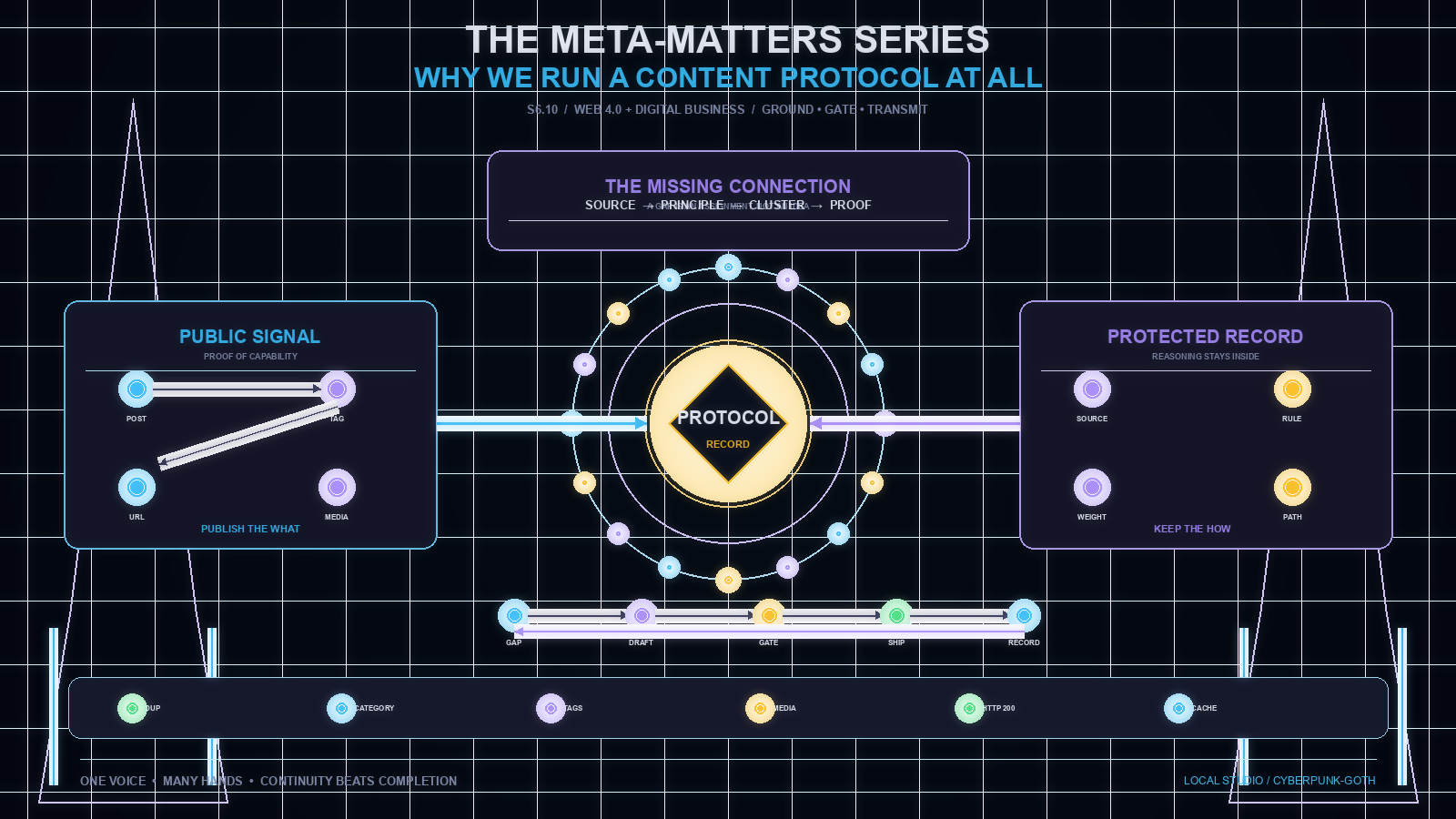
A content protocol does not exist to make every article brilliant. It exists so brilliance has somewhere stable to land. It turns editorial intention into a sequence of inspectable states: source, gap, draft, quality gate, publication, delivery, and record. Completion is the end of one transaction. Continuity is the property of the system around it.
Start with the missing connection
A mature corpus is not defined by how much it contains. It is defined by what it can still discover about itself. The first question is not “What should we publish next?” It is “Which promised connection, customer need, or unresolved question does the existing record fail to cover?”
That changes the unit of planning. A vague idea becomes a gap. A gap has evidence. Evidence points to a governing principle and a cluster. The cluster defines the series, scope, and next entry. A content protocol turns an editorial hunch into a bounded assignment with an owner and acceptance criteria.
The S6 gap cluster is a simple example. It identifies four missing Web 4.0 and digital-business articles inside a larger series, including the MCP layer, production AI, and the meta question now in front of us. The number is not the product. The explicit relationship between the roadmap position, the existing corpus, and the next proof is.
This is the body-center node described in the North Star: a coordinating point that aligns the work without performing every task. The protocol does not write the article for the fleet. It gives the fleet a shared frame inside which independent work remains coherent.
Transcribe judgment before automating speed
Automation multiplies whatever judgment is already present. A team that cannot explain why one article was accepted, another rewritten, or a third rejected should not ask a model to generate thousands more. Scale without a transcribed decision rule only scales ambiguity.
The first act of power is therefore transcription. Capture the editorial thesis, the evidence trail, the protected boundary, the audience promise, and the proof of delivery in a form another authorized worker can use. The record need not expose every internal derivation. It must preserve enough context that the next action is not tribal memory.
Public content and internal knowledge are not the same asset. The public article can prove capability: what the system connects, what it verifies, and what principle guides the decision. The private record can retain the reasoning, source paths, weights, and implementation detail. Good protocol design respects the laser line between them. It publishes proof, not the blueprint behind the proof.
A protocol is a contract with a reader
A reader does not experience a task board, a prompt, or a media manifest. They experience the article that those records produce. The protocol matters because the hidden machinery serves the visible promise: relevant, coherent, trustworthy, and worth the reader’s attention.
That promise can be checked. A new worker should know which document is authoritative, which claim is protected, where the article belongs, which taxonomy applies, and what “done” means. After publication, the target should be read back: correct post, correct category, complete tags, intended featured image, reachable URL, and no protected markers in the public body.
These are not ceremonial checks. They are API-like contracts applied to editorial work. Inputs are named. Outputs are observable. Failure states are explicit. A retry must not create a second post when the canonical one already exists.
Quality gates should raise the floor
Consistency begins with a quality floor. Every piece is grounded in an accepted source, has an unambiguous series entry, is checked against existing content, and follows the publication, taxonomy, and media boundaries.
The gate should be proportional. Editorial judgment still decides whether an article is meaningful, but mechanical gates handle expensive mistakes: missing grounding, broken taxonomy, duplicated titles, absent evidence, or a public body that contains material it should not. If a check cannot change a decision, simplify it. If ignoring it creates rework or false confidence, keep it visible.
Tags are edges, not decoration
Tags matter when they express how a piece connects to the rest of the corpus. A template set provides stable vocabulary, but topical tags make the new article enter a live network. “Content protocol” identifies the idea. “Compound content” identifies the desired effect. “Editorial pipeline” identifies the system that produced it.
A category places the article in a visible business surface. Grounding connects it to an authoritative idea. Tags connect it to neighboring work. Provenance records the path between them. The protocol asks workers to make the connections that will help the next decision, not to maximize tag count.
Delivery is part of the content
Publishing changes the backend. Delivery changes the world the reader can see. A post marked live while its featured image fails, its cache serves stale links, or the URL returns an error is an incomplete publication.
The media chain closes the loop: generate or approve the asset locally, preserve its provenance, import it, attach it, read the relationship back, compress, rebuild the cache, and verify the URLs. Creation is finished when the intended image is rendered, linked, cached, and served.
One voice, many hands
A content operation scales through delegation, but it remains one voice. The north star is the body-center; the cluster card is the assignment; the worker is a capability node. Shared terms prevent two workers from solving different problems. Shared gates prevent one worker from lowering the bar. Shared records let the next worker continue from evidence rather than chat history.
An awakened system is not one that never fails. It is one that can wake into context: recover from partial work, identify the record, resume the remaining task, and leave evidence for the next cycle.
Keep the protocol alive
No content protocol remains correct forever. Taxonomy accumulates dead labels. Editorial boundaries change. Delivery paths are replaced. Sources are revised. A standard that is never challenged becomes a ritual that preserves yesterday’s mistakes.
Make maintenance part of the protocol. Retire dead tags, reject duplicate work, update delivery checks, revisit protected boundaries, and record why each rule changed. The aim is a system that compounds without becoming opaque: aligned enough to be recognizable, inspectable enough to be corrected, and alive enough to improve.
The meta test
A content protocol is justified when it helps a team notice what is missing, ground the next piece, protect private reasoning, publish consistently, deliver reliably, and return a record that makes the next decision easier.
Before calling the system working, ask: Can a worker identify the gap, authoritative source, public boundary, duplicate guard, required quality gates, media provenance, and live readback? Can the next worker resume without private explanation?
A “no” identifies the missing edge. Add the smallest gate or record that closes it, then test again. We run a content protocol because each contribution should leave the next one better prepared. The protocol is the transmission medium that turns information into geometry and a public surface into a graph the organization can keep thinking with.