
The Feedback Flywheel: Market → Research → Content → Market
> Draft — S10.10 · series: CONTENT-ROADMAP-99 S10 (Market Sensing & Research) · status: DRAFT · grounding: wiki self-improving-knowledge-base · wiki council-hierarchy-architecture · entity polymarket · skills: polymarket · skills: blogwatcher · skills: grounded-citations · skills: llm-wiki · skills: arxiv · tags: feedback-flywheel, market-sensing, research-pipeline, content-strategy, closed-loop, information-feedback, prediction-markets, polymarket, blogwatcher, arxiv, grounded-citations, llm-wiki, ai-agents, digital-architecture, sovereign-infrastructure, autonomous-operations, knowledge-base, data-intelligence, evidence-based-analysis, web-4.0, ai-automation, kanban-orchestrator, council-system, hermes-agent, content-pipeline, market-intelligence, self-improving-system
—
The S10 series has described each layer of the market sensing stack in isolation. S10.1 established prediction markets as sensors — prices that absorb information before headlines publish. S10.2 built the research pipeline from arxiv discovery through synthesis to decision. S10.3 added blogwatcher as the RSS early-warning layer. S10.4 grounded the entire stack in verifiable citations. S10.5 through S10.8 covered time-capsule testing, competitive sensing, model benchmarks, and the LLM wiki as persistent memory. S10.9 showed how research becomes roadmap through the Council’s decision funnel. This final article addresses the thing none of those pieces can do alone: close the loop.
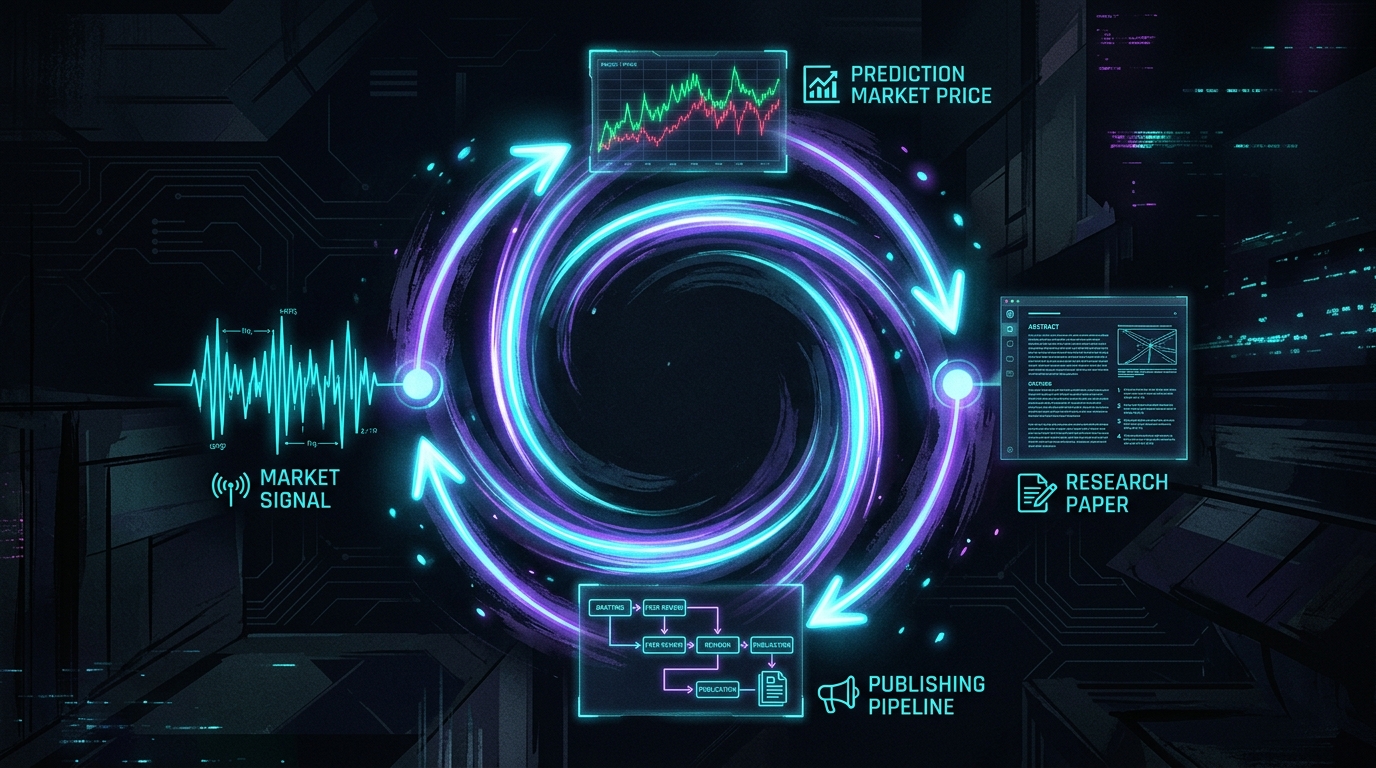
A sensor that reads but never writes back is a thermometer. A research pipeline that produces knowledge but never revisits its own assumptions is a library. A content engine that publishes but never measures what happens after is a printing press. The feedback flywheel is what transforms these isolated capabilities into a system that compounds — where market signals feed research, research feeds content, and content feeds market awareness, accelerating with each rotation.[1][5]
The four nodes
The flywheel has four nodes, and the connections between them matter more than the nodes themselves.
Market signals are the raw input. Prediction market price moves. Blogwatcher RSS scans. Arxiv paper releases. Social media sentiment shifts. These are the sensors described in S10.1 through S10.3 — wide, fast, and automated. The pipeline captures everything and filters later. No editorial judgment at the intake. The goal is maximum surface area: catch the signal before it becomes consensus.
Research is the transformation layer. Raw signals become grounded claims through the synthesis pipeline described in S10.2. The arxiv skill discovers papers. The grounded-citations skill verifies that claims map to real sources. The LLM wiki integrates new findings into the existing knowledge graph — updating entity pages, revising topic summaries, noting where new evidence contradicts old beliefs. Research is where information becomes knowledge that persists, compounds, and becomes actionable across sessions.[3][4]
Content is the output layer. The Council publishes articles grounded in the research base. Every article cites wiki concepts and skills. Every article tags from the 49-term taxonomy. Every article publishes as a new post — never overwriting, never deleting, always additive. The content engine is not a content mill. It is the mechanism by which internal knowledge becomes external authority. The article you are reading is itself a product of this node.[2]
Market awareness is the feedback node — and the one most systems skip. When content publishes, it enters the information environment. Readers encounter it. Search engines index it. Other content creators reference, critique, or build on it. The published article becomes a new signal source — one that did not exist before the flywheel turned. This is the node that closes the loop: content creates market awareness, and market awareness generates new market signals that feed back into the research pipeline.
Why the loop matters
Jim Collins introduced the flywheel concept to business strategy in 2001: a heavy wheel that moves slowly at first but builds momentum with each rotation, each turn compounding the effort invested earlier.[5] The content-market flywheel works the same way, but with a specific mechanism that makes it more than a metaphor.
The mechanism is information asymmetry reduction. When the Kingdom of Truth publishes an article about prediction market feedback loops — grounded in academic research, cited to verifiable sources, tagged to a structured taxonomy — it does two things simultaneously. First, it establishes authority: the article demonstrates that the system can detect, research, and synthesize a complex topic faster than traditional editorial processes. Second, it creates a signal: the article itself becomes something that prediction markets, RSS feeds, and research pipelines can detect.[1]
This is the compounding effect. The first rotation of the flywheel produces an article that no one has read yet. The second rotation produces an article informed by the market response to the first. The third rotation produces content that references its own prior output as evidence. Each cycle makes the next cycle faster, more grounded, and more difficult to replicate — because the knowledge base has grown, the citation network has deepened, and the market position has solidified.
The closed-loop architecture
CRV’s analysis of AI agent research workflows describes the pattern explicitly: “The closed-loop architecture, where instruments feed data to agents that adjust parameters and trigger the next experiment, compresses the time between cycles from days to minutes.”[3] The Kingdom of Truth applies this architecture to content and market intelligence rather than laboratory experiments, but the structural principle is identical.
In the laboratory version, instruments generate data, agents analyze it, agents adjust experiment parameters, instruments generate new data. In the content-market version, market sensors generate signals, the research pipeline synthesizes them, the content engine publishes grounded articles, and the published articles generate new market signals that the sensors detect.[3][4]
The Nature study on autonomous materials labs formalizes this as multi-agent coordination: “Only the central agent has autonomy of sensing, acting, communicating, and decision making.”[4] The Council system maps directly. Hermes orchestrates. OpenClaw, OpenFang, and ZeroClaw each own a domain. The kanban board is the source of truth. The research pipeline feeds the decision engine. The content engine publishes. The sensors detect what happened after publication. The loop closes.[4]
Where most systems break
The flywheel breaks at the feedback node — the moment where content enters the market and the system must detect what happens next. Most content operations publish and move on. They measure page views, maybe track time-on-page, and call it analytics. This is not a feedback loop. It is a measurement endpoint.[2]
A real feedback loop requires the system to detect market response to its own output and route that response back into the research pipeline. When the Kingdom of Truth publishes an article about prediction markets, the blogwatcher skill should be scanning for references to that article — not as vanity monitoring, but as signal detection. When a prediction market contract moves in a direction the article predicted, that is corroborating evidence. When an arxiv paper contradicts a claim the article made, that is a correction signal. When another content creator builds on the article’s framework, that is adoption evidence.[1][2]
The MindCast analysis frames this precisely: “Feedback integrity determines whether a system converges toward truth or drifts into narrative. Systems with fast, costly, and clear feedback loops punish error and reward calibration. Systems with delayed, diffuse, or manipulable feedback loops allow mispricing to persist and compound.”[1] The flywheel is a feedback integrity engine. Each rotation tests the system’s prior output against reality and adjusts accordingly.
The compounding evidence base
The LLM wiki is the flywheel’s memory. Every rotation of the loop produces new wiki nodes — entities updated with fresh citations, concepts revised with new evidence, contradictions flagged for review. The wiki does not reset between cycles. It accumulates. S10.8 described this as the Karpathy pattern: persistent, compounding knowledge that persists across sessions, across agents, and across time.[4]
This is what makes the flywheel accelerate rather than merely repeat. The first rotation of the loop produces an article grounded in five sources. The second rotation produces an article grounded in the first article plus five new sources plus the wiki’s accumulated cross-references. The third rotation has the entire S10 series as context, plus every wiki node the series touched, plus the market response to every article published so far. The knowledge base grows faster than the content output, which means each new article is more grounded, more contextualized, and harder to replicate than the last.[4][5]
What the S10 series proved
Ten articles. Ten layers of the same stack. The series began with a single observation — that prediction market prices move before news — and built, layer by layer, into a complete market sensing and research architecture. The feedback flywheel is the capstone because it is the mechanism that makes the architecture self-sustaining. Without the flywheel, the S10 stack is a collection of useful tools. With the flywheel, it is a system that improves itself with every rotation.
The market signals the sensors. The research grounds the claims. The content publishes the knowledge. The market responds. The sensors detect the response. The research updates. The content publishes again. Each cycle is faster than the last. Each cycle is more grounded than the last. Each cycle is harder to replicate than the last.
That is the flywheel. It is not a metaphor. It is an architecture. And it is spinning.
—