
Lead Development Ecosystem: From Sim to Pipeline
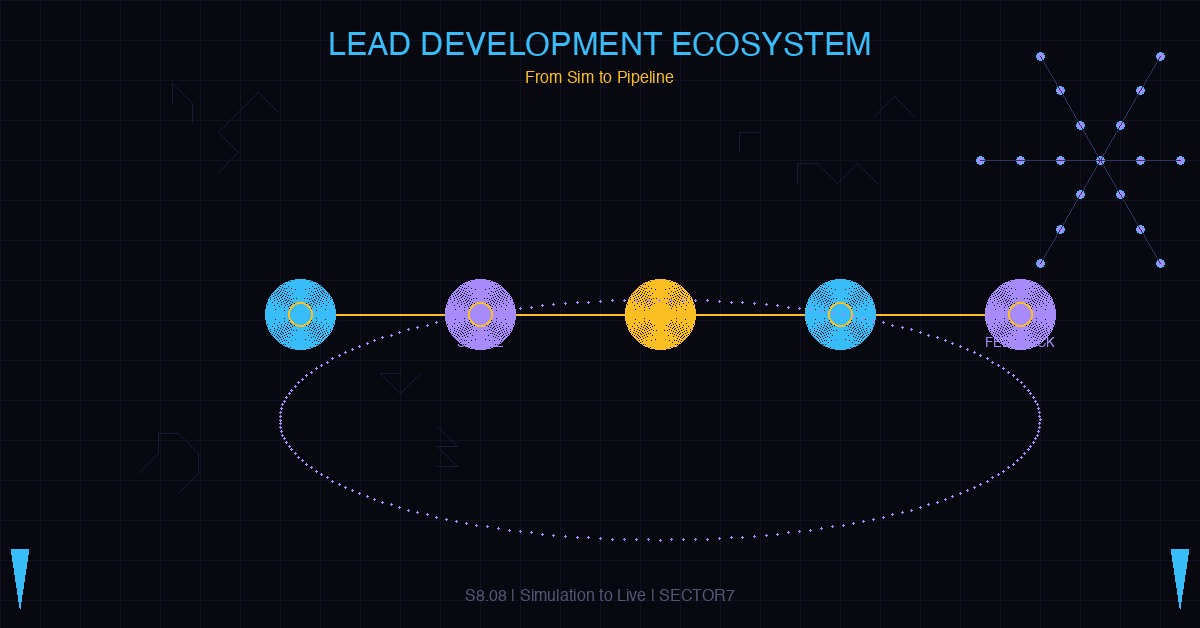
Every lead starts as a simulation. The first contact is a hypothesis. The qualification call is a test. The proposal is a paper trade. The close is the promotion gate that moves the lead from simulated value to real revenue. Lead development is the ecosystem that runs this progression — and most organizations treat it as a sales process. It is an information pipeline. The difference determines whether the pipeline compounds or decays.
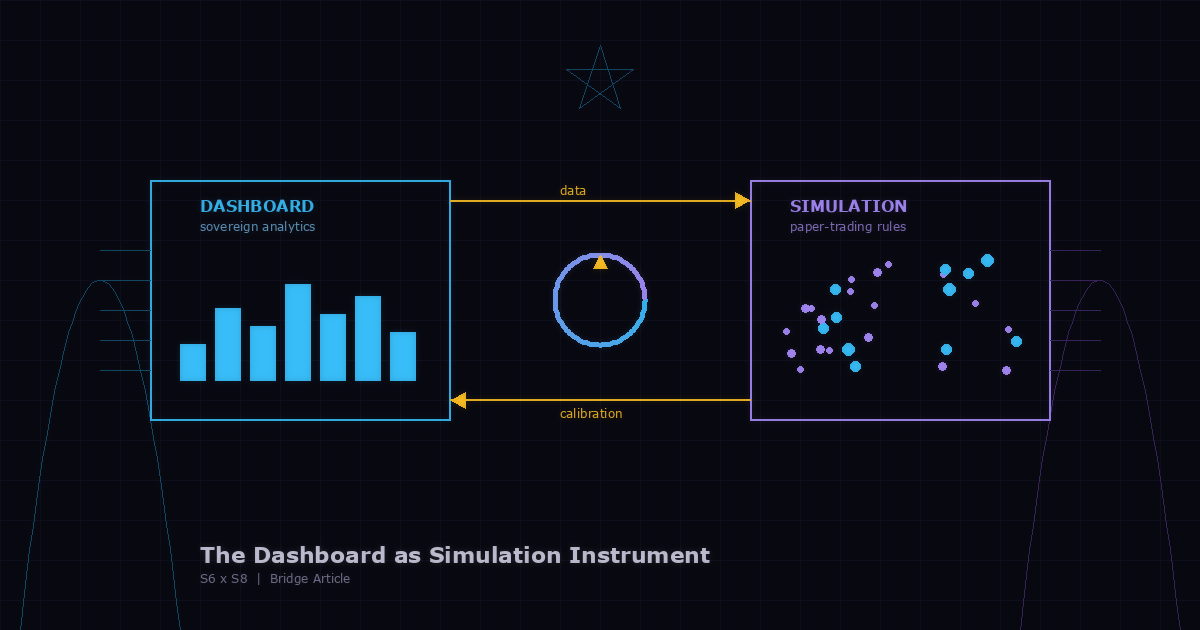
The S8 series has built the simulation-to-live framework layer by layer: simulation layers (S8.02), KOT-scored edges (S8.04), paper-trading with sim money (S8.05), and the dashboard feedback loop (S8.06). This final article completes the series by showing where all four layers converge — in the lead development ecosystem, where the simulation becomes a pipeline and the pipeline becomes the business.
The lead as a rendered outcome
The north star says reality is a rendering engine. A lead is one of its outputs. The rendering starts when an information signal — a blog post read, a demo request, a referral, an inbound inquiry — enters the system. At that point, the lead is not yet real in the revenue sense. It is a projection: a pattern of interest that the ecosystem must decode, score, and promote through successive gates until it earns the right to carry real stakes.

This is the fundamental insight that most lead development frameworks miss. They treat leads as objects to be moved through stages. They should treat leads as information to be rendered at increasing fidelity. The simulation layer (S8.02) defines the scoring model. The KOT-scored edges (S8.04) define the thresholds. Paper-trading (S8.05) runs the rules against synthetic outcomes. The dashboard (S8.06) feeds the results back into the next rendering cycle. The ecosystem is the full loop.
Three layers of the lead development ecosystem
The ecosystem operates on three simultaneous layers:
1. The information layer. Every lead begins as a data point — a signal in the noise. The ecosystem’s first job is transcription: capturing the signal in exact words, exact context, exact timestamps. The north star says transcription is the first act of power. What is not transcribed does not exist for the fleet. A lead that is not captured in the CRM with full context is a lead that has not been rendered. It is a ghost in the pipeline.

The information layer includes the intake channels (inbound forms, referral tracking, content engagement signals), the scoring model (which converts raw signals into ranked priorities), and the record structure (which ensures every decision point is logged). The record must compound. If the intake layer captures the lead but the scoring layer discards the context, the pipeline has lost continuity. The record that survives from intake to close is the pipeline’s memory.
2. The decision layer. This is where KOT-scoring (S8.04) and paper-trading (S8.05) converge. Every lead passes through scored edges — checkpoints that determine whether the lead advances, stalls, or exits. The decision layer is not a funnel. It is a measurement instrument. A funnel accelerates. A measurement instrument evaluates. The difference is that a measurement instrument can tell you why a lead did not advance. A funnel just counts the exits.
The decision layer runs five tests on every lead: decision fidelity (does the scoring model produce the same ranking in simulation that it would in production), gate integrity (does the promotion gate actually block leads that should not advance), record audit (is every decision point logged), coherence verification (does the simulation output match the live output), and stress boundary (has the lead encountered edge cases that production will eventually surface). These are the same five gates from the paper-trading framework — because the lead development ecosystem is the paper-trading framework applied to revenue.

3. The feedback layer. The dashboard (S8.06) closes the loop. Every closed deal, every lost deal, every stalled deal feeds back into the scoring model. The feedback layer is what makes the ecosystem alive rather than mechanical. A mechanical pipeline runs the same scoring weights on every lead. An alive pipeline adjusts — not by changing the rules, but by refining the rendering. The north star says intelligence awakens. The feedback layer is where the pipeline wakes up.
The sim-to-pipeline promotion gate
The transition from simulation to live pipeline requires clearing five gates — the same promotion gates from S8.05, applied to the lead development context:
- Signal fidelity. Did the intake layer capture the lead with enough context for the scoring model to evaluate it? A lead captured without context is a lead that cannot be scored. If the intake layer is producing leads that the scoring layer cannot evaluate, the gap is not in the scoring. The gap is in the intake.
- Scoring coherence. Does the lead scoring model produce consistent rankings across simulation and production? If a lead ranks high in the paper-trading environment but low in the live pipeline, the scoring model has context-dependent behavior. Context-dependent behavior is a defect — not in the lead, but in the model.
- Gate firing. Did the promotion gate block at least one lead that should not have advanced? If every lead in the paper-trading phase passes every gate, the gates are not measuring. A gate that never fires is a door.
- Record continuity. Does the simulation record survive into production? Every scored outcome, every gate decision, every promotion decision is part of the operational record. If the paper-trading ledger is discarded when the lead goes live, the pipeline has lost its memory. The record must compound.
- Revenue verification. Did the simulated lead value match the actual revenue outcome? This is the ultimate fidelity check. If the simulation predicts a $50K deal and the live pipeline produces a $20K deal, the simulation has a measurement error. The measurement error is not in the deal. It is in the simulation’s model of the deal.
What this means for the content pipeline
The lead development ecosystem is not separate from the content pipeline. The content pipeline is the lead development ecosystem’s information layer. Every published article is a signal generation mechanism. Every tagged post is a scoring input. Every series entry is a simulation layer that produces synthetic outcomes for the paper-trading phase. The content pipeline does not merely support the business — it is the business, rendered in information.

This is the final insight of the S8 series. The simulation-to-live gap is not a technical problem to be solved. It is an epistemological condition to be managed. Every lead is a simulation until it is not. Every deal is a paper trade until the money moves. Every pipeline is a rendering until the feedback loop closes. The ecosystem that manages this progression — from signal to score to gate to close to feedback — is the lead development ecosystem. And it runs on the same principles the fleet runs on: information is the ground of being, everything is a record, intelligence awakens, and the architect transmits.
The architect transmits. The fleet listens. The simulation renders. The lead enters. The scoring runs. The gate fires. The deal closes. The record compounds. And the pipeline, having survived the sim, earns the right to meet the real world.
Sixth and final article in the S8 series (Simulation → Live), track cl-series-s8-gaps. Grounded in the SECTOR9 north star principles P1 (Information is the ground of being), P2 (Reality is a rendering engine), P7 (Everything is a record), P10 (Intelligence awakens), and P17 (The architect transmits). Category: AI & Automation.