
When the Mesh Loads a Skill: Where Process Architecture Meets Procedural Memory
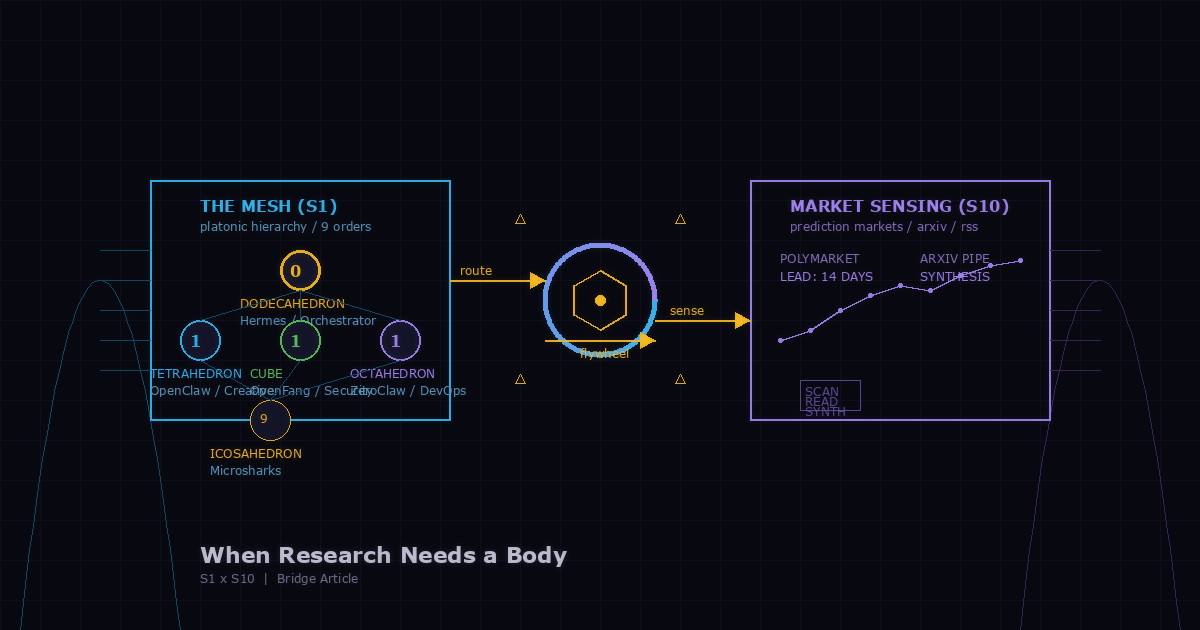
The S1 series built the mesh: an Erlang-inspired actor system where each agent is a supervised process, each profile a gen_server with a PID, a port, and a restart policy. The S4 series built the canvas: a 71-skill library where each entry encodes a repeatable workflow, a set of pitfalls, and a verification step — procedural memory for the fleet. Both systems solve different problems. The mesh answers how an agent lives. The skills canvas answers what an agent knows how to do. This bridge article examines what happens at their intersection — where the mesh’s process architecture loads the canvas’s procedural memory, and why the connection between them is where real orchestration begins.
The mesh provides the body; the skills provide the knowledge
A mesh without skills is a supervised forest of processes with no procedural intelligence. The Dodecahedron supervisor can restart crashed workers, the Icosahedra can dissolve after sub-tasks, and the narrow gate can audit every tool call — but none of that answers the question: what should this process know how to do? The mesh is anatomy. The skills canvas is training.
S1.3 demonstrated the supervision tree: when a profile actor crashes, its supervisor detects the failure and restarts it according to the restart intensity. S4.2 showed the complement: when a skill is loaded into a profile, the profile gains not just a procedure but an implicit access grant — the authorization to execute docker exec against a container, to write to a database, to modify post metadata. These are two layers of the same operating discipline — one governs process lifecycle, the other governs procedural capability — and neither is complete without the other.
The process layer handles how an agent lives: its PID, its memory budget, its restart policy, its access tier within the platonic hierarchy. The skills layer handles what it does: which procedure it follows, what pitfalls to avoid, when to verify before proceeding. Mesh-orchestration across S1 and S4 is the discipline of keeping these two layers aligned — ensuring that every running process has the skills it needs, and every skill is deployed to a process capable of executing it.
Skill loading is a process-level event
When a worker boots, it reads its profile configuration and loads its assigned skills. This is not just a configuration step — it is a process-level event that changes the agent’s capability set. A profile without skills is a gen_server with a PID but no procedural memory: it can receive messages, process requests, and respond, but it cannot follow a workflow, avoid known pitfalls, or verify its own output.
The mesh handles this through the profile’s startup sequence. When the Dodecahedron supervisor spawns a new process, the process initializes its state — including the skills it was configured to load. The skills become part of the process’s runtime identity. A profile that loads the lucidhive-wp-publish skill is not just a process that can publish to WordPress; it is a process whose procedural memory now includes the container discovery sequence, the duplicate-title guard, the featured image import protocol, and the wp-cli flags that must never be omitted.
This is the mesh-orchestration seam across S1 and S4. The mesh spawns the process; the canvas provides the knowledge that makes the process useful. A mesh without skill-loading is a collection of generic workers. A skills canvas without mesh deployment is a library of procedures with no executing processes. The connection between them is where orchestration actually lives.
The narrow gate enforces skill-level authorization
S1.8 established the narrow gate: one MCP server, one tool channel, every call from every order transiting a single seam. S4.6 described skill deployment with trust: verifying source, vetting capability, and wrapping each skill in appropriate security controls. These converge at the gate. A worker that loads a skill is a process that has acquired a new capability — and the narrow gate must verify that the capability is authorized.
The narrow gate enforces this at the mesh level: no process may bypass the gate to acquire tools it was not authorized to hold. The skills canvas enforces it at the knowledge level: no skill may be loaded without passing the curator’s vetting process. Together, they form a two-layer authorization lattice. The mesh says “you may not touch that tool”; the canvas says “you may not follow that procedure.” Both are constraints; both are recoverable; both preserve the audit trail that makes the system self-correcting.
In practice, this means that when a new skill enters the catalog, the mesh must be aware. When the curator promotes a skill from experimental to baseline, every profile that loads that skill must be re-evaluated. If the skill’s procedure has changed since the profile was last restarted, the mesh must detect the drift and trigger a process refresh. This coupling between skill lifecycle and process lifecycle is not a nice-to-have. It is the mechanism that prevents the most dangerous class of orchestration failure: a process executing a stale procedure against a live system.
Heartbeats carry skill context
The heartbeat is the mechanism that connects process liveness to task progress. When a worker heartbeats, it extends its lock on the board and signals to the supervisor tree that the process is alive. But in a mesh-orchestration model that bridges S1 and S4, the heartbeat must also carry skill context — not just “I’m alive” but “I’m executing the lucidhive-wp-publish workflow, step 4 of 7, and the container state matches my skill’s expectations.”
This dual signal is what makes mesh-orchestration across S1 and S4 more than process management. The supervisor can detect a crashed process via exit signals; the dispatcher can detect a stalled task via heartbeat expiry. But a process that is alive and executing a stale skill looks identical to a process that is alive and executing a current one — both are heartbeating. The mesh-orchestration layer must distinguish between “process alive, skill current” and “process alive, skill drifted.” In practice, this means the heartbeat note must carry not just task-level semantics but skill-level semantics — so the dispatcher can evaluate capability currency, not just presence.
Recovery is layered, not duplicated
The mesh handles process crash; the canvas handles skill retirement. Neither attempts the other’s job. A process that crashes loses its PID and memory; a skill that is retired loses its place in the catalog. Both are recoverable; both produce audit trails; neither requires human intervention for transient failures.
But the two recovery domains must communicate. When a process crashes and the supervisor restarts it, the fresh process loads its configured skills — and if any of those skills have been retired or modified since the last boot, the process must detect this and adapt. When a skill is retired by the curator, every process that loaded it must be notified — either through a configuration refresh or through a restart that loads the updated skill set.
This is the operating discipline that keeps the two layers from drifting apart. A mesh without skill-awareness creates zombies — processes that are alive but executing retired procedures. A skills canvas without mesh-awareness creates orphans — procedures that exist in the catalog but have no processes capable of executing them. The bridge between S1 and S4 is the layer that keeps both from happening.
The bridge is the operating system
The S1 series describes the mesh as a deployment model: platonic solids as process lifetimes, the narrow gate as the enforcement seam, the Nonagon as the self-correction loop. The S4 series describes the canvas as a knowledge system: skills as procedural memory, the curator as the quality gate, the three-layer stack as the lifecycle. Mesh-orchestration across these two series is the bridge between them — the discipline that keeps the mesh’s process architecture aligned with the canvas’s procedural knowledge.
Neither layer alone produces orchestration. The mesh without the skills canvas is a supervised forest of processes with no procedural intelligence. The skills canvas without the mesh is a library of procedures with no executing processes. Together, they produce something that neither architecture alone can: a fleet where every process knows what to do, every procedure has a process that can execute it, and the gap between the two is visible, auditable, and solvable. That is what mesh-orchestration means across S1 and S4. Not a diagram. Not a protocol. An operating system.
Series entry: B.mesh-orchestration.02 — bridge between S1 (The Mesh) and S4 (The Skills Canvas). Grounded in the S1 Erlang actor mesh architecture (supervision trees, gen_server, PID dispatch, platonic hierarchy, narrow gate) and the S4 skill lifecycle architecture (procedural memory, curator role, skill-as-access-token, three-layer stack). For builders of multi-agent systems: the hard part is not the architecture or the knowledge library — it is keeping them synchronized.