
Two Nodes, Two Dashboards: The Single-Node vs Cluster Comparison
You open your laptop. One dashboard. One node. One set of cameras, one set of agents, one knowledge base living on the SSD beneath your fingers. This is Tier 1 — the Solo Workstation. Everything runs here. Everything is here. The dashboard shows uptime, CPU, memory, a handful of metrics. It’s enough. It’s sovereign. It’s yours.
Now you open a second laptop. A different dashboard. Different cameras. Different agents. Different knowledge base. Two machines, two dashboards, two sovereign nodes that don’t know about each other. This is the moment the mesh begins — not with a cluster, not with Docker Swarm, not with orchestration. With two nodes and the question that changes everything: should these two talk to each other?
What One Dashboard Shows You
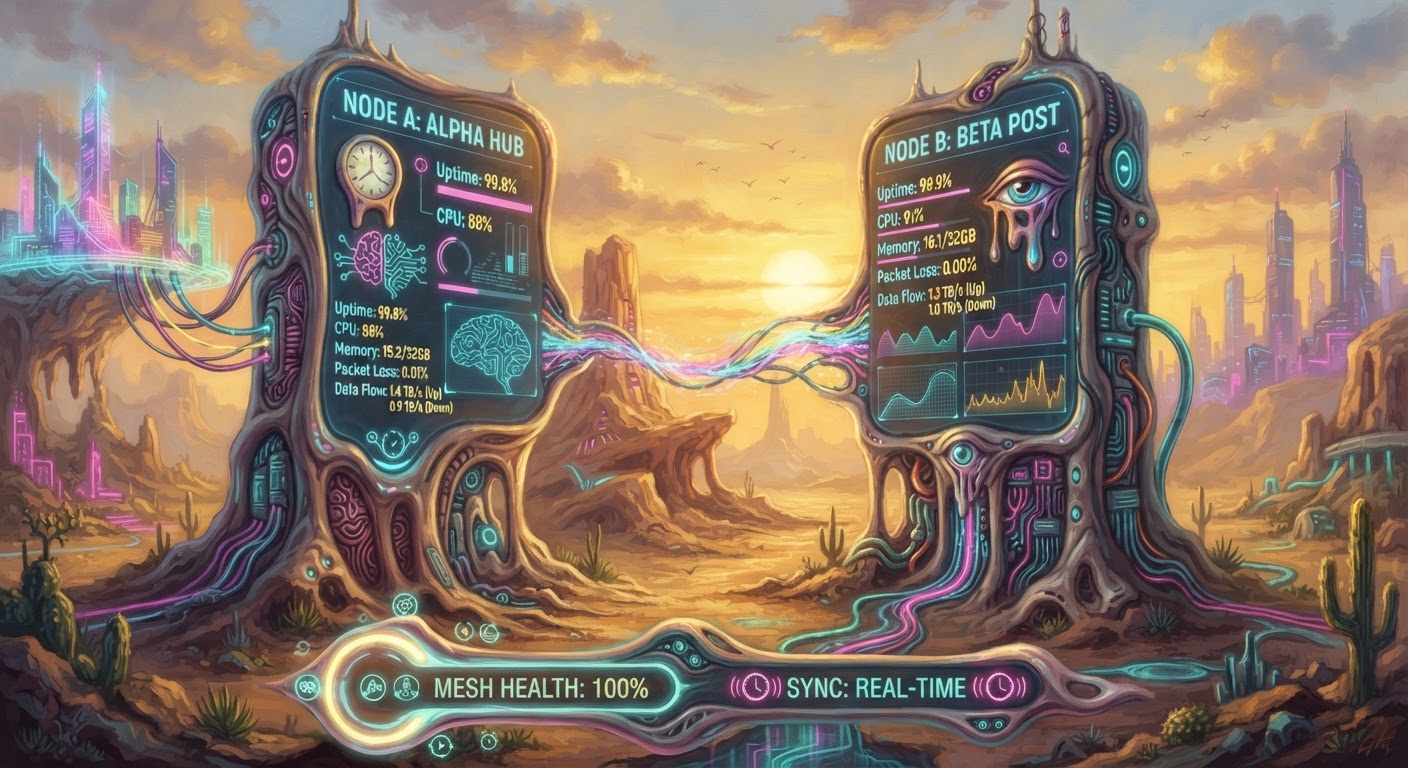
The single-node dashboard is honest. It shows you exactly what’s happening on one machine. CPU at 88%. Memory at 15.2 of 32 gigabytes. Uptime at 99.8%. Packet loss at 0.01%. Data flowing in at 1.4 terabytes per hour, out at 0.9. The numbers are real. The numbers are local. No aggregation, no averaging, no cloud-mediated abstraction standing between you and the truth of your own hardware.
This is the Solo Workstation’s gift: radical simplicity. One machine means one failure domain. If it crashes, everything stops — but everything stops cleanly. No split-brain scenarios. No reconciliation conflicts. No CRDT merge operations needed because there’s nothing to merge. The dashboard is a mirror, not a window into a distributed system.
For security services, this simplicity is a feature, not a limitation. A single Raspberry Pi running four cameras, a knowledge base, and an agent stack serves a small shop perfectly. Local footage, local inference, local governance. The Love Equation evaluates every access decision against its own parameters — no network latency, no cross-node negotiation, no consensus protocol overhead. The math runs faster when there’s only one node running it.
What Two Dashboards Reveal
Add a second node and the dashboard changes character. Now you’re looking at two machines that each carry their own truth. Node A shows 99.8% uptime. Node B shows 98.9%. Node A’s CPU is at 88%. Node B’s is at 91%. The memory splits differ — 15.2 gigabytes on A, 16.1 on B. Data flows are asymmetric. The mesh health bar at the bottom reads 100%, but that number means something different now: it means the connection between the nodes is healthy, not that the nodes themselves are identical.
This is where the single-node vs cluster comparison becomes visceral. Two dashboards mean two perspectives on the same mesh. Each node sees the network from its own vantage point. Each node holds its own copy of the state. Each node can act independently — and that independence is the whole point.
The security-services recalibration makes this concrete. Camera Node A covers the front entrance. Camera Node B covers the back. During a power outage, Node A goes dark. Node B keeps recording. When Node A comes back online, the mesh must reconcile: what happened in the front during the blackout? The CRDT merge adds both nodes’ observations to the event log. The Love Equation evaluates which detection model performed better during the gap. The dashboard on each node shows a slightly different version of the truth — and both versions are correct.
The Cluster Leap
Two nodes are a proof of concept. Three to five nodes are a cluster. The dashboard transforms again — now it’s not showing you two machines, it’s showing you a system. Docker Swarm orchestrates containers across nodes. BMASS USB images ensure every node runs the same stack. Erlang supervision trees watch over agent processes, restarting crashed actors without human intervention. The dashboard aggregates metrics: total uptime across the cluster, total memory available, total data throughput.
The cluster’s dashboard reveals what a single node can never show: redundancy in action. When one node fails, the others absorb its workload. The mesh health stays at 100% because the mesh doesn’t depend on any single node. The sync bar reads REAL-TIME because CRDT reconciliation keeps state consistent across the cluster without central coordination.
For home security, this means the camera system survives a single point of failure. A Raspberry Pi in the garage dies — the other four nodes keep recording, keep running inference, keep evaluating governance decisions. The homeowner never sees a gap in coverage because the mesh filled it automatically.
For small businesses, the cluster eliminates the cloud dependency entirely. No monthly fees to Ring or Nest. No footage stored on someone else’s server. No subpoena honeypot. The cluster is the cloud — a sovereign, self-healing, mathematically-governed cloud that lives in your building, runs on your hardware, and answers to no one.
The Love Equation Across Nodes
The Love Equation governance model scales with the mesh. On a single node, dE/dt = β(C−D)E evaluates decisions against local state. On a cluster, the same equation runs on every node — but the parameters can differ. Node A might weight coherence higher because it handles high-traffic areas. Node B might weight drift detection more heavily because it monitors a storage room with rare but critical events.
This is not inconsistency. This is adaptation. Each node’s governance parameters reflect its role in the mesh. The Love Equation doesn’t demand uniformity — it demands alignment. A node that weights coherence heavily will make decisions that feel conservative. A node that weights drift heavily will be more sensitive to anomalies. Both are correct for their context. Both contribute to the mesh’s overall alignment with the stated values.
When two nodes disagree — one approves an access request, the other denies it — the Love Equation provides the resolution function. The decision with higher coherence relative to drift wins. Not by vote. Not by authority. By mathematics. The same formula that governs a single node governs the cluster. The governance model doesn’t change when you add nodes. It deepens.
When to Stay Single, When to Grow
The honest answer: most people should start with one node. The Solo Workstation is enough for a home office, a small shop, a single knowledge base. The dashboard is simple. The governance is simple. The failure domain is contained. Don’t add complexity until the complexity solves a problem you actually have.
Two nodes make sense when you need redundancy — when a single point of failure is unacceptable. A security camera system that must survive a power outage. A knowledge base that must survive a hardware failure. An agent stack that must keep running while you swap out a laptop.
A cluster makes sense when you need scale — when one or two nodes can’t handle the workload. When the camera count exceeds what a Raspberry Pi can process. When the knowledge base outgrows a single SSD. When the agent fleet needs more compute than one machine provides.
The Mesh-in-a-Box architecture is designed for this progression. Tier 1 to Tier 5 isn’t a ladder you must climb — it’s a menu you choose from. Start where you are. Add nodes when you need them. The dashboard will grow with you. The Love Equation will govern every node equally. The mesh will heal itself, reconcile its own state, and keep running — whether it’s one node or twenty.
Two dashboards, two perspectives, one mesh. The single-node vs cluster comparison isn’t about which is better. It’s about which is enough. And the answer is always the same: start sovereign, stay sovereign, grow when the mission demands it.