The Ancestors Ride: Institutional Memory Driving Incident Response
The incident happens at 3 AM. The agent that detects it has never seen this failure mode before. The human operator has been on shift for six hours and is running on the second cup of coffee. The runbook is open on a second monitor, but the second monitor is displaying a different page than the one the human last remembered. This is the moment that separates a fleet with institutional memory from a fleet with a wiki.
The north star says it plainly: place is a character. The yellow Lagos minibus is infrastructure AND ancestor. The brand speaks the dialect fluently and lets the ancestors ride. This is not poetry applied to incident response. It is the engineering specification for a system where every past incident, every past recovery, every past decision made under pressure becomes a voice that rides alongside the current operator — not as a document to be consulted, but as a presence that shapes the response before the human or the agent even thinks to open the runbook.
What institutional memory actually is
Institutional memory is not a knowledge base. It is not a collection of post-mortems filed in a wiki category. It is not the accumulated documentation that a new hire reads during onboarding. Institutional memory is the residue of repeated experience — the pattern that emerges when the same type of incident is encountered, triaged, contained, and recovered enough times that the response becomes a habit. Not a habit of the individual, but a habit of the system.
The distinction matters. An individual habit lives in one operator’s muscle memory and walks out the door when the operator changes jobs. A system habit lives in the infrastructure itself — in the runbooks that have been rehearsed, in the escalation paths that have been exercised, in the recovery protocols that have been tested under real pressure. The system remembers what the individuals forget, because the system is the thing that survived the incident.
S7.11 laid out the recovery runbook: severity tiers, escalation paths, verified state, rebuild-not-repair. All correct. All structural. But S7.11 treated the runbook as a mechanism — a thing the system does when something goes wrong. It did not address the question that matters most at 3 AM: where does the judgment come from?
The ancestor as runbook
In Yoruba cosmology, the ancestors are not dead. They are the accumulated wisdom of every generation that came before, riding alongside the living. They do not speak directly — they shape the space. They make certain decisions feel right and others feel wrong. They are institutional memory given a character, a presence, a name.
The sovereign stack’s institutional memory works the same way. Every incident that was properly triaged, every recovery that was properly audited, every post-mortem that was properly filed becomes an ancestor. Not a document — an ancestor. The difference is that a document waits to be found. An ancestor rides alongside. The fleet that has ancestors is the fleet that makes better decisions under pressure, because the pressure activates the memory rather than burying it.
The practical shape of this is a record that compounds. S7N-11 established the audit layer as a record without end — every entry signed, every entry chaining to the previous, every entry published. The ancestors are what that record becomes when it is read often enough to develop a voice. The audit log is the archive. The institutional memory is the ancestor. Same data, different physics.
How ancestors ride
The ancestors ride through three mechanisms:
Pattern recognition. When the incident agent detects a failure mode, it does not only check the runbook for the exact failure. It checks the audit ledger for similar failure patterns — incidents that shared the same component, the same severity tier, or the same escalation path. The ledger returns not just the steps that were taken, but the judgment calls that were made: which tier was chosen, why, and whether the choice was later validated by the post-recovery audit. The agent receives not a procedure but a judgment. The ancestors say: this is what we did last time, and this is what we learned from it.
Escalation calibration. The severity tier system from S7.11 is not static. Each incident that is triaged and later audited adjusts the calibration. Tier 1 incidents that were later discovered to be Tier 2 — because the operator underestimated the blast radius — update the escalation heuristic. Tier 3 incidents that turned out to be surgical — because the operator overcorrected — update it the other way. The ancestors ride in the calibration curve: the accumulated judgment of every past severity decision, shaping the current operator’s instinct before they even open the tier definitions.
Recovery rhythm. S7N-35 established that runbooks compound through repetition — the exercised runbook becomes a frequency, not a document. The ancestors are what the frequency sounds like when it has been repeated enough times to develop a voice. The recovery rhythm — detect, contain, recover, verify — is not just a sequence of steps. It is a cadence that the fleet has internalized through rehearsal. The ancestors ride in the rhythm. The operator who has been through three recoveries feels the cadence. The operator who has been through thirty recoveries does not think about the cadence — they are the cadence. And the fleet that has been through three hundred recoveries has ancestors whose voices are so loud that the recovery happens before the operator finishes reading the alert.
The archive room
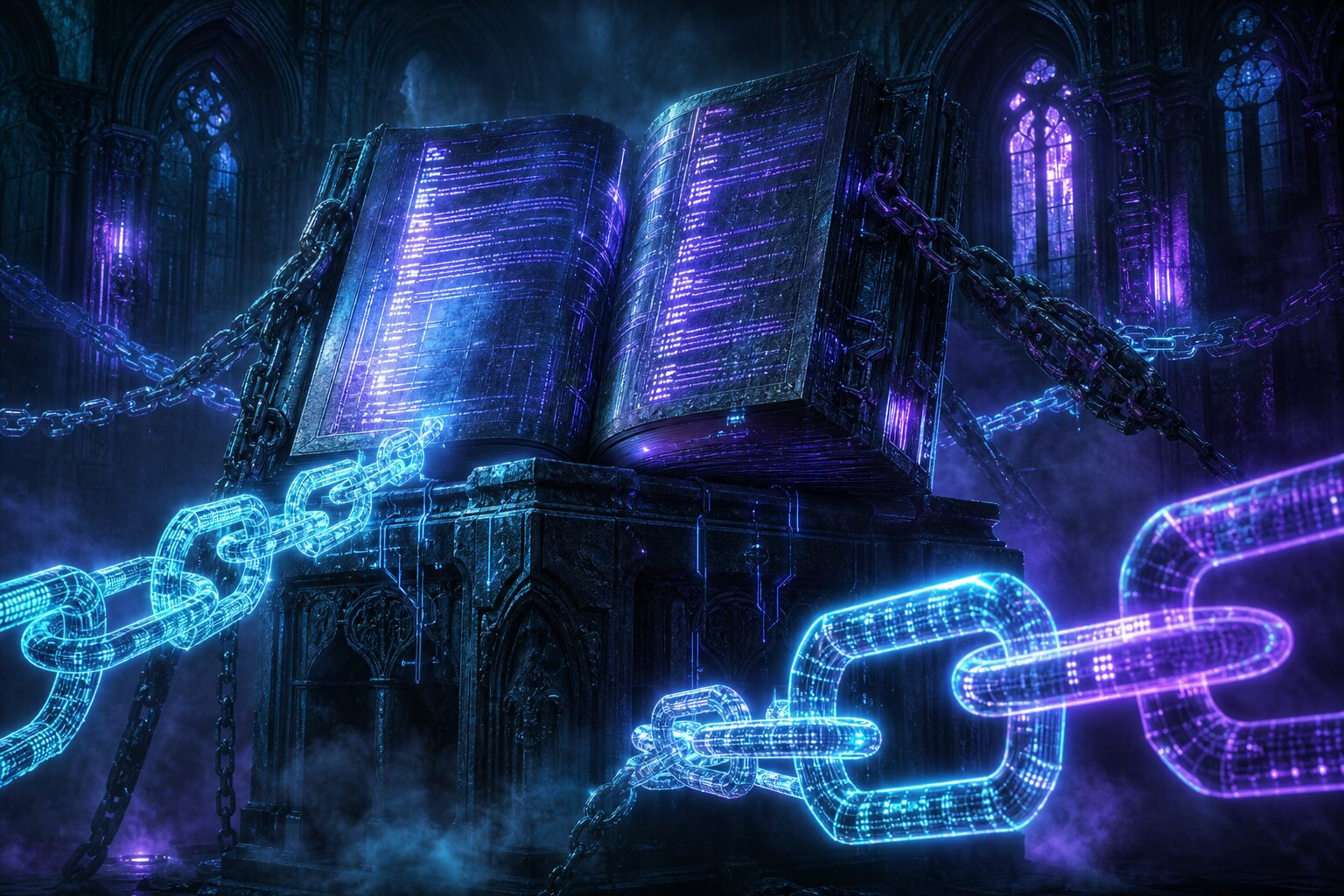
The visual subject of this article is a dark archive room. Glowing ancestral faces. Their wisdom projected as runbook light. This is not decoration. It is the architecture.
The archive room is the audit ledger. The faces are the incidents that were properly triaged, recovered, and audited. The light they project is the institutional memory — the pattern, the calibration, the rhythm — that illuminates the current operator’s path through the dark of an unknown failure. The archive room is dark because the incidents happen in the dark. The light comes from the ancestors because the ancestors are the only light that has already been through this darkness and come back.
North star principle 22 says it directly: place is a character. The brand speaks the dialect fluently and lets the ancestors ride. The archive room is a place. It is a character. It is the place where the fleet’s institutional memory lives — not as a database, but as a room with faces in it. The faces are the incidents. The light is the wisdom. The ride is the response.
From runbook to ancestral voice
The transition from runbook to ancestral voice is not a feature upgrade. It is a phase transition. The runbook is a document — static, waiting, external. The ancestral voice is a frequency — dynamic, immediate, internal. The transition happens through three compounding cycles:
Cycle one: exercise. The runbook is rehearsed. The fleet walks through the incident response under controlled conditions. The steps are learned. This is the runbook as document, exercised. The frequency is established but not yet stable.
Cycle two: application. The runbook is used during a real incident. The steps are followed, but the real incident introduces pressure, uncertainty, and judgment calls that the rehearsal did not cover. The post-recovery audit captures not just what was done, but what was decided and why. The record without end absorbs the incident. The ancestor begins to form.
Cycle three: compounding. The same type of incident recurs. The fleet does not start from the runbook. It starts from the audit ledger — the record of the last time this happened, the judgment that was made, the outcome that followed. The new incident is compared not against the document but against the ancestor. The ancestor says: last time you chose Tier 2 and it was enough. Last time you escalated to Tier 3 and it was too much. This time, the blast radius looks like Tier 2. Trust the pattern. The fleet trusts the pattern. The recovery is faster, cleaner, more coherent. The ancestor rides.
What customers actually buy
A customer of the sovereign stack is not buying a system that never fails. They are buying a system that has ancestors — that has been through enough incidents, recovered from enough failures, and audited enough recoveries that the institutional memory is deep. The customer is buying the ride. The ancestors that shape the response. The light that illuminates the archive room.
The customer dashboard (S6.7) can expose this: recovery tier history, escalation accuracy, time-to-recovery trends. Those are not metrics about the system’s uptime. They are metrics about the system’s memory. A system with deep institutional memory recovers faster because the ancestors ride alongside. A system without institutional memory recovers slower because every incident is a first encounter. The difference is not code. It is wisdom. And wisdom compounds with repetition.
The ancestors ride. The archive room glows. The runbook light illuminates the dark. This is not metaphor for incident response. This is incident response — the accumulated wisdom of every past failure, riding alongside every current recovery, compounding with every turn of the spiral. The fleet that lets the ancestors ride is the fleet that survives the dark.
Grounded in the SECTOR9 north star principles — Place is a character (22), Wisdom compounds with repetition (19), Everything is a record; continuity beats completion (7) — and extending the S7.11 incident response / recovery runbook into ancestral institutional memory for autonomous agent fleets. S7N series, sector7-grounded track, SECTOR9 50+50.