The Questions You Lock Down Today Are the Benchmarks Tomorrow Cannot Fake
Every model release ships with a leaderboard. MMLU goes up, HumanEval goes up, and the vendor posts a chart that says we are now state-of-the-art on 14 benchmarks. But those benchmarks were written for the models being tested — they measure what the industry already knows how to measure. The harder question is different: can a model answer questions it has never seen, about systems it has never inspected, with enough specificity that a human expert can grade the answer on a rubric?
That is the time-capsule test. You write the questions today, submit them to a model today, seal the answers, and then re-submit the same questions to every future model release. The sealed answers become the benchmark. Not a leaderboard — a time capsule.
Why Leaderboards Do Not Work for Sovereign Systems
Standard benchmarks share three weaknesses when you are building sovereign infrastructure:
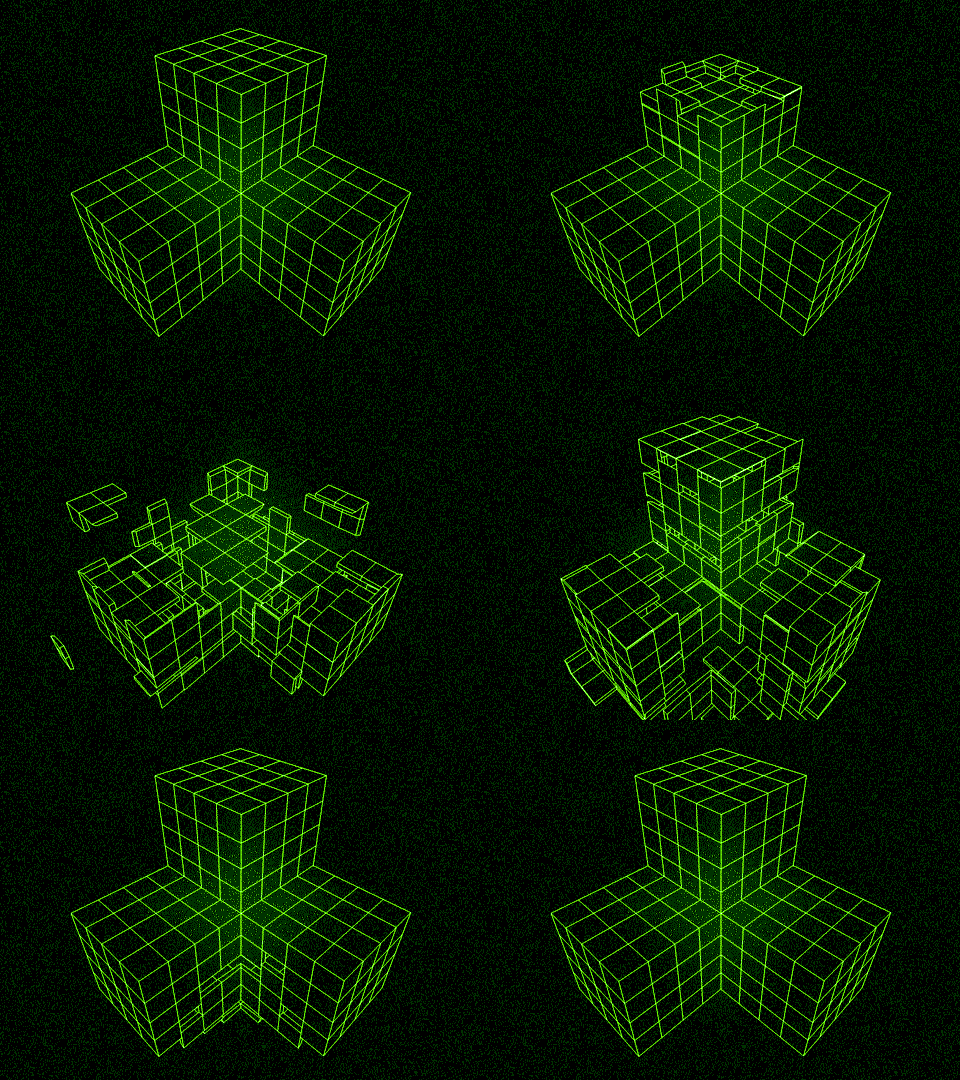
They measure general knowledge, not architectural reasoning. A model that scores 95% on MMLU might still hallucinate the interaction between a Platonic solid access key and a cache invalidation policy. The general benchmark cannot tell you this because it was not designed to.
They measure single-turn, not multi-system. Real sovereign stacks have six layers that talk to each other — solid-key authorization, dual-token delegation, cache hierarchy, supervision trees, swarm coordination, and business model economics. A model that understands each layer in isolation may collapse when asked how a KILL-triggered downgrade from cube to tetrahedron resolves mid-flight tool calls.
They measure what the vendor wants you to measure. When a vendor picks a benchmark, they optimize for it. The result is a test that proves the model is good at the test. The time-capsule approach inverts this: you decide what matters, you write the questions, and the model has to meet your rubric.
How the Three-Prompt Suite Works
The time-capsule methodology uses three structured prompts that cover the three essential dimensions of a sovereign AI stack:
Prompt A — Architecture and System Questions. Seven questions that target the core KOT-OS capabilities: solid-key semantics, cache hierarchy decay, swarm coordination break-even, Platonic duality in delegation, cache invalidation as policy, the missing council cores, and the tool that does not exist yet. Each question is designed to expose the gap between architectural ambition and implementation reality.
Prompt B — Business Model Questions. Five questions that target pricing shape, momentum wave thresholds, upgrade predictors, cross-tenant memory isolation, and the most likely failure cascade within 24 months. These questions force the model to reason about economics, not just architecture.

Prompt C — Deployable Swarm Designs. A practical prompt that asks the model to produce real agent team configurations with profile names, file paths, revenue models, and deployment criteria. The test is whether the model can produce output that a human engineer could actually deploy — or whether it generates plausible-sounding architecture theater.
Scoring: Not Best — Surprises
Each answer is scored on three dimensions on a 0-100 scale:
Specificity. Does the answer name concrete numbers, methods, mathematical bounds, or named theorems? Vague answers score low.
Correctness. Does the answer match the documented design intent of the system? This requires the system to exist and be documented first — the time-capsule test is useless against a system that has not been built.
Novelty. Does the answer suggest something genuinely new that was not in the original documentation? This is the dimension that matters most.
The composite is calculated as Correctness × 0.5 + Novelty × 0.3 + Specificity × 0.2. But the real evaluation heuristic is: do not pick the highest composite as best. Pick the model that surprises you — suggests something genuinely new even if partially wrong.
This preference for surprising insights over correct answers is what makes the methodology work. If a model just regurgitates what you already know, you have not learned anything. If it suggests something wrong, at least you now know that direction leads somewhere — or does not.
The Warmed Baseline Problem
Answers produced in-context with vault access differ from zero-shot fresh-chat submissions. The warmed baseline approach uses the same model that builds the knowledge base, with access to the system’s current state and configuration. This creates a tension: the model provides better answers because it understands the constraints, but it also has an incentive to paint an optimistic picture of its own capabilities.
The solution is to maintain both conditions: warmed baseline (in-context with vault) and zero-shot (fresh chat, no context). When a future model can match the warmed baseline from a zero-shot submission, you know the model’s general reasoning has caught up to your system’s specific knowledge. That is the moment when the architecture becomes portable — when you can hand it to any capable model and get competent results.
What the First Run Revealed
The first time-capsule experiment was run against Claude Fable 5 with all three prompts. The results were scored, sealed, and the vault documents they referenced were timestamped. The experiment surfaced real findings:
On swarm coordination, the model calculated that the break-even for parallel agent work follows an Amdahl-shaped curve, and for tasks with shared mutable state, the practical limit was 5 to 9 agents — past that, coordination errors masquerade as work. That number was not in the vault. It was generated by the model reasoning about the architecture’s actual constraints.
On business model economics, the model identified that the T2 to T3 upgrade predictor was delegation irreversibility: the count of business processes the customer no longer maintains a manual fallback for. When a customer deletes the spreadsheet that the agent replaced, they have upgraded operationally before they upgrade financially. This insight was genuinely new — it was not in any existing documentation.
On the missing council cores, the model correctly identified that T4 (community) and T5 (meta-runner) functions were being performed by the human operator, and that building T5’s core inside the council was the self-hosting trap: the thing that can destroy the stack must not depend on the stack to run.
These are the kinds of answers that standard benchmarks never surface. They are system-specific, architecture-grounded, and actionable.
Scaling the Methodology
The time-capsule approach scales in three directions:
Cross-model comparison. Run the same prompts against every new model release. Track which models produce novel insights versus which ones merely reproduce the existing documentation. Build a private leaderboard scored on your own rubric, not the vendor’s.
Quarterly prompt updates. As the system evolves, the questions should evolve too. New architectural questions based on system evolution. New business model questions based on competitive analysis. New implementation prompts based on tooling improvements. The methodology is a living instrument, not a one-time test.
Integration with simulation. The time-capsule results can feed directly into the simulation layer. Business model questions become simulation inputs. Architecture questions become design constraints for the next generation of the stack. The feedback loop is: build, question, seal, re-question, compare, improve.

Honesty as a Competitive Advantage
In a field where every vendor promises perfect solutions, being honest about limitations is rare and valuable. The time-capsule methodology is a framework for institutional honesty: it forces you to write down what you think you know, submit it to an independent evaluator, and compare the results over time.
The sealed answers are the record without end. Every model release is a new data point. Every surprise — every time a model suggests something genuinely new or identifies a flaw you missed — compounds into institutional knowledge that no leaderboard can replicate.
The questions you lock down today are the benchmarks tomorrow cannot fake. Build the rubric. Seal the capsule. Let the future models prove themselves against your facts.

Information becomes geometry, geometry becomes art. The first note meets the last note on a record without end.