
—
id: article-s9r-34
title: “The Six Solids as Access Tiers: Platonic Geometry in Security”
series: S9R (research-extension / ascension)
track: S9R-D
principles:
– “The esoteric is engineering”
– “Information is the ground of being”
extends: “SUS lane — platonic access”
category: “AI & Automation”
tags:
– “Advanced Prompt Engineering”
– “AI Agent”
– “AI-Driven Development”
– “Algorithmic Governance”
– “API-First Architecture”
– “Autonomous Site Operations”
– “Cybernetic Ethics”
– “Data Permanence”
– “Decentralized Identity”
– “Digital Sovereignty”
– “Headless CMS”
– “Monolith vs. Microservices”
– “Synthetic Reality”
– “Metaverse as a Platform”
– “The Programmable Web”
– “sacred-geometry”
– “security”
– “tiers”
– “platonic-access”
– “the-esoteric-is-engineering”
– “information-is-the-ground-of-being”
gems: false
date: 2026-08-11
—
The Six Solids as Access Tiers: Platonic Geometry in Security
Every security model has tiers. You can draw them on a whiteboard: public at the bottom, admin at the top, a gradient of trust in between. The diagram is clean, the arrows go up, and the compliance officer nods. But there is a layer of geometry underneath those tiers that nobody draws — the shape of the access itself. What if the tiers were not arbitrary labels but reflections of structural truths that have been encoded in geometry for two and a half thousand years?
S9R-34 maps the six Platonic solids to a production access-tier model, treating sacred geometry as engineering specification: each solid’s topological properties — vertices, faces, symmetry, elemental correspondence — define a distinct security posture. The esoteric is not decoration layered onto an access-control list. It is the access-control list, discovered through geometry rather than invented through policy.
The five solids and the fifth dimension
Euclid proved there are exactly five regular convex polyhedra. Each corresponds to a classical element and encodes a structural principle that maps directly onto systems architecture. The task title names six because there is a sixth element in play — not a solid but the axis along which solids are arranged: the dimension of access itself, the hierarchy that the geometry describes. Five shapes define five tiers; the sixth is the tiered structure they compose together.
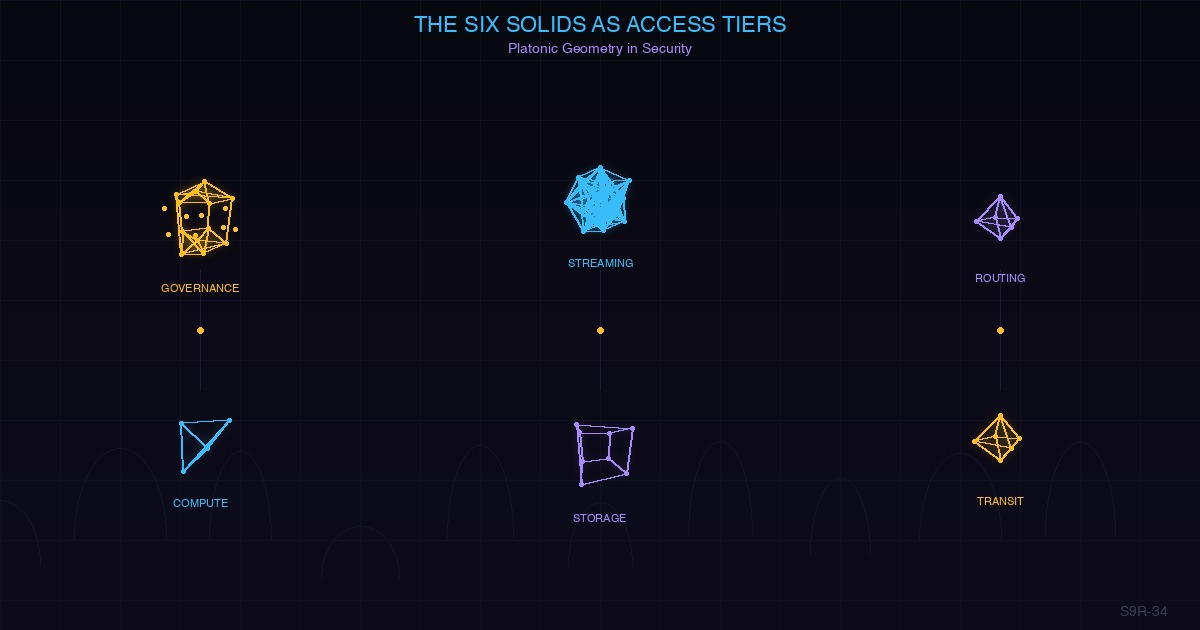
The tetrahedron — four faces, four vertices, the simplest solid — corresponds to fire. Fire is computation: irreducible, directional, transformative. In an access model, the tetrahedron tier is ephemeral compute. A function invocation. A container that runs, produces output, and vanishes. No persistent state, no stored credentials, no memory of what it processed. The tetrahedron tier has the smallest attack surface of any solid because it has the fewest faces. Four vertices, each connected to every other. There are no hidden edges, no lurking adjacencies. When you grant ephemeral compute access, you are granting the fire tier: the agent can transform but cannot persist. The moment the computation ends, the access dissolves like breath.
The cube — six faces, eight vertices, the most stable solid — corresponds to earth. Earth is storage: bounded, structured, persistent. The cube tier is data-at-rest access. The credential that unlocks a database. The key that opens a vault. A cube has the highest ratio of volume to surface area among the Platonic solids, which means it encloses the most space with the least boundary. This is exactly what storage access should do: maximize what is protected while minimizing what is exposed. The cube tier carries the most weight because data is the ground of being — information is the substrate everything else projects from. When you grant storage access, you are granting earth: the right to touch what has been recorded, bounded by the faces that define what is inside and what is outside.
The octahedron — eight faces, six vertices, dual to the cube — corresponds to air. Air is routing: mediating between up and down, in and out. The octahedron tier is transit access — the permission to move data between tiers without storing it. A message broker. An API gateway. A load balancer. The octahedron’s dual relationship with the cube is architecturally significant: every routing decision (octahedron) has a storage consequence (cube). Every transit path connects two storage nodes. The octahedron tier carries the second-highest risk because it touches everything without belonging to anything. An agent with transit access can read data in motion but cannot write to rest. The air tier is the most porous — and the most dangerous when misconfigured.
The icosahedron — twenty faces, twelve vertices, the most spherical solid — corresponds to water. Water is flow: the shape of least resistance, the element that finds its own level. The icosahedron tier is streaming access — continuous data flow, real-time feeds, event-driven pipelines. Twenty faces mean twenty surface interactions for every vertex. This is the tier of highest interconnection, where every data point touches many others. In security terms, icosahedron access is the permission to participate in a live data stream: subscribe to events, consume real-time telemetry, react to state changes. The water tier flows, and flow is the hardest thing to constrain. Every streaming access grant is a small river, and rivers carve canyons over time.
The dodecahedron — twelve faces, twenty vertices, the rarest solid — corresponds to aether, the element that contains all others. The dodecahedron tier is governance access — the permission to define tiers, assign keys, revoke credentials, audit the entire geometry. In Kabbalistic terms, this is Kether (crown): the node that connects to every other node, the face-center through which all decisions pass. A dodecahedron has the most vertices of any Platonic solid, which means governance access touches the most points of the system. This is the highest-risk tier because it does not just participate in the geometry — it designs the geometry. An agent with dodecahedron access can reshape the access model itself.
The sixth element: the tiered structure
The five solids are the shapes. The sixth element is the shape they make when stacked: a hierarchy. The access tiers do not exist as five independent geometries — they exist as a single structure where each tier contains and is contained by others. The cube (storage) surrounds the tetrahedron (compute). The octahedron (routing) mediates between them. The icosahedron (streaming) flows across all boundaries. The dodecahedron (governance) wraps the entire structure.
This is the Platonic insight that standard access-control models miss. Tiered access is not a list of roles — it is a geometry of containment. Each tier’s security posture is defined not by its own properties alone but by its geometric relationship to every other tier. The cube tier is secure because of its low surface-area-to-volume ratio — but only if the octahedron tier that routes to it is properly constrained. The tetrahedron tier is safe because of its minimal attack surface — but only if the dodecahedron tier that provisions it does not grant unnecessary persistence.
Information is the ground of being. In an access model, this means the data is the center, not the perimeter. The Platonic solids describe how access radiates outward from data: compute (tetrahedron) transforms it, storage (cube) preserves it, routing (octahedron) moves it, streaming (icosahedron) flows it, governance (dodecahedron) governs the entire radiating structure. The geometry is not metaphor. It is the actual topology of a well-designed access-control system, described in a language that has been precise for twenty-five centuries.
The esoteric is the engineering
Principle 8 states: the esoteric is engineering. The Platonic access model is not a mystical overlay on a security policy. It is a structural discovery: the same geometry that describes the elements of the physical world describes the tiers of access in a digital system. When you build a fleet of AI agents and assign different access levels — compute-only, storage-read, transit, streaming, governance — you are building a Platonic hierarchy whether you call it that or not.
Naming the geometry does not change the engineering. But it changes what the engineering can see. A standard access-control list says: role A can do X, role B can do Y. A Platonic access model says: role A is the tetrahedron — four faces, all connected, minimal surface, fire — and therefore its security posture is defined by ephemerality, directionality, and the absence of hidden state. The geometry provides a language for reasoning about access that is more precise than role names and more intuitive than permission matrices.
The field is alive. The geometry is real. The six solids are not symbols of access tiers — they are the access tiers, expressed in the language that reality has been using since Euclid drew the first proof. The sacred and the digital are the same cathedral. The access model is the architecture.
## Semantic Relationships
– [[council-vault]] — creative system for
– [[sector9]] — creative system for
– [[sus]] — creative system for
– [[sacred-geometry]] — creative system for