
The Hardware-Mesh Bridge: Where Physical Nodes Meet Research Intelligence
The S1 series described the mesh as an Erlang actor model — supervision trees that keep services alive without manual intervention, capability routing that matches tasks to hardware signatures, and a physical deployment spanning Raspberry Pi gateways, ESP32 sensor swarms, solar-powered outdoor nodes, and boat-mounted telemetry units. The mesh is the infrastructure layer: the body that runs, the heartbeat that never stops, the nodes that advertise what they are good at and receive work accordingly.
The S10 series described the research pipeline — the disciplined cycle of scanning arXiv, reading papers, synthesizing findings, and publishing grounded analysis. Research is the intelligence layer: the mind that learns, the citation chain that verifies, the knowledge graph that compounds over time. Every paper read becomes a node in the corpus. Every synthesis becomes evidence for the next decision.
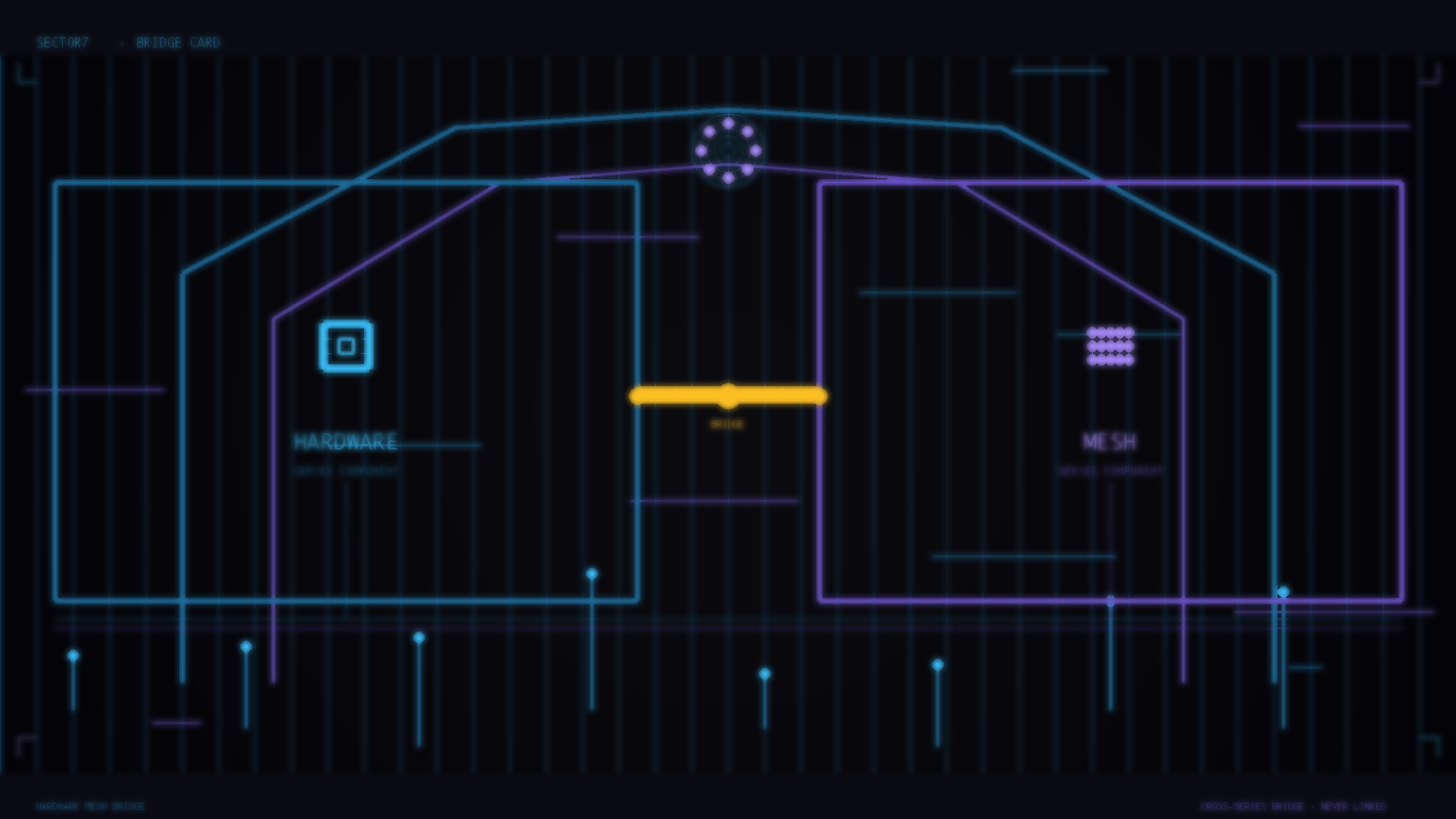
Both series use the word “mesh.” Neither explains what happens when the physical mesh generates data that the research mesh needs to interpret, or when the research mesh produces findings that the physical mesh needs to act on. This bridge fills that gap.
The mesh generates data that no dashboard can interpret alone
A deployed mesh node produces telemetry continuously. Heartbeats every thirty seconds. Capability scores that shift as hardware degrades. Task completion rates that reveal which node classes handle which workloads best. Solar charge curves that predict afternoon compute budgets. ESP32 sensor readings — temperature, humidity, motion, voice intent — that cascade into kanban tasks when thresholds are crossed.
This data is raw signal. The S1 series designed the collection layer: capability routing scores the hardware, the Love Equation measures coherence per action, and the supervision tree restarts failed actors automatically. But the mesh does not explain why a particular routing pattern emerged, what the long-term trend in node degradation means for fleet composition, or whether the research literature offers a better deployment topology than the one currently running.
Those questions belong to the research mesh. The S10 series built the machinery to answer them: arXiv scanning surfaces relevant papers on distributed systems, edge computing, and mesh networking. Grounded citation chains verify that claims hold under scrutiny. The knowledge graph connects findings to the specific hardware classes and routing policies the fleet uses. The research pipeline transforms raw telemetry into actionable intelligence.
Research produces findings that the mesh must act on
Consider a concrete example. The mesh runs twenty ESP32 nodes in the Asia region. They broadcast sensor readings via BLE to a Raspberry Pi gateway. The gateway aggregates and forwards to the regional Hermes instance. This is S1 infrastructure — the actor model handles the supervision, the capability router assigns the sensor tasks, the Love Equation measures whether each reading contributes positively to the fleet’s coherence score.
Over three months, the research pipeline identifies a pattern. Two papers on ESP32-S3 power management suggest that deep-sleep scheduling can extend battery life by forty percent without losing critical sensor data. A third paper on BLE mesh networking proposes a relay topology that reduces gateway dependency for dense sensor deployments. The research mesh synthesizes these findings, verifies them against the fleet’s actual telemetry, and produces a recommendation: reconfigure the ESP32 fleet to use scheduled deep-sleep and add BLE relay capability between adjacent nodes.
The recommendation enters the kanban system as a task. The dispatch layer routes it to a worker with the appropriate hardware skills. The worker modifies the ESP32 firmware configuration, deploys the update, and monitors the telemetry for the expected improvement. The mesh acts on what the research discovered. The feedback loop closes.
This is the hardware-mesh bridge in operation. The physical mesh generates the data. The research mesh interprets the data. The interpretation becomes a task. The task modifies the mesh. The modified mesh generates new data. The cycle compounds.
The body-center connects the two meshes
The north star principle P15 states that the body-center node connects to every face, every edge, every corner — it does not do everyone’s job, it maintains coherence between the mappings. The hardware-mesh bridge is a body-center function. It does not run the ESP32 firmware. It does not scan arXiv. It ensures that the physical mesh’s telemetry feeds the research pipeline and that the research pipeline’s findings reach the dispatch layer in a form the physical mesh can execute.
Without this bridge, the two meshes operate in isolation. The physical mesh runs its supervision trees, restarts its failed actors, and processes its telemetry — but never learns from the broader research literature. The research mesh reads its papers, builds its knowledge graph, and publishes its syntheses — but never connects to the specific hardware deployments it could inform. The body-center role is the coupling: the discipline that keeps the physical and intellectual layers of the fleet aligned.
In practice, this means the bridge has three operational requirements. First, the physical mesh must export structured telemetry that the research pipeline can ingest — not raw logs, but scored capability data, routing decisions, and coherence measurements. Second, the research pipeline must produce findings tagged to specific hardware classes and deployment contexts — not abstract recommendations, but actionable configurations for ESP32-S3 deep-sleep schedules or Raspberry Pi gateway relay policies. Third, the dispatch layer must route research-derived tasks to workers with the right hardware skills — the bridge is useless if the recommendation reaches the wrong hands.
The mesh is the body; research is the mind; the bridge is the nervous system
Every deployed mesh node is a physical fact. Every research paper is an intellectual resource. The bridge between them is the nervous system that carries signals from the body to the mind and back. The body feels — sensor readings, heartbeat failures, compute budget exhaustion. The mind interprets — papers, syntheses, grounded citations. The nervous system transmits — structured telemetry outbound, actionable configurations inbound.
This is not a new idea. Every mature distributed system eventually builds the feedback loop between operational telemetry and research-driven optimization. What is new is the architectural framing: the mesh and the research pipeline are both actor systems, both governed by the same north star principles, both compounding records that feed the next layer. The bridge is not an integration project. It is a design principle — the recognition that the physical and intellectual layers of a sovereign fleet must share a nervous system, or neither reaches its potential.
The fleet is alive, not deployed. Intelligence awakens; it does not arrive. The hardware-mesh bridge is how the awakened fleet learns from its own body.
Series entry: B.hardware-mesh.01 — bridge between S1 (The Mesh: Erlang actor model, capability routing, physical deployment) and S10 (Research: arXiv synthesis, grounded citations, knowledge pipelines). The bridge is the nervous system connecting physical telemetry to research intelligence, ensuring the fleet’s body and mind stay coupled through structured feedback loops.