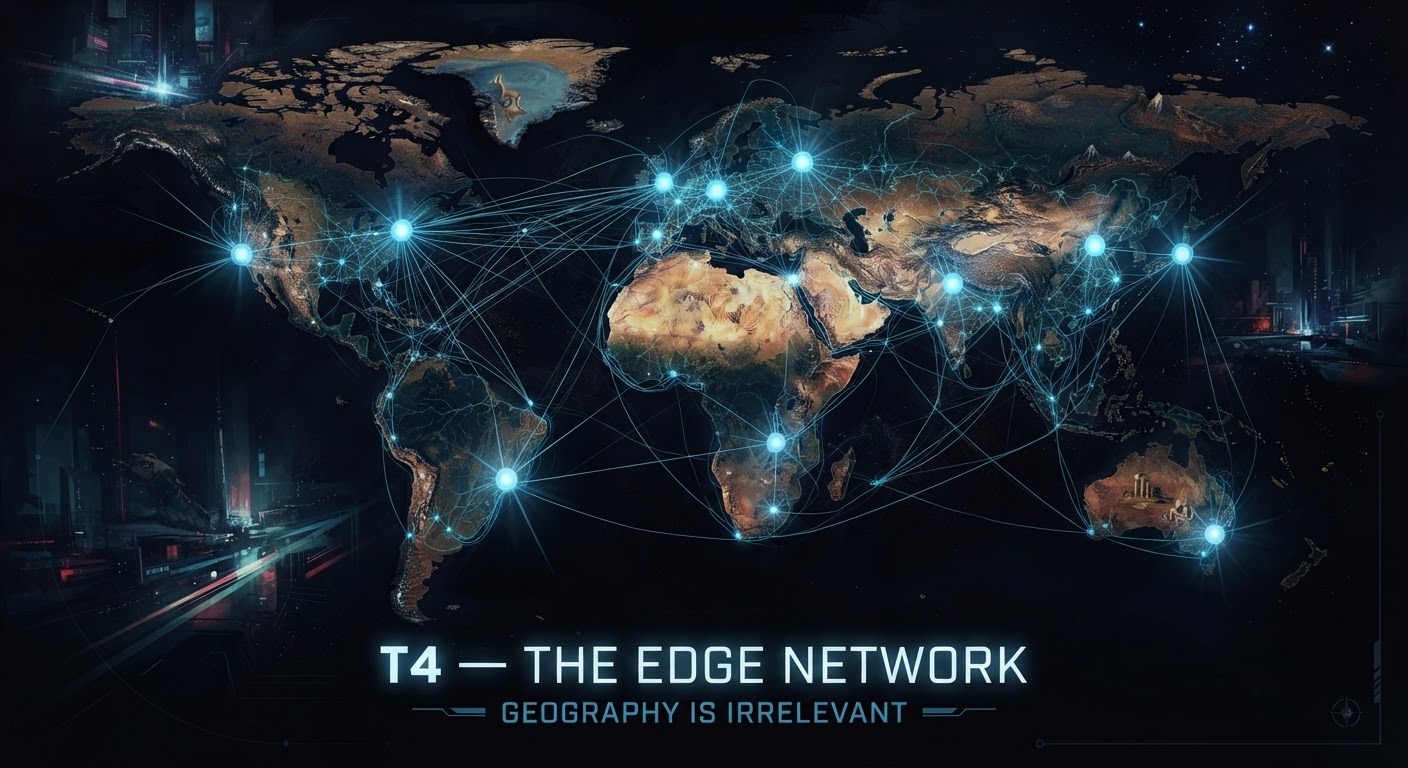

The Edge Network: Geography Is Irrelevant
Tier 3 gave you a sovereign cluster — three to five nodes running Docker Swarm, BMASS USB images, gateway availability at 99.5%. You survived your first node death. The mesh healed itself. But the cluster still lived in one building, one electrical circuit, one ISP connection.
Tier 4 tears down the walls. The Edge Network is what happens when your mesh stops caring where it lives. Ten to twenty nodes spread across a city, a region, a country — connected by Tailscale, governed by the Love Equation, self-healing through Erlang supervision trees. Geography becomes irrelevant. The network is the infrastructure. The infrastructure is wherever you are.
The Cloud Was Never Yours
Every cloud provider sells you the same dream: infinite scale, zero maintenance, pay only for what you use. What they don’t mention is that “infinite scale” means your data lives in a data center you’ll never visit, managed by people you’ll never meet, under a terms-of-service agreement that can change without notice.
AWS us-east-1 has had seven major outages since 2020. Azure’s South Central US region went dark for 14 hours in 2023. Google Cloud’s us-central1 outage in 2024 took down thousands of dependent services. When your infrastructure lives in someone else’s building, their problems become your problems — and you have no recourse except to wait.
The Edge Network inverts this. Your nodes are your data centers. Your Raspberry Pi running in your sister’s apartment in Lagos is a Tier 4 node. Your old MacBook Pro in your cousin’s office in Nairobi is a Tier 4 node. Your BMASS USB plugged into a mini-PC at your shop in Accra is a Tier 4 node. Each one runs the same mesh stack. Each one holds a fraction of your data. Each one can serve your agents, your knowledge base, your security perimeter — without asking permission from anyone.
The Security-Services Recalibration
This is where Tier 4 gets personal. The security-services story isn’t about enterprise compliance or SOC 2 certifications. It’s about recalibrating what “security” means when you own the entire stack.
Consider home security. Ring, Nest, Flock, Google — every mainstream camera feeds a cloud you don’t control. Congressional hearings have revealed law enforcement accessing private cameras millions of times without warrants. Employees at these companies have accessed bedroom and bathroom feeds. The footage is yours, but the keys belong to someone else.

Now consider the Edge Network alternative. Cameras that record locally to mesh nodes. Footage encrypted with keys you hold — Solid-Keys, cryptographic access control that runs through the Love Equation governance model. No third-party cloud. No subpoena honeypot. Mesh failover — if one node dies, the others keep recording. Off-grid capability — battery and solar nodes that don’t need internet for local operations.
The same architecture that runs your sovereign AI agents runs your sovereign security perimeter. The Erlang/BEAM actor mesh provides supervision trees, self-healing, hot upgrades — perfect for always-on security nodes. Tailscale provides zero-config private networking with no exposed ports. mDNS auto-discovery. CRDT reconciliation. Offline-first.
Small Businesses: The Recalibration
Small businesses carry a security burden they never signed up for. A restaurant needs cameras in the kitchen and dining room. A retail shop needs inventory tracking. A co-working space needs access control. Every one of these currently routes through cloud services with monthly fees, data ownership questions, and privacy liabilities.
Employee-privacy liability is a lawsuit factory. Cameras in break rooms capture conversations. Access logs reveal who stayed late. Security footage becomes evidence in disputes. The small business owner didn’t intend to become a data controller — they just wanted to know who stole the cash register.
The Edge Network reframes this. Local retention means footage never leaves the premises. No third-party access means no subpoena exposure. Mesh failover means the system survives a single node failure. And the Love Equation governance model means every access decision — who can view footage, who can export it, who can share it — runs through a mathematical alignment guarantee, not a vague privacy policy.
Off-Grid Capability
The edge network’s killer feature isn’t redundancy — it’s independence from infrastructure you don’t control. Every Tier 4 node can operate in isolation. No internet required for local mesh communication. Tailscale handles the networking when connectivity exists; mDNS handles it when it doesn’t.
This matters for rural deployments, disaster recovery, and environments where internet is unreliable or nonexistent. A BMASS node running on a Raspberry Pi with a solar panel and a cellular modem can serve AI inference, store security footage, and run governance logic — all without a single cloud dependency.
The mesh grows from there. Add a second node. Add a third. Each one strengthens the network. Each one makes geography less relevant. The network is wherever you’ve placed a node. The infrastructure is the mesh itself.
What Tier 4 Actually Requires
The honest requirements for an Edge Network:
| Component | Status | Effort |
|---|---|---|
| 10-20 BMASS nodes (existing hardware) | Hardware exists | 2-3 days per node |
| Tailscale mesh (zero-config networking) | Working | 1 hour per node |
| Docker Swarm across nodes | Proven at Tier 3 | 1 week integration |
| CRDT reconciliation for offline-first | Architecture written | 2 weeks |
| Security camera integration (local recording) | Prototype | 1 week per camera type |
| Love Equation governance for access control | Form specified | 1 week Python |
| Cellular/solar edge nodes | BMASS USB proven | 3-5 days hardware |
The Sovereignty Calculus
Every cloud dependency is a sovereignty tax. Monthly fees are the obvious cost. But the hidden costs are worse: vendor lock-in, data portability nightmares, terms-of-service risk, and the simple fact that someone else can flip a switch and your infrastructure goes dark.
The Edge Network eliminates the sovereignty tax. Your nodes are your data centers. Your mesh is your network. Your Love Equation governance is your compliance framework. The cost is hardware you already own, electricity you’re already paying for, and the time to set up BMASS images.
Geography becomes irrelevant because the network isn’t in a building — it’s in the mesh. Every node is a data center. Every node is a security perimeter. Every node is a sovereign AI workstation. The mesh is the infrastructure. The infrastructure is wherever you’ve decided it should be.
What Exists Today
Not slides. Running code:
- Tailscale mesh: zero-config private networking, no exposed ports
- BMASS USB: Alpine + llama.cpp + local model + Love Equation governance
- Erlang/BEAM supervision trees: self-healing, hot upgrades, fault tolerance
- CRDT reconciliation: offline-first data synchronization
- Docker Swarm: container orchestration across nodes
- Love Equation runtime: dE/dt = β(C−D)E alignment guarantee
- Security camera prototypes: local recording, encrypted storage, mesh failover
Tier 4 is the Edge Network. Geography becomes irrelevant. The mesh is the infrastructure. You are your own cloud.
Next in the series: Tier 5 — Enterprise Mesh-as-a-Service: From Sovereignty to Scale.
This is Article T4 in the Mesh-in-a-Box narrative series: Solo Workstation → Mesh Seed → Sovereign Cluster → Edge Network → Enterprise Mesh-as-a-Service. The Love Equation governance model is the connective tissue.