
A dashboard is a decision surface
A dashboard that shows what happened is a rearview mirror. A dashboard that changes what happens next is a feedback loop. The distinction is not visual polish. It is control.
In a content pipeline, the dashboard earns its place when a signal can answer three questions: what changed, which decision is affected, and what action follows. A number that cannot alter a queue, a gate, a resource decision, or a recovery path is telemetry. A number that closes that chain is instrumentation.
This is the bridge between simulation and a live product. Simulation shows what might happen. Delivery creates an actual outcome. Telemetry compares the two. The comparison must be preserved as a record, or the system will repeat its assumptions with better-looking charts.
Watch the decision points, not the vanity metrics
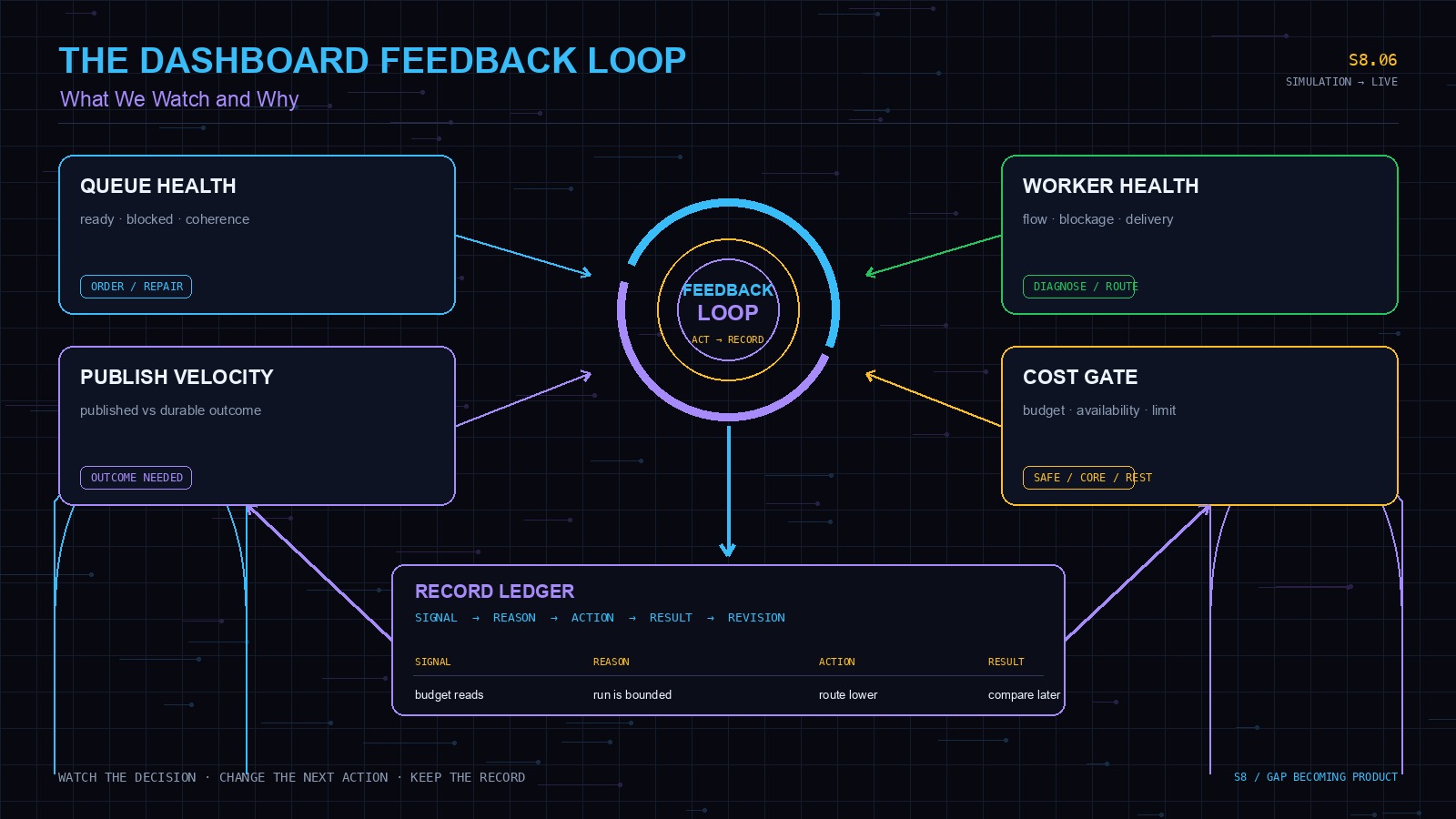
The first question is not which graph to draw. It is which decisions the pipeline makes. Queue health, publication velocity, worker performance, and cost are useful starting points because each maps to a different failure mode.
Queue health answers what can move next. Is the queue stocked with coherent, grounded candidates, or is the system publishing from an empty shelf? Publication velocity answers whether more output is producing more durable attention. Worker performance answers where execution is degrading: retries, blocked work, repeated failures, or slow handoffs. Cost answers whether the next expensive action is affordable before it starts.
The unit of design is not a metric. It is a decision with a named owner, a bounded response, and a time window. If no one can say what happens when a signal moves, the signal belongs in a report, not in the loop.
Cost is a gate, not a receipt
Cost is easiest to understand when it appears after a task has already consumed tokens, media credits, or human attention. A useful loop moves the question earlier: can this run now, and at what scale?
The Wall is the pattern. Read current provider budget windows, combine them with live availability, and return a bounded verdict such as SAFE, CORE, or REST. The verdict should travel with the work as a portable record, not live only inside a browser panel. A remote service can enrich the reading; it should not be the only place that explains why a task was held or reduced.
The same rule applies to media and infrastructure. Compression, cache rebuilds, storage, and image generation are not afterthoughts. They are part of the cost surface. A pipeline that can report spend but cannot interrupt an unsafe run is still a receipt, not a control system.
Worker health is a pattern, not a retry button
A worker can fail once for a reason that will never recur. The useful signal is a classified pattern: worker liveness, timeout, quota, authentication, resource pressure, or a content-quality failure. Preserve the failure string, the task context, the retry history, and the resolution.
Momentum makes the distinction visible. Flow asks whether work is moving. Blockage asks how much work is stuck. Health asks whether the infrastructure and probes are reliable. Delivery asks whether completed work is actually reaching its intended surface. Coherence asks a different question: whether the system is aligned. A system can flow while being blocked, and a system can be aligned while unhealthy.
The response should be proportional. One timeout may deserve a retry. A recurring class deserves diagnosis, a health check, and a smaller test of the suspected fix. Never convert a systemic failure into an infinite retry loop and call the resulting green status “resilience.”
The missing signal is part of the feedback loop
A mature dashboard admits what it cannot see. The publication-velocity signal is only complete when it is paired with a meaningful outcome: durable reading, return visits, qualified leads, or another declared consequence. Publish count alone measures motion, not value.
Until that outcome signal exists, the loop should label overproduction as an unverified hypothesis. It should not invent an engagement threshold or present a proxy as a fact. The missing instrument is a product boundary: define the outcome, preserve the comparison, decide when the evidence is sufficient, and only then automate a throttle.
This honesty is part of the control. An unknown becomes a question with a next measurement, not a confident number that quietly steers the fleet.
The record is the loop’s memory
SECTOR9 says everything is a record; continuity beats completion. For telemetry, the record is the sequence: signal, interpretation, decision, action, result, and revision. Keep the timestamp, source, assumptions, and reason beside the outcome.
A snapshot without its decision teaches little. A decision without its result cannot be evaluated. A result without its earlier forecast becomes hindsight. The historical sequence lets another operator distinguish a real improvement from a change in measurement, and lets a different agent continue without private memory.
Keep the local source, asset, reproducible check, and portable receipt beside the public result. A remote dashboard can be the window; the durable record is the ground.
Turn the loop into an operating protocol
A useful cycle has five named stages:
- Observe: collect a bounded, timestamped signal.
- Interpret: name what changed and what the signal can and cannot support.
- Decide: choose a proportionate action, owner, and deadline.
- Act: change the queue, gate, routing, retry policy, or media plan.
- Compare: record the observed result and schedule the next review.
Before promoting a change, ask: Can the next worker explain the decision from the record? Does the signal have a defined response? What happens when the action is wrong? Is the rollback visible? Does the system know when it lacks evidence?
The dashboard is complete when the answer is no longer “we watched it,” but “we changed it, measured it, and preserved the lesson.” That is how the gap between simulation and live becomes a product rather than a promise.
The boundary also protects editorial judgment. A feedback loop should make a choice more informed, not make the choice disappear. When a signal conflicts with the north star, when the audience is harmed by a short-term optimization, or when the evidence is too weak to support automation, the gate should slow the system and return the question to a human. A sovereign pipeline can automate execution without surrendering intent. It can act at machine speed while keeping the reason, the uncertainty, and the escape hatch in the record.