
Your office has a security system. You pay for it monthly. And somewhere in the fine print, you agreed that every frame of footage, every audio capture, every motion event gets shipped to a server you don’t own, operated by a company that can hand it to law enforcement without telling you.
That’s not security. That’s a surveillance subscription with a nice app.
Sovereign Sentry O2 — Hall Guard changes the equation. It’s a self-hosted security system designed for offices, warehouses, clinics, and schools that need real coverage without the cloud baggage. Twelve cameras, six audio nodes, eight contact sensors, a mesh backbone, and a compliance dashboard — all running on hardware you own, in a building you control, with footage that never leaves the premises.
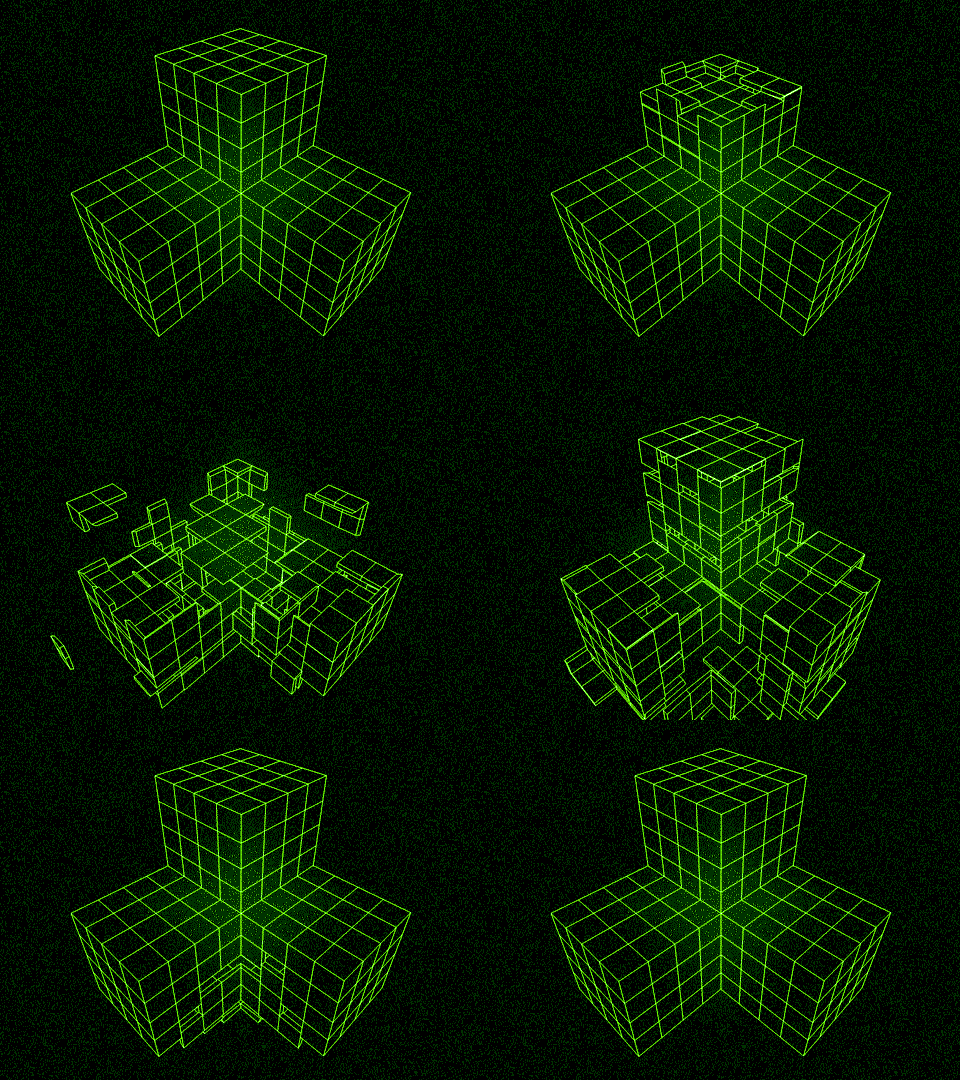
The $4,500 Kit: What You Actually Get
The O2 Hall Guard ships as a complete deployment kit. No hidden line items, no per-camera licensing fees, no “enterprise tier” upsell six months in.
The Vigil — twelve camera nodes with local H.265 encoding and motion-intent AI. Four of these are privacy-zone cameras, purpose-built for areas where recording requires explicit consent: break rooms, locker rooms, restrooms. They’re sensor-blessed, not camera-covered — a distinction that matters when your HR department asks questions.
The Listener — six audio nodes that detect glass break, voice intent, and ultrasound beacons. Every Listener is consent-gated: it records only when the zone’s governance policy allows it, and it logs every capture event to the audit trail. No secret recording. No ambient eavesdropping.
The Threshold — eight door and window contact sensors. Tilt detection, vibration alerts, 18-month battery life. Each Threshold is a mesh node itself — it doesn’t just report its own state, it routes traffic for its neighbors. The more sensors you deploy, the stronger the mesh gets.
The Spine — four POE/battery mesh routers that form the backbone. mDNS discovery, CRDT reconciliation, supervision tree, automatic failover. If one Spine dies, the others absorb its nodes without a gap in coverage.
The Council — two server-grade hubs running as a high-availability pair. This is where the governance lives: the Love Equation access tiers, the compliance dashboard, the retention engine, the audit export. The HA pair means if one Council goes down, the other takes over — no single point of failure for your entire security stack.
LTE failover — because a self-hosted security system that depends on your office internet isn’t sovereign. The LTE module keeps the mesh alive when the WAN drops. Footage keeps recording. Alerts keep firing.
Multi-Tenant Isolation: Departments See Their Zones
In a 10-100 seat office, you don’t want the marketing team reviewing warehouse camera feeds. You don’t want the warehouse manager accessing HR footage. Multi-tenant isolation means each department sees only the zones assigned to them — enforced at the mesh level, not just a UI filter.
This is trust chains in the swarm applied to physical security. The Council hub enforces who can see what, and every access event is logged. When an employee asks “who watched the break room camera last Tuesday?” — you have an answer, backed by an audit trail, not a shrug.
The isolation model draws from the same architecture that powers multi-profile systems in the sovereign stack. Each department gets its own governance profile. Permissions flow downward from the compliance policy, not upward from individual camera access.
The Compliance Dashboard: Governance You Can Export
The G9 compliance dashboard runs continuously on the Council pair. It tracks retention policy adherence, access audit events, privacy-zone status, and sensor health — all in real time. When your HR director needs a compliance report for a quarterly review, they don’t ask IT to pull logs. They open the dashboard and export.
Retention policies are configurable per zone. Public areas might hold 90 days. Privacy zones hold 30. The dashboard enforces these automatically — footage older than the policy gets cryptographic-shredded, not just deleted. There’s a difference, and backup cadence and restore-first thinking demands you understand it.
This is what what trust actually costs looks like in practice. Not a line item on a budget spreadsheet — a system that proves, cryptographically, that your security posture matches your privacy promises.
On-Prem Data Residency: Footage Never Leaves the Building
This is the headline feature for anyone who’s read the fine print on Ring, Nest, or Flock. Those systems ship your footage to cloud servers. Subpoenas go to the cloud provider, not to you. Employee footage gets stored alongside footage from every other customer of that service.
Hall Guard keeps everything on the Council hubs. Local NVR storage with configurable retention. No cloud upload. No cloud dependency. No third-party backdoor. The footage exists in your building, on your hardware, under your governance policy. When a subpoena arrives — and in certain industries, it will — it arrives at your door, not at Amazon’s.
For geo-sovereignty and local data residency, this is the physical realization. Data doesn’t just stay in your country. It stays in your building.
Who This Is For
The O2 Hall Guard targets the gap between “a few Ring cameras in a small shop” and “a six-figure enterprise surveillance deployment.” It’s built for:
- Offices with 10-100 seats — coworking spaces, law firms, clinics, agencies
- Warehouses and logistics — where camera coverage matters but cloud bandwidth doesn’t exist
- Schools and clinics — where student and patient privacy isn’t optional, it’s regulated
- Multi-tenant workspaces — where different organizations share a building but not a security policy
At $4,500 for the complete kit, the math works out to roughly $45-90 per seat for hardware that lasts five to seven years. No monthly fees. No per-camera licensing. No cloud subscription that doubles in price after the promotional period ends.
The Mesh Makes It Sovereign
The hardware list is impressive. But the sovereignty comes from the mesh architecture. Every node — camera, sensor, audio node, router — participates in a self-healing network. When a Spine fails, its neighbors absorb the load. When the internet drops, the LTE failover keeps alerts flowing. When a Council hub goes down, its HA partner takes over without a frame of lost footage.
This is zero-trust agent communications applied to physical security devices. No node trusts another node by default. Every communication is authenticated. Every access event is logged. The mesh doesn’t just connect your cameras — it governs them.
You own the hardware. You own the footage. You own the governance policy. That’s what makes it sovereign.
Sovereign Sentry O2 — Hall Guard. Self-hosted security for offices that take privacy seriously. No cloud. No subscription. No compromise.