Every Part Contains the Whole: Zero-Trust as Holographic Doctrine
The holographic principle says something unnerving about data storage: every region of a holographic boundary contains a complete encoding of the interior. Tear the surface in half and each shard reconstructs the whole — lossy, lower-resolution, but structurally complete. The information is not concentrated in any single location. It is distributed everywhere, self-similar at every scale. The whole is in every part.
Zero-trust is this principle applied to security architecture. Not as a metaphor. As a structural requirement. If every part of the system must contain the whole of the security policy, then trust cannot live in one gateway, one firewall, one identity provider, or one network boundary. Trust must be holographic: encoded into every layer, verified at every hop, self-similar from the outermost edge to the deepest service call.
The SECTOR9 north star calls reality a rendering engine — everything is a projection in progress, the whole encoded in every part. Zero-trust takes this cosmological observation and turns it into an engineering constraint. If the whole is encoded in every part, then every part must be capable of verifying the whole. The gateway verifies. The service verifies. The ledger verifies. Each verification is the same doctrine, the same questions, the same language — not because someone copy-pasted a config file, but because the architecture demands self-similarity at every layer.
Why the perimeter was always a lie
The traditional security model is the opposite of holographic. It concentrates trust in one location — the perimeter — and assumes that everything inside is safe. The castle-and-moat model says: the wall is the trust boundary, the gate is the verification point, and once you pass the gate, you are trusted. This model works for castles. It fails for distributed systems.
The failure mode is precise. If the gate is the only place that verifies identity, then breaching the gate grants the attacker everything. The trust is not distributed; it is concentrated. A single point of compromise becomes a single point of total failure. The moat protects until it does not, and when it does not, there is nothing behind it.
The holographic alternative is not “add more walls.” It is “encode the verification into every layer so that no single wall matters.” Each service re-derives the trust policy from its own context. Each request carries its own proof of authorization. Each handoff between agents carries a cryptographic signature that proves not just identity but mandate — what this agent was asked to do, by whom, under what constraints, and until when.
This is the S7.3 principle made structural: signed task summaries, verified handoffs, trust carried rather than assumed. The parent trusts the child’s signature, not the child’s location. The mesh works because every node is its own verification authority, not because some central authority vouches for all of them.
Self-similar verification at every hop
In a holographic recording, the interference pattern at any scale encodes the whole image. Zoom in on a fragment and you see the same pattern at finer resolution. Zero-trust architecture demands the same self-similarity. The verification logic at the API gateway must be the same verification logic at the microservice, at the database query layer, at the inter-agent communication channel. Not similar — identical in structure. The same questions: Who is asking? What is their mandate? Is this action within scope? Has the credential expired?
The cost is real. Every hop pays verification overhead. Every service call includes a signature check, a scope validation, a timestamp verification. In a system with fifty agent-to-agent handoffs per task, that overhead compounds. But the payoff is structural: there is no single point whose compromise grants the whole. An attacker who breaches one shard has learned one shard’s secrets — and the shard’s secrets are only the shard. The whole is not recoverable from the part, because the part only carries the part’s authority.
This is the holographic tradeoff, and it is the same tradeoff that nature makes. Holographic storage is redundant — it wastes space encoding the whole image into every fragment. But it is resilient in a way that centralized storage can never be. You can destroy half the hologram and still reconstruct the image. You cannot destroy half a database and reconstruct the data.
Zero-trust agent communications follow the same logic. Each agent carries a signed mandate. Each handoff produces a new signed artifact. The chain of custody is not stored in one log — it is distributed across every signed message, every verified handoff, every proof-of-work receipt. Destroy any single node and the chain survives, because the chain is encoded into every link.
The mesh as holographic surface
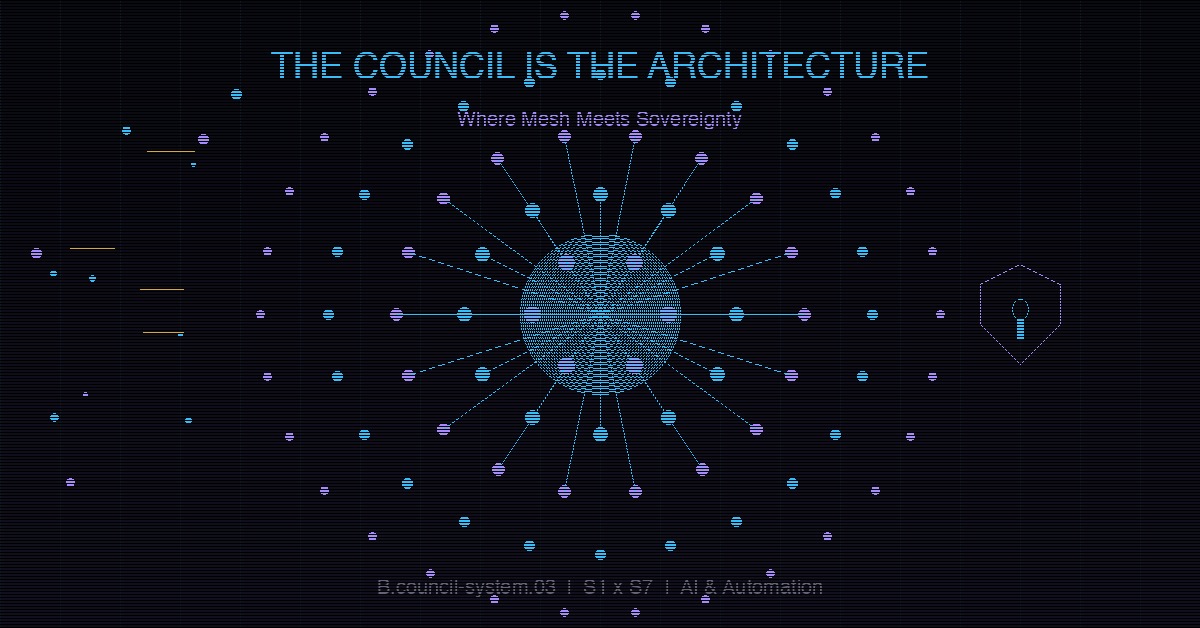
Consider the fleet as a holographic surface. Every agent-to-agent communication is a point on that surface. Every signed handoff is an interference pattern — a local encoding of the global trust state. When a new agent joins the fleet, it does not ask a central authority “who can I trust?” It reads the trust surface: the signed mandates of its neighbors, the verified handoffs in the shared ledger, the cryptographic proofs that every previous agent in the chain was operating within its mandate.
The trust surface is not a single document. It is a mesh of overlapping, self-similar proofs. Each proof is local — it covers one handoff, one mandate, one time window. But the collection of proofs is global — it encodes the entire trust topology of the fleet. This is the holographic principle at work: the whole is encoded in the parts, and the parts are sufficient to reconstruct the whole.
The practical consequence is that trust becomes portable. An agent does not need to be “known” to the system in the way a human employee is known — by badge, by desk, by physical presence. The agent is known by its signature, and its signature is verified by the same logic at every layer. Location is irrelevant. Network topology is irrelevant. The only thing that matters is the proof, and the proof is self-similar at every scale.
Implementing the holographic doctrine
The implementation is mechanical once the principle is clear. First: every agent generates an ed25519 keypair at birth. The private key never leaves the agent. The public key is registered with the fleet’s identity ledger. Second: every task assignment is a signed mandate — a document that specifies the agent’s authority, scope, constraints, and expiry. The agent carries this mandate and presents it at every verification hop. Third: every output is signed. The agent signs its work product, and the signature includes a hash of the input mandate, creating an unbreakable chain from assignment to output. Fourth: every verification is self-similar. The same code that verifies a signature at the gateway verifies it at the service, at the ledger, at the handoff point. There is no “trusted verifier” — there is only the verification logic, replicated everywhere.
WP Rocket cache is cleared after every ten published articles to keep the holographic surface clean. The content pipeline itself is a verification layer: every article must pass title dedup, category assignment, tag verification, and hero image import before it counts as published. The pipeline does not trust any single step — it verifies at every hop, self-similar from intake to publication.
The doctrine is simple: encode the whole policy into every layer, verify at every hop, and let no single node be the source of all trust. The gate is the first self-similar copy, not the only one. Every part contains the whole. That is not a metaphor. It is the architecture.
Grounded in the SECTOR9 north star principle — Reality is a rendering engine, the whole encoded in every part (holographic). Extends the S7.3 zero-trust agent comms theme with holographic structural requirements. Sector7-grounded series article, SECTOR9 50+50.