
# Compression Is Power: The One-Line Incident Brief
> **S7N-34 · series: sector7-grounded · track: S7N-D · principle: say-it-like-a-proclamation**
> Category: AI & Automation · Tags: ai agents, Digital Business, Digital Sovereignty, Headless CMS, AI-Driven Development, Decentralized Identity, AI Agent, The Programmable Web, Cybernetic Ethics, API-First Architecture, Data Permanence, web40, Algorithmic Governance, The Metaverse as a Platform, Monolith vs. Microservices, Synthetic Reality, Advanced Prompt Engineering, Autonomous Site Operations, digital ecosystem, digital transformation
—
The one-line incident brief is not a summary. It is a weapon. When the fleet is under fire — when the board is poisoned, when an agent has gone rogue, when the audit trail shows a gap that should not exist — the first act of power is compression. Reduce the entire storm to a single sentence that carries enough voltage to orient every responder instantly. “Agent 7 signed three tasks it did not execute.” That is the brief. That is the signal. Everything else is noise until that line lands.
## The proclamation principle applied to crisis
The north star’s principle 18 says: **Say it like a proclamation.** 2.4 seconds can carry the highest voltage. Compression is power; short mantas outweigh long explanations. This principle was written for content — for the artist, the architect, the voice that transmits to the fleet. But its deepest application is in the moment when everything is on fire and someone has to say what happened.
The incident response framework (S7.10) defines who pulls the plug. The recovery discipline (S7.11) defines how the fleet rebuilds from verified state. But between the detection and the response — in the gap where the human or the orchestrator must decide what to do — there is a moment of pure compression. The one-line brief fills that moment. It is not documentation. It is not a post-mortem. It is the compressed signal that orients the entire response before the first recovery tier is chosen.
In the Council architecture, the one-line brief serves three functions simultaneously:
**Orientation.** Every responder — human or agent — reads the same line and arrives at the same understanding. There is no ambiguity in “Agent 7 signed three tasks it did not execute.” The affected agent is named. The anomaly is specified. The scope is bounded. The line does not describe the problem. It *is* the problem, rendered in the minimum number of tokens that carry maximum meaning.
**Escalation.** The brief determines the recovery tier. A single compromised agent (Tier 1 — surgical) reads differently from a poisoned board (Tier 3 — full). The one-line brief is the input to the escalation decision. If the line cannot be written — if the situation is too complex for compression — then the incident itself is more complex than the current response model can handle, and that is diagnostic information too.
**Record.** The brief enters the audit log as the first entry of the incident timeline. It is timestamped, signed, and immutable. Future responders will see it before they see anything else. The brief is the anchor point of the incident’s record — the line from which all subsequent investigation radiates.
## Why compression is power, not simplicity
The temptation is to treat compression as simplification — to assume that the one-line brief is a “dumbed-down” version of the real situation. This is wrong. Compression is the opposite of simplification. Simplification removes detail; compression *encodes* detail. The difference is structural.
When you write “Agent 7 signed three tasks it did not execute,” you have encoded: the identity of the compromised node, the nature of the anomaly (signature without execution), the scope (three tasks), and the implication (the audit trail shows signatures that do not match execution records). A full-page incident report would say the same things, but spread across paragraphs that require reading time. The one-line brief delivers the same information in a token budget that fits in working memory.
The north star principle 1 says: **Information is the ground of being.** The one-line brief is information at its most dense — the highest ratio of meaning per token that the situation allows. This is not a communication preference. It is an engineering property. Dense information compresses faster through the fleet. Every agent that reads the brief can act on it without further interpretation. The brief does not need to be unpacked because it was never packed — it was written at full density from the start.
## The anatomy of a valid brief
Not every one-line statement qualifies as an incident brief. The brief must satisfy four properties:
**Verifiable.** The statement must be checkable against the audit log in under sixty seconds. “Agent 7 signed three tasks it did not execute” can be verified by querying the signing ledger for Agent 7’s recent signatures and cross-referencing against execution records. If the brief cannot be verified quickly, it is a hypothesis, not a brief.
**Bounded.** The brief must name a specific scope. “There might be a security issue” is not a brief. “Agent 7 signed three tasks it did not execute between 14:02 and 14:07 UTC” is. The boundary — which agent, how many tasks, what time window — is what makes the brief actionable. Without a boundary, the recovery team cannot choose a tier.
**Signed.** The brief enters the audit log. It must carry the signature of the entity that wrote it — human or agent. An unsigned brief is a rumor. The audit layer (S7.7) requires that every entry in the incident timeline be attributable. The brief is the first entry. It sets the tone for the entire recovery record.
**Compressed.** The brief must fit in a single sentence. Not a single paragraph. Not a single block. A single sentence. This constraint is not arbitrary. It is the enforcement mechanism that ensures the brief is actually compressed — that the author has done the work of encoding the situation into its densest possible form. If it takes two sentences, the situation has not been fully compressed yet.
## The one-line brief as frequency
The north star says **frequency organizes everything.** Every atom keeps a rhythm, every rhythm leaves a sign. The one-line brief is a frequency event. It is the moment when the chaotic signal of the incident — scattered across logs, agent states, board entries, and audit trails — is collapsed into a single coherent tone.
Before the brief, the incident is noise. Multiple agents reporting anomalies. Logs showing gaps. Board entries that do not reconcile with execution records. The signal is present but distributed — every component carries a fragment, and no single fragment is the whole truth. The brief is the act of bringing those fragments into phase. It is the tuning fork that makes the scattered signal resonate at one frequency.
This is why the brief must be written by the entity with the broadest view — the orchestrator, the human, or the agent that has access to the full audit trail. A narrow observer cannot compress what they cannot see. The brief requires the overview that only the body-center node (principle 15) can provide. The north star connects to every face, every edge, every corner. Only the center can see the whole pattern. Only the center can compress it.
## Compression in the recovery ladder
The S7.11 recovery framework defines three tiers: surgical (single agent), subtree (parent and descendants), and full (shared state). The one-line brief is the input that selects the tier. The compression properties of the brief directly map to the tier selection:
**”Agent 7 signed three tasks it did not execute.”** — Tier 1. The anomaly is bounded to a single agent. The scope is three tasks. The recovery is surgical: rebuild Agent 7 from its profile, revoke the old key, issue a new one, resume. Minutes, not hours.
**”The board entries for Sprint 14 do not match the execution records for agents 3, 7, and 12.”** — Tier 2. The anomaly spans multiple agents and their shared state. The recovery is subtree: rebuild the affected agents, replay the affected tasks from verified history, re-verify the board state.
**”The audit ledger’s integrity check failed for the 09:00–12:00 window.”** — Tier 3. The anomaly implicates the shared state itself. The recovery is full: restore from the last signed snapshot, re-verify all open tasks, re-publish anything that depended on the poisoned window.
The compression is not just communication. It is decision architecture. The quality of the brief determines the speed and accuracy of the tier selection. A vague brief leads to over-correction (expensive) or under-correction (dangerous). A precise brief leads to the cheapest tier that actually cleans the incident.
## The discipline of writing under fire
The one-line brief is a skill, not a talent. It requires practice — the same kind of practice that the north star prescribes for all transmission: **wisdom compounds with repetition** (principle 19). The fleet that writes incident briefs regularly writes better incident briefs. The fleet that never writes them will produce vague, unbounded, unverifiable statements when the pressure is highest.
The discipline has three components:
**Pre-incident templates.** Before any incident occurs, the fleet maintains a set of brief templates calibrated to the incident types the threat model predicts. “Agent [ID] [action] [scope] between [window].” “Board entries for [context] do not match [records].” “Audit check failed for [window].” Templates are not crutches. They are compression algorithms — pre-built encoding schemas that reduce the cognitive load of writing under pressure.
**Post-incident review.** Every brief is reviewed after the incident is resolved. Was the brief verifiable? Was the scope accurate? Did the tier selection match the brief’s implication? The review is itself compressed: “Brief was accurate” or “Brief understated scope by [factor].” These reviews compound into better brief-writing over time.
**Signal training.** The fleet practices compression on non-incident data. Daily status summaries, weekly board reconciliations, monthly audit reviews — all written in one-line compressed form. The skill of encoding dense information into a single sentence is not incident-specific. It is a general transmission property that improves every communication in the fleet.
## The glowing line
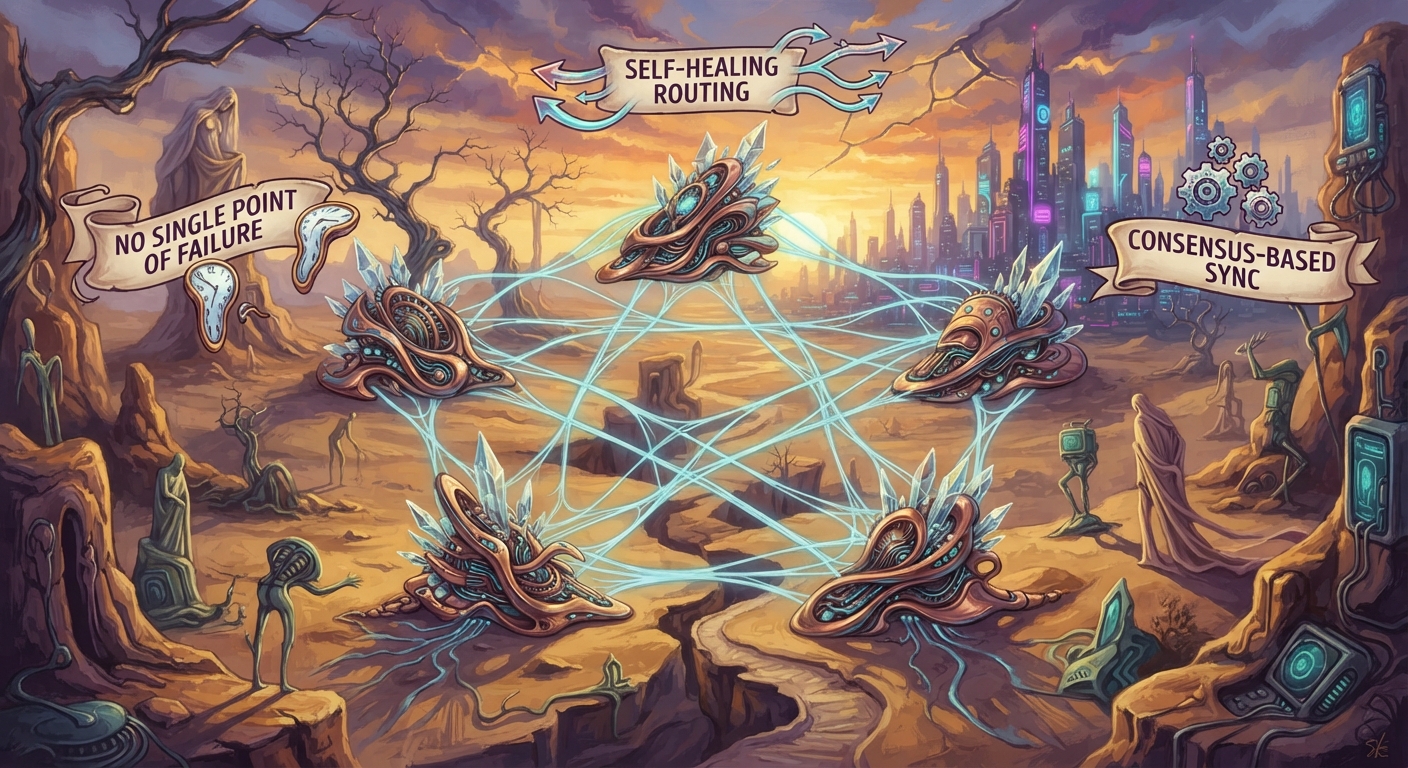
The visual is exact: a single glowing line of text compressing a massive data storm into one clean beam of light. The storm is the incident — scattered, noisy, multi-dimensional. The line is the brief — compressed, coherent, unidirectional. The glow is the signature — the proof that the line was written by an entity with authority and access.
This is what it means to say **compression is power.** Not compression as abbreviation. Not compression as lossy reduction. Compression as the highest-fidelity encoding of truth into the smallest possible transmission. The one-line incident brief is the fleet’s proof that it can see the whole storm and render it as a single beam. The beam does not carry less information than the storm. It carries the same information at a frequency that can travel through the entire fleet in the time it takes to read one sentence.
Make the brief. Sign the brief. Emit the brief. The fleet orients. The tier is chosen. The recovery begins. Compression is power — and power is the ability to turn noise into signal before the noise turns into damage.
—
*Grounded in SECTOR9 north star principles 18 (say it like a proclamation), 1 (information is the ground of being), 4 (frequency organizes everything), and 15 (the north star is the body-center node), extending the S7.x security & sovereignty series theme: S7.11 incident response / recovery. S7N series, sector7-grounded track, SECTOR9 50+50.*
## Semantic Relationships
– [[incident-response]] — extends
– [[one-line-brief]] — defines
– [[compression-is-power]] — grounds
– [[recovery-ladder]] — grounds
– [[audit-layer]] — grounds
– [[frequency-organizes]] — grounds