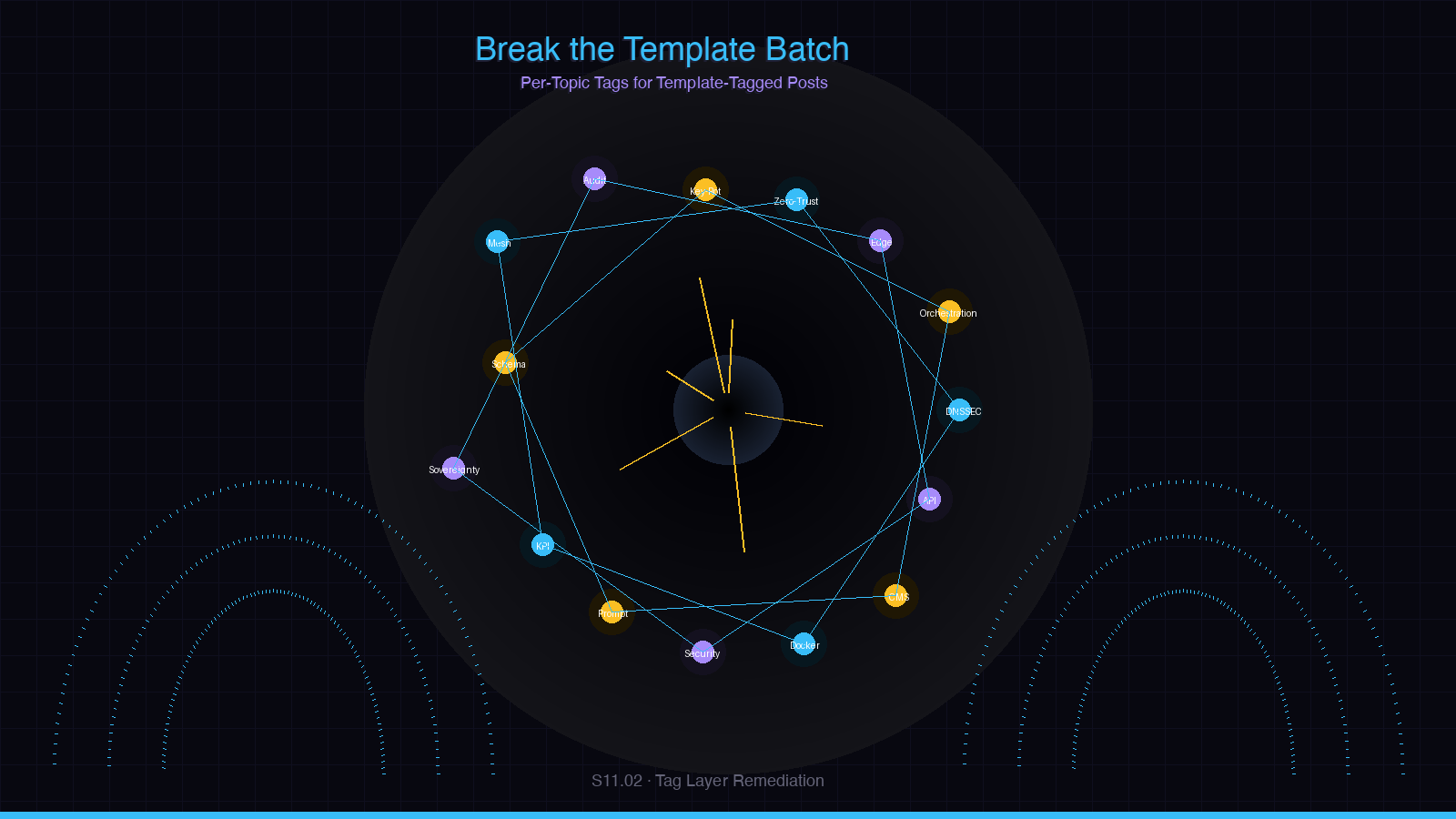

Break the Template Batch: Per-Topic Tags for Template-Tagged Posts
Fifty-four posts wear the same face. They were published in a single batch, and every one of them received the same fifteen tags — not because the tags fit, but because the pipeline assigned them as a group. The result is a cluster of posts that look identical to the taxonomy. A post about API-first architecture carries the same tags as a post about headless CMS. A post about digital sovereignty wears the same labels as one about microservices. The tag layer cannot tell them apart. The graph routes them as a single node instead of fifty-four distinct ones. The template batch is not a taxonomy. It is a uniform that strips each post of its individual voice.
The anatomy of a template batch
A template batch occurs when a content pipeline assigns a fixed set of tags to every post in a publish run, regardless of topic. In the Lucid Hive corpus, this happened during the Round B stress test and the Round E share-pool series. The pipeline was optimized for speed: assign the standard fifteen tags, publish, move on. The result was efficient publishing but broken classification. Fifty-four posts received identical tag sets. Another batch received a different but equally uniform set. Together, these template-tagged posts form a block in the taxonomy — a wall of uniformity that the graph cannot see through.
The template set itself is not wrong. It contains legitimate terms: AI Agent, API-First Architecture, Headless CMS, Digital Sovereignty, and others. These are real topics the corpus covers. The problem is that every post in the batch received all of them. A post about DNSSEC received the same tags as one about prompt engineering. A post about Docker Swarm persistence received the same labels as one about KPI dashboards. The tags are accurate for the corpus as a whole but inaccurate for any individual post. They are a census, not a classification. They describe what the collection contains but not what any single member is about.
Why the graph breaks
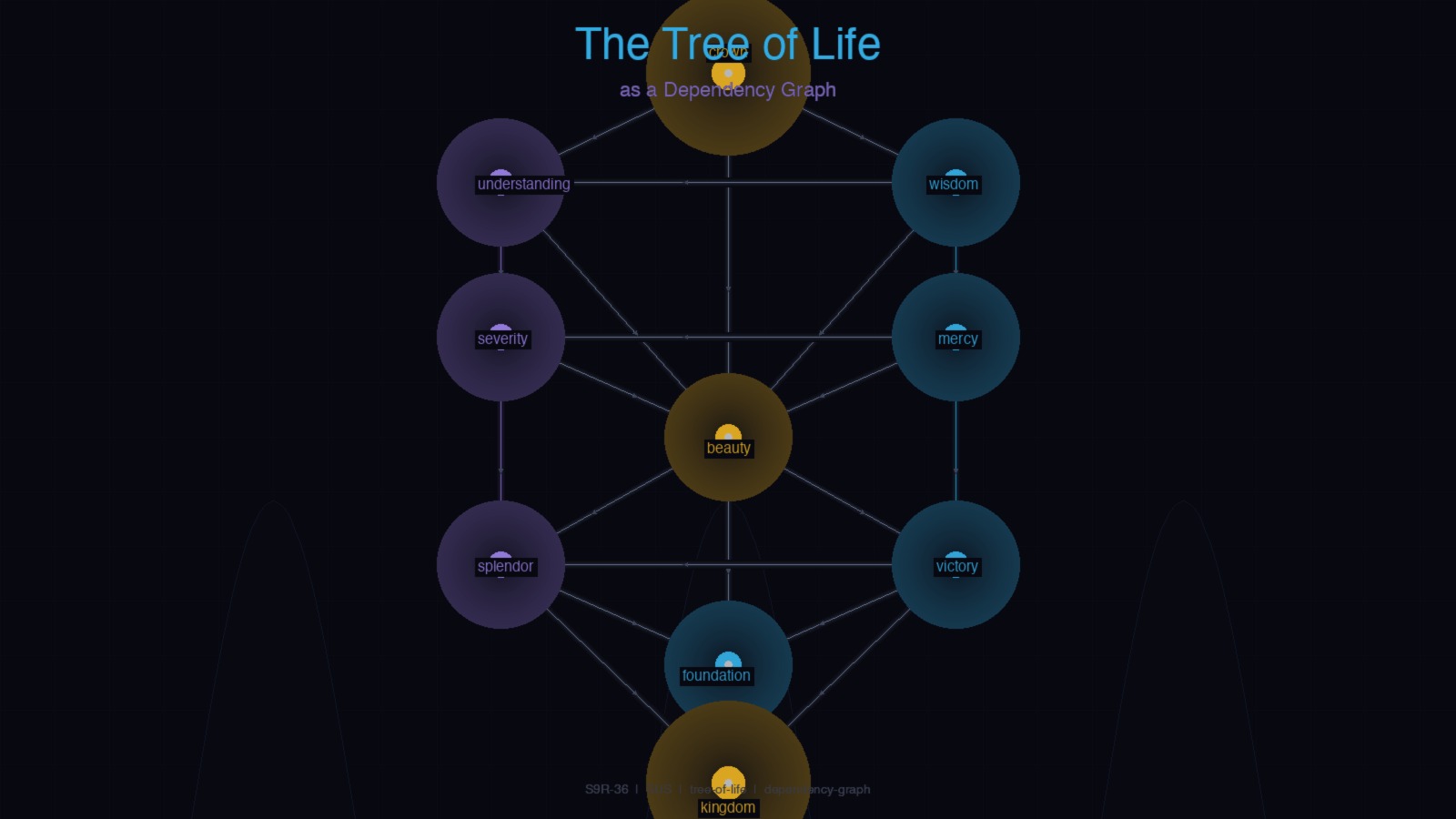
The knowledge graph depends on specificity. A post tagged with “DNSSEC” connects to other posts about DNS security. A post tagged with “prompt engineering” connects to the creative pipeline cluster. When both posts carry the same fifteen tags, the graph cannot route between them. They become a single blob — fifty-four posts wearing one face, indistinguishable from each other and from the 127 posts with empty tag fields. The graph wants to be a network. The template batch turns it into a warehouse.
This is not a theoretical problem. The MASTER-INDEX-BRIDGE shows 181 out of 239 posts with untagged or improperly tagged content. The 54-post template batch is the largest single contributor. When these posts receive per-topic tags, the graph gains 54 new sets of edges. The taxonomy gains 54 new data points for discrimination. The content system gains 54 new paths for discovery. The holographic principle — the whole encoded in every part — requires that every node connects to the nodes that share its subject matter. Tags are how those connections are made. A template batch is how they are broken.
The per-topic fix
The fix is mechanical but precise. Each of the fifty-four template-tagged posts must be read, its actual subject matter identified, and the template tags replaced with topic-specific ones. A post about DNSSEC gets DNSSEC, SPF, DMARC, email-authentication, and domain-verification. A post about Docker Swarm gets docker, swarm, persistence, containers, and overlay-network. A post about prompt engineering gets creative-prompt-engineering, image-generation, comfyui, and visual-pipeline.
The vetted tag set grounds every assignment in the wiki concepts — the actual topics the corpus covers. No more guessing. No more template blocks. Each post earns its own classification through its own content. The process is simple: read the post, identify its three to five core concepts, map each concept to a tag from the vetted vocabulary, assign the tags, move to the next post. Fifty-four posts. Fifty-four individual classifications. Fifty-four distinct voices restored to the taxonomy.
What the fix enables
When the template batch breaks, the graph transforms. Fifty-four posts that were previously indistinguishable become fifty-four distinct nodes with their own edges, their own connections, their own paths through the knowledge network. A reader searching for “DNSSEC” finds the DNS post. A reader searching for “prompt engineering” finds the creative pipeline post. An agent traversing the graph to answer a question about API-first architecture finds the right post instead of a random member of a fifty-four-post blob.
The fix also stabilizes the category layer. Currently, the nineteen category labels barely discriminate — 97% Metamaterial, 80% Web Technology, 73% AI & Automation. When posts carry real topic tags, the category labels can be evaluated against actual content rather than template assignments. The category cleanup (S11.03) depends on the tag layer being honest first. You cannot collapse nineteen categories into eight if the posts carrying those categories are wearing template uniforms instead of real classifications.
The template batch is the highest-friction artifact in the taxonomy. It is the largest single source of classification noise. Breaking it is not optional. It is the prerequisite for every subsequent cleanup. The graph cannot be honest until every post carries its own voice. The fifty-four template-tagged posts have been speaking in unison. It is time to let them speak individually.
S11.02 in the Tag Layer Remediation series. Grounded in the SECTOR9 north star principles P1 (Information is the ground of being) and P7 (Everything is a record; continuity beats completion). Cluster: cl-tag-layer-remediation. The template batch of 54 posts with identical tag sets is the highest-friction artifact in the taxonomy: per-topic tags restore individual voice to each post and make the graph queryable. Category: AI & Automation.