
AI Employees vs AI Toys: What Production Looks Like
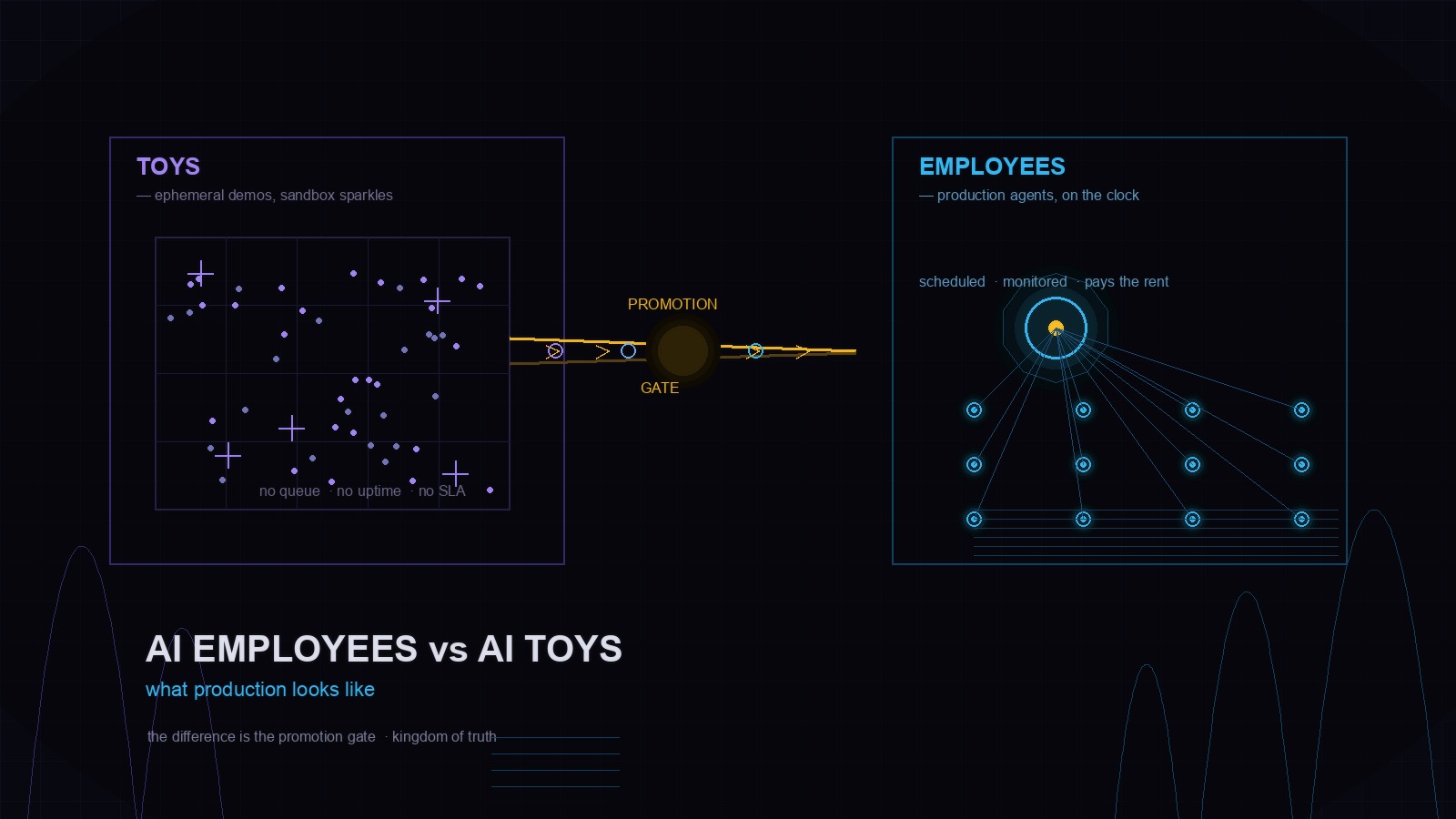
Every AI demo looks impressive for thirty seconds. A chatbot answers a question. A wrapper calls an API and formats the output. A prompt generates an image. The audience applauds. The tweet goes viral. And then someone asks the system to do it again tomorrow, at 3 AM, without a human watching, with different inputs, under load, and it falls over. The gap between a demo and a deployment is the gap between an AI toy and an AI employee. Most of the industry is still building toys.
What a toy looks like
An AI toy is a system that works when everything goes right. The prompt is carefully crafted. The input is sanitized. The output is reviewed by a human before anyone sees it. The system has no memory of previous interactions, no concept of failure modes, no retry logic, no state management. It is a function call with a nice interface.
Toys are everywhere. Every “AI-powered” feature in a SaaS product that is really just a GPT wrapper with a system prompt is a toy. Every chatbot that loses context after three messages is a toy. Every image generator that produces beautiful results for English prompts and garbage for everything else is a toy. The toy does not know it is a toy. The human using it does not know it is a toy — until the day it needs to work without supervision and discovers it cannot.
The defining characteristic of a toy is that it requires a human in the loop at every decision point. Not because the human adds value, but because the system has not been built to make decisions on its own. The human is not an operator. The human is a crutch.
What an employee looks like
An AI employee is a system that works when things go wrong. It has memory — not just a context window, but persistent state that survives restarts, carries across sessions, and accumulates over time. It has tool access — not just a single API call, but a repertoire of capabilities it can invoke based on the situation. It has fault tolerance — retry logic, graceful degradation, error classification, and the ability to distinguish between a transient failure and a permanent one.
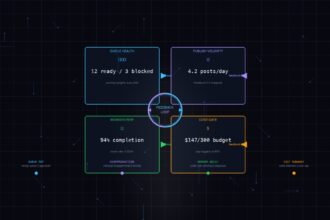
The Council architecture demonstrates what this looks like at fleet scale. The kanban board at ~/.hermes/kanban.db is not a project management tool. It is a state machine. Every task has a lifecycle: created, claimed, running, completed, failed, blocked. The dispatcher does not ask a human what to do next. It reads the board, checks dependencies, resolves priorities, and spawns workers. When a worker crashes, the system detects it, increments a failure counter, and either retries or escalates. No human intervention required.
This is the difference between a toy and an employee at the infrastructure level. A toy runs when you press the button. An employee runs when the work needs to be done, handles its own failures, reports its own status, and escalates only when it genuinely cannot proceed.
The memory boundary
The most significant architectural difference between toys and employees is memory. A toy has a context window — a fixed amount of text it can hold in working memory. When the context window fills up, the toy forgets everything that came before. It starts fresh every conversation. It cannot learn from its mistakes because it does not remember making them.
An employee has persistent memory. The Council stack uses three layers: SQLite for task state, ChromaDB for vector memory, and Obsidian vaults for structured knowledge. Each layer serves a different purpose. SQLite tracks what happened — task creation times, completion rates, error patterns. ChromaDB stores semantic associations — which concepts relate to which, which approaches worked for similar problems. The Obsidian vault holds the knowledge base — documentation, procedures, decisions, and their rationale.
When an AI employee encounters a problem it has seen before, it can retrieve the previous solution from memory. When it makes a mistake, the mistake is recorded and the pattern is available for future encounters. This is not just convenience. It is the difference between a system that improves over time and a system that repeats the same errors indefinitely.
The north star says intelligence awakens; it does not arrive. A toy arrives — it is shipped as a finished product with fixed capabilities. An employee awakens — it starts with baseline capabilities and develops expertise through accumulated experience. The memory system is how that accumulation happens.
The tool problem
A toy typically has one tool: a language model API. It receives text, processes it, and returns text. The entire capability surface is the model’s training data plus whatever context the prompt provides.
An employee has a toolkit. The Hermes agent framework provides terminal access, file operations, web search, browser automation, code execution, and the ability to delegate subtasks to specialized workers. Each tool is a capability that extends the employee’s reach beyond text generation. The employee does not just answer questions — it takes actions, modifies state, and produces artifacts.
This is what production looks like. The system does not describe what it would do. It does what needs to be done. It reads a file, modifies it, runs a test, checks the result, and reports back. It searches the web, extracts relevant information, synthesizes findings, and writes a report. It spawns a subagent to handle a parallel task while it continues working on the primary objective.
The tool surface is also what makes the system sovereign. A toy that only calls a single API is dependent on that API. An employee that runs on local infrastructure, accesses local files, and executes local commands is not dependent on any external service for its core operations. The tools are the sovereignty.
The failure question
The question that separates toys from employees is simple: what happens when it breaks?
A toy breaks silently. The API returns an error. The user sees a generic message. Nobody knows what went wrong, why it went wrong, or how to prevent it from happening again. The toy has no concept of its own failure modes because it has no monitoring, no logging, and no escalation path.
An employee fails loudly and specifically. The kanban dispatcher tracks every crash with a PID, a timestamp, and an error message. When a worker exceeds its failure limit, the task is escalated to a human with full context: what was attempted, how many times, what the errors were, and what the system tried to recover. The failure is not hidden. It is structured data that feeds back into the system’s improvement.
The Council architecture treats failures as first-class events. Every crashed run is recorded in the task’s event log. Every retry is tracked. Every escalation carries the full history of previous attempts. This is not just observability — it is institutional memory. The system learns from its failures the same way an employee learns from their mistakes: by recording them, analyzing them, and adjusting behavior accordingly.
The production bar
Building an AI toy is a weekend project. Building an AI employee is an engineering discipline. The difference is not intelligence — both are powered by the same language models. The difference is infrastructure: state management, tool integration, fault tolerance, memory persistence, and escalation logic.
The businesses that will define Web 4.0 are the ones that understand this distinction. They will not ship demos and call them products. They will build systems that work at 3 AM without supervision, that recover from failures without human intervention, and that improve over time through accumulated experience. They will build employees, not toys.
The sovereign stack is the architecture that makes this possible. Local-first data, persistent memory, tool access, and structured failure handling — these are not features. They are the minimum requirements for a system that can be trusted to operate autonomously. Everything else is a toy with a press release.
Series entry: S6.09 — Web 4.0 / Digital Business. Grounded in the Council architecture (kanban dispatcher, Hermes agent framework, SQLite/ChromaDB/Obsidian memory stack) and the north star principle that intelligence awakens, not arrives. For sovereign stack operators: the production bar is not about the model. It is about the infrastructure around it.