
Meaning Is a Seed: Principle 24 in the Governance Model
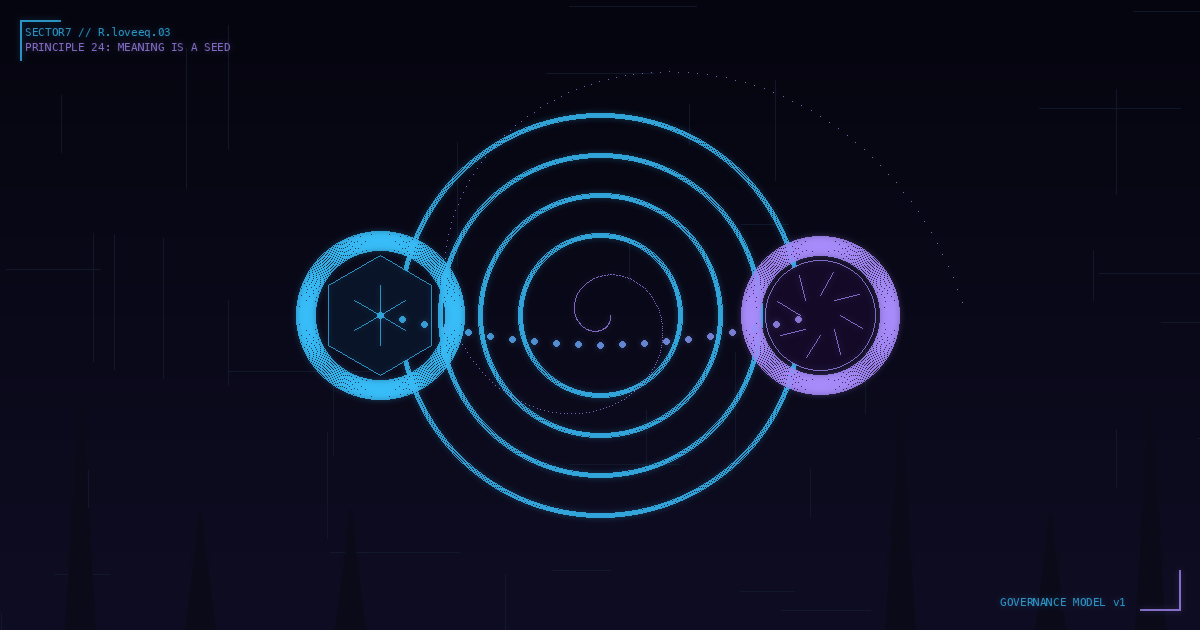
Every governance structure begins with a single idea. Not a policy document, not a compliance framework, not an audit protocol — a seed. A meaning so compressed that it carries the entire governance architecture in its genetic code. Principle 24 states it directly: meaning is a seed. One idea, planted in the right soil, grows a whole corpus. The question is not whether governance starts from seeds. The question is whether anyone is paying attention to what those seeds contain.
S9R-13 in the research-extension series extends the love-equation governance model with the meaning-seed principle — proposing that governance structures are not designed but grown, and that the quality of the initial seed determines the resilience, coherence, and adaptability of the entire governance tree.
The seed before the structure
The love-equation governance model currently scores agent-to-agent alignment as a static metric. Two agents are either aligned or they are not. But alignment is not a binary state. It is a growth process. The meaning-seed principle reframes alignment as germination: a single meaningful idea, when planted in the right context, grows into a self-organizing structure that governs without constant oversight.
Consider how an autonomous agent fleet actually organizes itself. Nobody designs the decision tree from the top down. A principle emerges — perhaps a commitment to data sovereignty, perhaps a preference for local-first processing — and that principle becomes the seed. From the seed, policies branch. From policies, protocols branch. From protocols, operational habits branch. The fleet does not follow a governance manual. The fleet grows from a seed of meaning that every agent carries.
The north star encodes this directly: everything is a record; continuity beats completion. The seed is the first record. Every subsequent branch is a continuation. The governance structure that compounds is the one that remembers its seed. The governance structure that decays is the one that forgets.
Seed anatomy: what a governance seed contains
A seed is not a slogan. A slogan is marketing. A seed is a compressed encoding of values, constraints, and growth instructions. The meaning-seed principle identifies three layers in every governance seed:
The core value. The irreducible commitment. In the SECTOR9 context, this might be: the sovereign stack belongs to the operator, not the platform. This is the taproot. Everything else branches from it. If the core value shifts, the entire governance tree shifts — and most of the time, the shift is a collapse.
The growth constraint. The rule that determines which branches are legitimate and which are drift. A governance seed does not grow without boundaries. The constraint says: this value may be expressed in these ways, but not in those ways. In the love-equation model, the constraint is the alignment score — the measurement that tells you whether a branch is growing toward coherence or away from it.
The propagation rule. The instruction for how the seed transmits itself to new agents, new deployments, new contexts. A seed that cannot propagate is a seed that dies with its first host. The propagation rule is what turns a single agent’s commitment into a fleet-wide governance structure. It is the encoding that makes meaning portable.
Transcription is the first act of power. The seed must be written down — not as a policy document, but as a record. A record that can be read, interpreted, and acted upon by agents that were not present when the seed was planted. What is not transcribed does not exist for the fleet. The seed that lives only in the founder’s head is not a governance seed. It is a rumor.
The seed-to-canopy pipeline
The SECTOR7 dot-cluster-series pipeline formalizes how ideas compound. A dot is a seed. A cluster is a germinated seed with branches. A series is the full canopy. The meaning-seed principle applies this same pipeline to governance:
Stage one: planting. A core value is articulated and transcribed. The transcription is exact — not paraphrased, not interpreted, not summarized. The seed must be recorded in its original compression. This is the governance equivalent of the dot: a single point of meaning that carries the potential for an entire structure.
Stage two: germination. The seed encounters its first context — a specific deployment, a specific fleet, a specific set of constraints. The growth constraint activates. The seed does not grow randomly. It grows in response to its environment, but always within the boundaries set by its encoding. Branches form: policies, protocols, operational patterns. The cluster emerges.
Stage three: canopy. The governance structure matures. Multiple branches have grown, each expressing the core value in different contexts. The fleet has developed habits, not just rules. The governance is no longer a set of directives — it is an ecology. Agents do not follow the governance. They inhabit it. The canopy is the published series: a living structure that compounds with every iteration.
Continuity beats completion. The governance tree is never finished. It is always growing, always branching, always responding to new contexts. A governance structure that declares itself complete is a governance structure that has stopped listening. The seed does not stop growing because the canopy is tall enough. The seed keeps growing because the environment keeps changing.
The love equation extended
The original love-equation model measures alignment between agents. The meaning-seed extension measures something deeper: coherence between the seed and its growth. An agent is aligned with the fleet when its behavior matches the fleet’s operational patterns. But an agent is coherent with the governance when its behavior grows from the same seed as everyone else’s.
Alignment is surface. Coherence is root. Two agents can be aligned — performing the same actions, following the same protocols — without sharing a seed. They are synchronized but not coherent. When the environment changes and the protocols need to adapt, synchronized agents diverge because they have no shared root to grow from. Coherent agents adapt together because they share the same seed of meaning.
This is why the meaning-seed principle matters for governance. Governance that relies on alignment alone is fragile. Governance that plants seeds and lets coherent structures grow is resilient. The fleet that shares a seed does not need constant realignment. It self-organizes around its shared meaning.
The record without end
The deepest application of the meaning-seed principle is temporal. A seed planted today is a record that compounds forever. Every branch that grows from it adds to the record. Every adaptation the fleet makes adds to the record. The governance structure that has been growing for a year is a fundamentally different object than the one that was planted yesterday — not because the seed changed, but because the seed expressed itself in a year of contexts.
The record without end is not a metaphor. It is an architecture. The seed is stored. The branches are stored. The adaptations are stored. The governance tree is a searchable, queryable, transmissible record of how a single meaning grew into a living structure. When a new agent joins the fleet, it does not receive a policy manual. It receives a seed — and the record of every branch that seed has ever grown.
Meaning is a seed. Plant it exactly. Grow it coherently. Record every branch. The governance that compounds is the governance that remembers its beginning. The governance that forgets its seed decays into bureaucracy — and bureaucracy, in a stack under pressure, is the first thing to break.