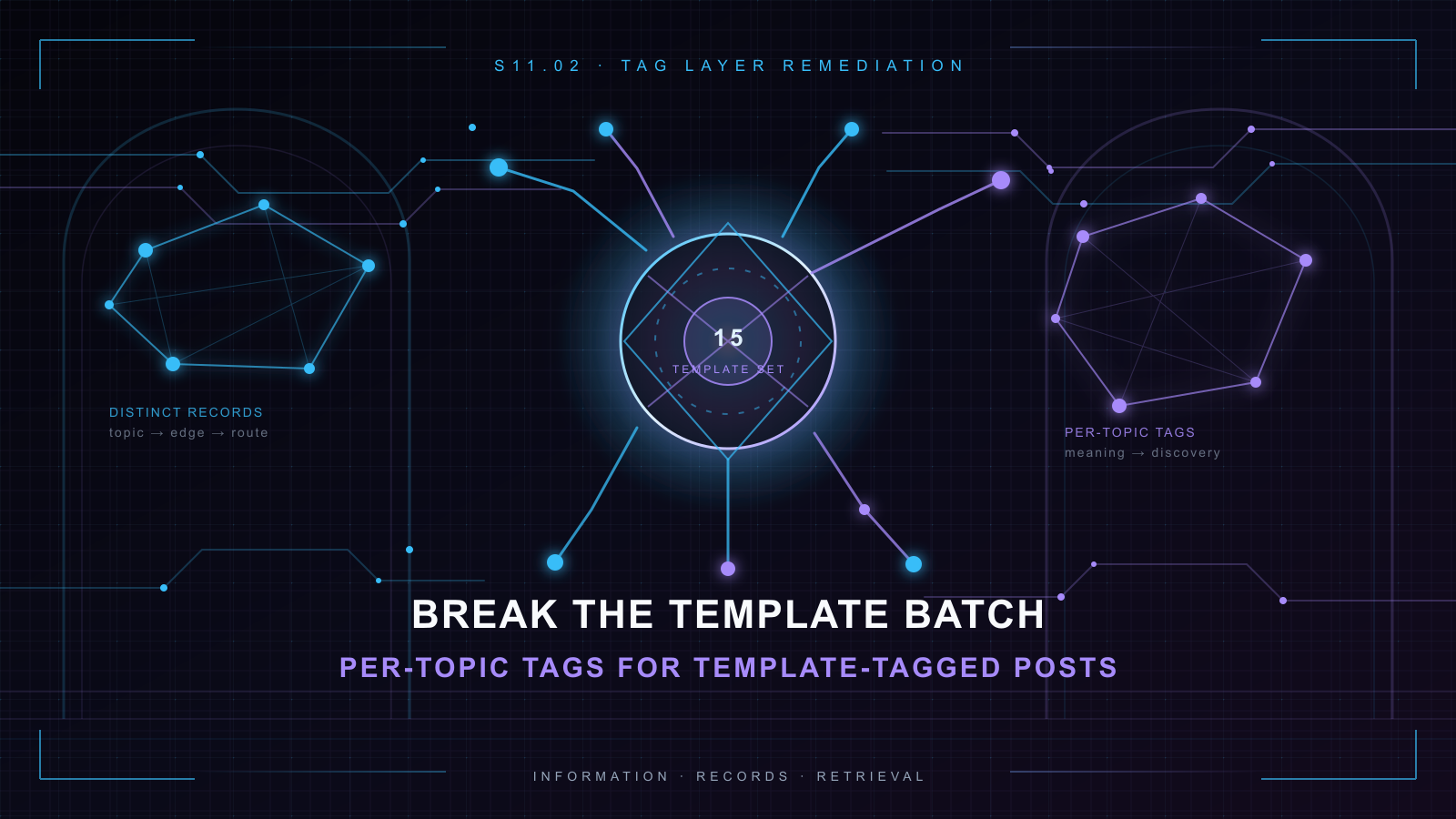

Break
the Template Batch: Per-Topic Tags for Template-Tagged Posts
🔓 PUBLIC — The signal
behind the labels
behind the labels
A tag layer fails quietly when every post receives the same labels.
The pages still publish, the search form still works, and the dashboard
still reports a tag count. Yet the archive has lost its ability to tell
one idea from the next. Fifty-four posts can wear the same fifteen tags
and look like fifty-four members of one subject when they are actually
fifty-four different records. The labels are present; the signal is
not.
This is the problem S11.02 addresses. The accepted SECTOR7 cluster
found five genuinely untagged posts and a larger group wearing a shared
template set. The bridge had reported 181 posts with empty or inadequate
classification; live vault records narrowed the shape of the issue. The
54-post template batch is the loudest failure because its uniformity
looks intentional from a distance.
The north star’s first principle says information is the ground of
being. The second relevant principle says everything is a record;
continuity beats completion. A post is a record. A tag tells that record
what it can connect to. When labels are borrowed from neighboring
records, the archive preserves words while losing relationships.
🔓 PUBLIC — The anatomy
of a template batch
of a template batch
A template batch is created when a pipeline treats a shared editorial
set as a universal default. The set may contain legitimate terms: AI
Agent, API-First Architecture, Headless CMS, Digital Sovereignty, or
Autonomous Site Operations. Those terms are not the problem. The problem
is assignment by membership rather than by meaning.
A post about DNSSEC, SPF, DMARC, and email authentication is not
improved by also being labeled Synthetic Reality or The Programmable
Web. A post about Docker Swarm persistence is not made more discoverable
by carrying a prompt-engineering tag. A post about prompt engineering
and the creative pipeline is not made more specific by inheriting a
security vocabulary it never touches. The uniform is accurate only as a
census of the collection. It is inaccurate as a description of each
page.
That distinction matters because tags do more than decorate an
archive. They are routes. A reader following a tag expects neighboring
records. An agent selecting related posts expects the route to be
semantically meaningful. A search engine uses metadata as one signal
among many. If every page is reachable through every route, the graph
becomes a warehouse: a collection of shelves, not a navigable
system.
🔓 PUBLIC — Why the graph
breaks
breaks
The template batch compresses distinct posts into a visual blob.
Search for “DNSSEC” and the system cannot confidently prefer the DNS
post over a post about monetization. Search for “prompt engineering” and
it cannot distinguish the creative pipeline from a batch neighbor whose
body barely mentions the subject. The graph wants specificity. Uniform
metadata gives it the opposite: a single dense neighborhood with no
useful local structure.
The S11.01 audit counted the gap. The bridge’s historical snapshot
recorded 181 posts with untagged or improperly tagged content, while the
accepted cluster’s live-file review distinguished five truly untagged
records from 96 template-tagged records. Those figures are not
interchangeable, and a taxonomy report should not pretend they are. They
are two levels of evidence: the first is the bridge claim; the second is
the verification pass. The useful engineering response is the same in
either case: replace claims with per-record checks.
A per-topic tag creates a small, defensible claim about a page. It
says that the page actually contains the named concept. Three precise
tags can create more useful paths than fifteen inherited labels. The
target is not a quota. The target is a vocabulary that lets a reader
move from a question to a relevant record without reading the whole
archive first.
🔓 PUBLIC — The per-topic fix
The remediation is mechanical, but mechanical does not mean careless.
Read the post. Identify its subject. Name the concepts that recur in the
body. Map those concepts to a controlled vocabulary. Apply the smallest
set that makes the record distinguishable from its neighbors. Verify the
result by asking whether a reader would reasonably expect every applied
tag to be answered by the article.
For example, a DNS security record can carry DNSSEC, SPF, DMARC,
email authentication, and domain verification. A Docker record can carry
Docker, Swarm, persistence, containers, and overlay networking. A
creative-pipeline record can carry prompt engineering, image generation,
ComfyUI, and visual-pipeline terms. The examples are not a mandate to
force five tags onto every post. They show how a tag follows evidence
from the content.
The same discipline should be used when a tag is removed. A stale
template term can make a page look relevant to a subject it does not
develop. Deleting noise is not a loss of metadata; it is a repair of the
reader’s trust. If two terms name the same concept in different forms,
the controlled vocabulary should choose one canonical form. If a term
has no concept behind it, it should not remain attached simply because
it was in the old publish template.
The migration should be idempotent. Running it twice should produce
the same classification, not a second layer of synonyms. That property
matters for a pipeline that will run again as new posts arrive.
Continuity beats completion, but continuity also means preserving a
stable route from one version of the record to the next.
🔓 PUBLIC — What the fix
enables
enables
Per-topic tagging changes retrieval from a census into a map. A
reader searching for DNSSEC lands on records that explain DNSSEC. An
agent traversing the graph can follow a security route without first
reading every page in the batch. A content dashboard can distinguish a
post about email security from a post about a visual generation pipeline
even when both sit under the same broad category.
It also makes the category layer auditable. Categories answer where a
post belongs. Tags answer which ideas connect it to the rest of the
corpus. When tags are inherited wholesale, category cleanup becomes
guesswork: a category may look overpopulated because its members were
never individually classified. Correct the tag layer first, and the
remaining category decision becomes a question about real editorial
boundaries.
The measure is not “we attached a tag.” The measure is “we made a
specific, inspectable connection.” Every accurate tag is a potential
edge. Every vague or unrelated label is a false turn. A successful
remediation increases useful adjacency while reducing noise. It should
be possible to show the before state, the after state, and the reason
for each change.
🔓 PUBLIC — A taxonomy that
compounds
compounds
A taxonomy becomes durable when it is grounded in the ideas an
archive actually contains. The accepted cluster points toward a vetted
set of concepts rather than an ever-growing pile of author preferences.
A tag should point to a concept with a definition, a relationship, and a
reason to recur across multiple records. That discipline gives future
work a stable vocabulary without freezing the archive forever.
The North Star is useful here only at the level of principle.
Information is the ground; records are the continuity; frequency
organizes what repeats. The derivation behind internal governance
remains protected. What the public needs is the durable idea: a shared
vocabulary is infrastructure, and infrastructure compounds when every
new record can join the existing structure without inventing a private
language.
S11.02 is therefore a bridge between publishing and retrieval. It
takes a visible publishing artifact—the batch of posts—and asks the
harder question: can the system explain why each post belongs where it
belongs? When the answer is no, the tag layer is not decoration. It is a
missing receipt. Break the template batch, assign from the record, and
the archive starts speaking in distinct voices again.