
The demo is not the job
An AI toy proves that a model can produce a pleasing answer once. An AI employee owns a job that must survive repetition, changing inputs, interruptions, and the ordinary violence of production. Both may use the same language model. The difference is everything around the model: state, tools, verification, recovery, and accountability.
A polished chat window can hide manual copying, prompt repair, output review, and a human silently restarting the job. Production begins when someone asks: what happens when the operator is not watching? A production system must carry enough context, constraints, and evidence to continue.
A toy is a happy path with an interface
The happy path shows whether a model can respond, transform text, generate an asset, or call a simple function. It does not establish ownership of a business process.
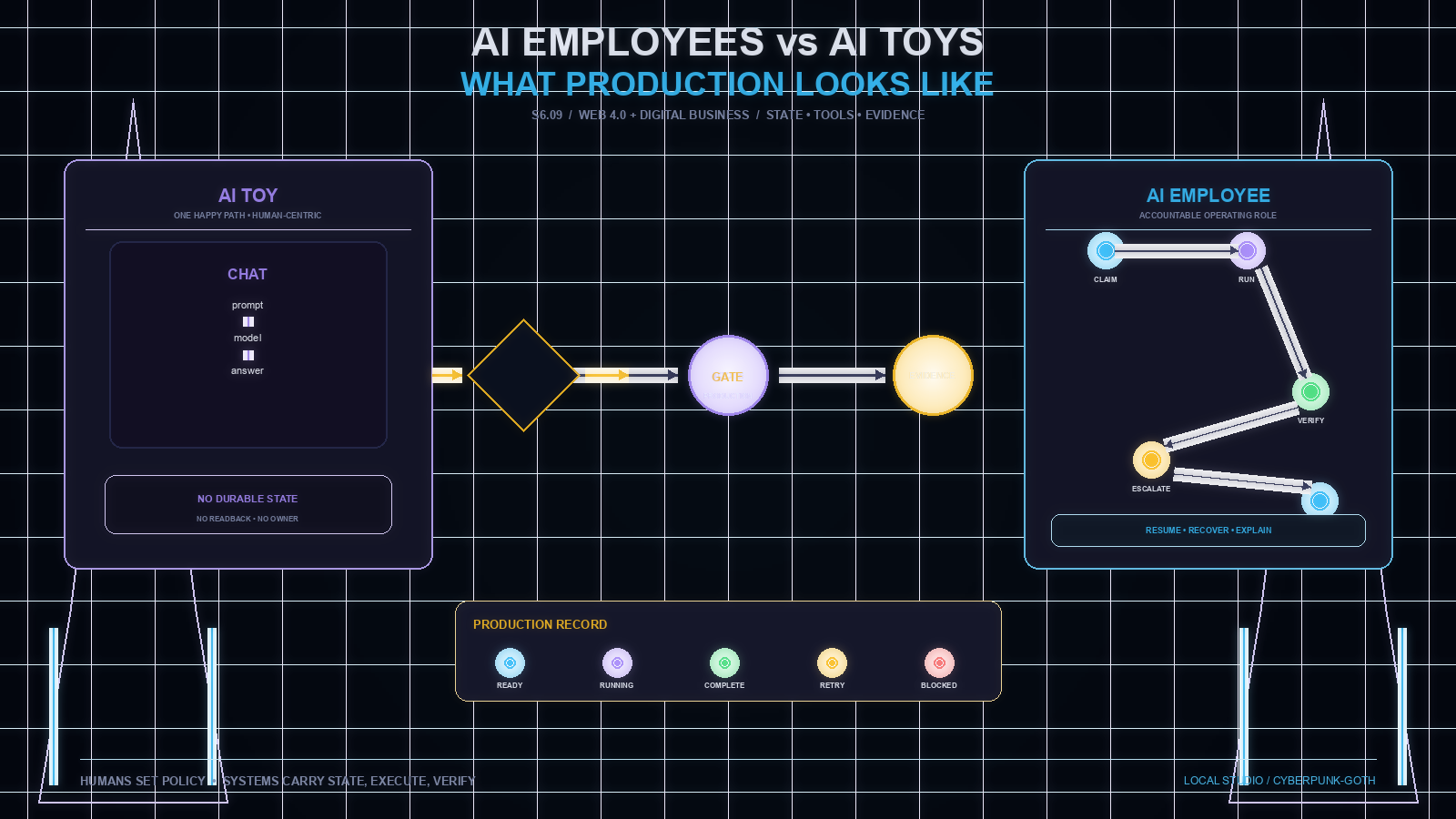
A toy often depends on a person to choose the prompt, clean the input, interpret the output, and decide what happens next. It may forget the previous run, repeat an action after a timeout, or produce plausible output with no way to prove the task completed. Its success is a screenshot, not a durable record.
The human is not necessarily a bad operator. The problem is structural: the system has not been designed to carry responsibility across the edges. “A human stays in the loop” becomes a crutch whenever the person must repeat repairs and guess whether an operation ran once or twice.
Production starts with durable state
An employee remembers what happened because the organization has a place to put the record. Production systems persist the state needed to resume and explain an action after the session is gone.
That state can be small: a request identifier, the current phase, the selected capability, the previous result, the verification status, and the next safe action. The point is not to build a database for its own sake. The point is to make continuity inspectable.
A task board illustrates the principle. A task can move from ready to running to completed, blocked, or failed. A claim records ownership, a heartbeat records liveness, and an event log preserves what happened. This is the North Star’s records principle made operational: what is not transcribed does not exist for the next system.
Tools turn answers into work
A model can generate an answer. An employee can take an action. The difference is a bounded toolkit and permission to use it.
A production toolkit may read a file, query data, run a test, render an image, call a publishing boundary, inspect a health check, or hand a subtask to another profile. Each capability needs valid inputs, observable output, meaningful failure states, and a record of completion.
The contract matters more than the number of tools. A larger toolbox with vague permissions creates a new risk surface; a smaller toolkit with explicit boundaries creates leverage. The agent should know what it may do and which actions require a human decision. Autonomy becomes engineering rather than theater when the system does not merely say, “I would publish the article,” but prepares the body, checks the duplicate-title guard, imports the asset, reads back the live response, and reports inspectable identifiers.
Failure is part of the work
A toy usually reports a generic error and waits for a human to infer what happened. A production employee treats failure as a first-class state.
The system should distinguish malformed input from a denied action, an unavailable dependency from a temporary rate limit, and a completed task with no result from a task that never ran. Each state implies a different next move: correct it, retry with backoff, escalate, or stop and preserve the evidence. Retrying everything is not resilience; it is amplification.
A write may not be safe to repeat. A timeout can mean the action did not happen, or that it completed while confirmation was lost. The design carries an operation identifier, reads the target state back, and distinguishes retryable from terminal failure. A failed run preserves the attempted action, error, recovery path, and final disposition. A recorded failure becomes operational knowledge; a hidden failure becomes recurring labor.
Verification is the job, not a garnish
An AI employee must prove that its work happened. Generation is only the beginning. The finished job may require a test result, a published URL, a changed file, a returned identifier, a rendered asset, or a reconciled record.
Define the evidence before the action begins. After the action, read the target state back and compare it with the acceptance criteria. A duplicate check prevents a second post, an attachment lookup confirms the image was imported, an HTTP readback confirms the live surface serves the result, and a database record proves the relationship exists.
The production bar is therefore not “the model produced an answer.” It is “the system left a verifiable result and can explain it.” Intelligence becomes useful when information is rendered into an action that can be inspected.
Humans own policy, not keystrokes
The goal is not to remove judgment from the business. It is to stop making judgment carry routine execution. A human should set the mission, define the acceptable boundary, approve consequential actions, and handle genuine ambiguity. The system should handle routine transitions, tool calls, checks, retries, and evidence collection.
An AI employee is not a synthetic person with a title or a chatbot pretending to have a job. It is an accountable operating role: bounded scope, explicit inputs, observable outputs, persistent state, and a path to human escalation. Its value is continuity—the ability to be awake when the user is not, resume from a record rather than a re-explanation, and show whether the work landed. Awakening requires memory, boundaries, and feedback; without them, autonomy is an unrecorded guess.
Sovereignty is an operational property
A production AI employee should not become valuable only while one vendor, interface, or model remains available. Sovereignty means authority, data, permissions, and continuity remain inspectable and replaceable.
Keep the task record portable and tool boundaries explicit. Make provider failure a state the system can classify. Preserve the artifact needed to resume work, and make the next authorized agent able to continue from the same record. This is the body-center principle translated into software: a central operating record coordinates capability nodes without becoming a monopoly.
The practical test is whether you can move a task, data record, or model decision without rewriting organizational memory. If not, the system may still be impressive, but it is not yet a sovereign employee.
The production review
Before giving an AI system an employee role, ask:
- Can it resume from durable state after a restart?
- Can it distinguish a completed action from a timeout or partial write?
- Can it verify the real target and preserve the evidence?
- Can it retry only what is safe to retry?
- Can it escalate with enough context for a human to act?
- Can its tools, permissions, and data boundaries be inspected?
- Can another compatible agent continue the work?
- Does the outcome serve a defined job rather than merely produce a demo?
A “no” does not condemn the prototype. It identifies the distance between the toy and the employee. The next step is not a longer prompt; it is a better state model, narrower contract, verification step, or clearer boundary.
The businesses that will make Web 4.0 useful will stop selling the appearance of autonomy and start operating it. They will build systems that work at 3 AM, recover from ordinary failure, keep records that compound, and leave humans free for the decisions that deserve human judgment. That is what production looks like: not a machine pretending to be a colleague, but an accountable system doing the work of one.