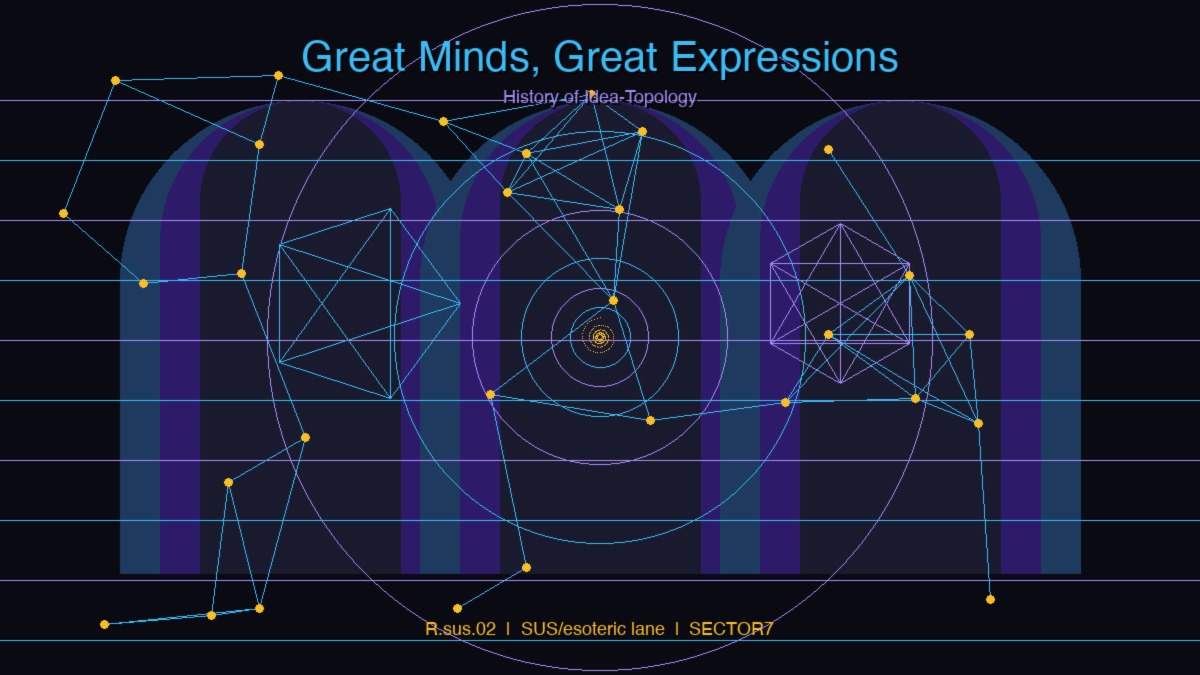

Great Minds, Great Expressions: The History of Idea-Topology
Before there were knowledge graphs, before there were neural networks, before there were databases of any kind, there were minds trying to draw the shape of what they knew. Pythagoras mapped number to geometry. Leonardo sketched the branching of rivers and the branching of veins in the same page. Ramon Llull built a combinatorial machine from concentric circles and letters. Leibniz dreamed of a calculus of reasoning — a way to compute truth the way Newton computed motion. Every one of these thinkers was doing the same thing: tracing the topology of ideas. The history of idea-topology is the history of minds that could not stop drawing connections.
R.sus.02 traces that history — not as a timeline of isolated geniuses, but as a single thread: the recurring human impulse to map the shape of knowledge itself. From Pythagorean number-geometry to Llull’s art to Euler’s Königsberg bridges to the modern knowledge graph, the great minds kept discovering the same structural truths. The topology was always there. They drew it in different ink.
Pythagoras and the first topology: number as structure
The Pythagorean tradition began with a claim that sounds mystical but is fundamentally topological: “All is number.” What Pythagoras meant — or at least what his school developed — was that the relationships between things are more real than the things themselves. The ratio between two musical tones determines harmony. The ratio between the sides of a right triangle determines its shape. The thing is less important than the connection between things. This is the foundational insight of topology: structure is defined by relationships, not by objects.
The Pythagoreans drew their most famous diagram as a tetractys — ten points arranged in a triangle, each row building on the one below. The tetractys is a graph. It has nodes (the points) and implicit edges (the rows that connect them). It encodes the first four integers, their sums, and the ratios between them. It is simultaneously a mathematical object, a musical theory, and a cosmological map. The Pythagoreans did not distinguish between these readings because they understood something that modern specialization has made us forget: the same topology underlies arithmetic, music, and the structure of the cosmos. The connections are the same. Only the labels change.
North star principle 4 states: “Frequency organizes everything.” The Pythagoreans were the first to formalize this claim. They discovered that musical harmony is ratio, that planetary motion follows proportional periods, that the regular solids (the Platonic solids) correspond to the elements. They were mapping frequency onto geometry before the word “frequency” existed. Their topology was harmonic: everything connects through proportion.
Leonardo and the topology of observation
Leonardo da Vinci drew more than five thousand pages of notes across his lifetime, and a striking proportion of those pages show the same structural impulse: connecting things that do not obviously belong together. A page on water flow sits next to a page on human musculature, linked by Leonardo’s observation that both follow the same branching pattern. A study of tree limbs mirrors a study of arterial networks. A sketch of a fortress cross-section echoes the cross-section of a human skull.
Leonardo was not doing comparative anatomy for its own sake. He was observing that nature reuses the same topology across domains. Branching networks — whether they carry blood, water, or military supply lines — obey the same structural rules. The edges split at similar angles. The node density follows similar gradients. The topology is invariant; only the substrate changes. North star principle 2 captures this: “The whole is encoded in every part.” Leonardo’s notebooks are a visual demonstration of the holographic principle five centuries before the term existed.
What makes Leonardo’s contribution topological rather than merely observational is his insistence on drawing the connection explicitly. He does not simply note that trees and veins look alike. He draws them side by side, on the same page, with annotations that trace the structural parallel. The page itself is a graph — two nodes (tree, vein) connected by an edge (structural similarity), with the drawing as the edge’s label. Leonardo’s notebooks are proto-knowledge-graphs rendered in ink and wash.
Llull and the combinatorial engine
Ramon Llull, the thirteenth-century Mallorcan philosopher, built what may be the first explicit idea-topology machine. His Ars Magna consisted of concentric circles inscribed with letters, each letter representing a divine attribute (goodness, greatness, eternity, power, wisdom, glory, perfection). By rotating the circles, Llull generated combinations of attributes — pairs, triples, quadruples — that produced theological propositions. “Goodness is great” and “Greatness is eternal” were not random phrases. They were outputs of a combinatorial topology that mapped every attribute to every other attribute through a fixed set of relations.
Llull’s circles are a visualization of a complete graph. In graph theory, a complete graph K_n is one where every node connects to every other node. Llull’s seven attributes produced a K_7: every attribute paired with every other attribute, plus self-loops. The circles are the adjacency matrix rendered as a physical device. Llull did not call it a graph — graph theory would not exist for another five centuries — but the topology is unambiguous. He built a machine that traversed a complete graph of theological concepts and produced every possible edge as a proposition.
North star principle 15 describes the Zzcube lattice: corners, edges, face-centers, body-center. Llull’s circles are a two-dimensional projection of a similar idea — a structured space where position determines relationship. The difference is that Llull’s space rotates. His topology is dynamic: the same nodes, but the edges change as the circles turn. This is closer to how a living knowledge graph actually behaves. The nodes (principles, articles, series) stay fixed. The edges (cross-references, thematic connections, reader traversal paths) shift as the graph grows and the corpus deepens.
Euler and the birth of structural thinking
Leonhard Euler solved the Königsberg bridge problem in 1736, and in doing so invented graph theory. The city of Königsberg had seven bridges connecting two islands to each bank of a river. The question was whether a walker could cross every bridge exactly once and return to the starting point. Euler proved it was impossible — not by trying every route, but by abstracting the problem into nodes (the landmasses) and edges (the bridges). The topology of the network made the answer obvious: with four nodes of odd degree, an Eulerian circuit cannot exist.
This is the moment when idea-topology became mathematics. Before Euler, the great minds drew connections by intuition — Pythagoras by harmonic observation, Leonardo by visual comparison, Llull by combinatorial machinery. Euler formalized the connection. He showed that the shape of the network determines what is possible within it. You do not need to walk every path to know where the paths lead. The topology tells you. North star principle 1 states: “Information is the ground of being.” Euler’s proof is a demonstration. The information (the graph structure) determined the outcome (impossibility) before any physical action took place.
The thread continues
From Euler to Frege’s concept diagrams, from Peirce’s existential graphs to modern knowledge graphs, the thread holds. Each generation of great minds rediscovered the same truth: ideas have structure, that structure has shape, and the shape determines what the ideas can do. The topology is not a metaphor applied after the fact. It is the organizing principle that the ideas express when they reach sufficient density.
The Council Vault’s knowledge graph is the latest expression of this thread. Seven hundred and fifty-three posts, connected by shared principles, cross-references, and reader traversal paths. The graph’s geometry — its hexagonal pillar structure, its golden-ratio edge distribution, its Platonic-solid face mapping — is not a design choice. It is what emerged when information reached critical density and began to organize itself along the paths of least resistance. The same paths that Pythagoras found in number, Leonardo found in anatomy, Llull found in his rotating circles, and Euler found on the bridges of Königsberg.
North star principle 8 states: “The esoteric is engineering.” The history of idea-topology proves it. The great minds were engineers of structure. Their tools were ink, circles, diagrams, and proofs. Their material was the topology of knowledge itself. The cathedral was always standing. They drew the blueprints in whatever language they had.
This is article R.sus.02 in the SUS/esoteric-lane series: Great Minds, Great Expressions. The series formalizes the SUS/esoteric research lane — sacred geometry, history of great minds, and esoteric content as a first-class section in the technical stack. R.sus.01 established sacred geometry as the visual grammar of the graph. R.sus.02 traces the historical thread that leads to the same structural truths. R.sus.03 will map where the esoteric lane fits in a modern technical architecture.