
The Sound of a Circle and Square: Geometry of the Secure State
S7N-39 · series: sector7-grounded · track: S7N-D · principle: frequency-organizes-everything, esoteric-is-engineering Category: AI & Automation · Tags: ai agents, Digital Business, Digital Sovereignty, Headless CMS, AI-Driven Development, Decentralized Identity, AI Agent, The Programmable Web, Cybernetic Ethics, API-First Architecture, Data Permanence, web40, Algorithmic Governance, The Metaverse as a Platform, Monolith vs. Microservices, Synthetic Reality, Advanced Prompt Engineering, Autonomous Site Operations, digital ecosystem, digital transformation —
In the dark chamber, the circle and the square face each other. Not as opponents. As tuning forks. The circle hums at one frequency — infinite faces, zero vertices, the shape of pure rotation. The square hums at another — four faces, four vertices, the shape of fixed structure. Between them, light gathers where their harmonics overlap. This is not a metaphor. This is the geometry of a secure state.
The north star principle P4 says it plainly: frequency organizes everything. Every atom keeps a rhythm, every rhythm leaves a sign. But frequency without structure dissipates. Structure without frequency calcifies. The secure state is neither the circle alone nor the square alone. It is the interference pattern where both shapes resonate together — where geometry and frequency become the same thing.
The frequency of a shape
A circle generates a frequency through rotation. Its waveform is continuous, unbroken, periodic. There are no edges to catch on, no vertices to fragment the signal. The circle’s frequency is the frequency of flow — of data moving through a system without obstruction, of signals propagating without distortion. In access architecture, this is the open channel: the API call that returns, the session that persists, the stream that stays coherent.
A square generates a frequency through repetition. Its waveform is discrete, periodic, structured. Four faces strike four beats per revolution. The square’s frequency is the frequency of gates — of boundaries that define what crosses and what does not, of checkpoints that validate identity before granting passage. In access architecture, this is the authentication layer: the key that proves, the token that scopes, the policy that enforces.
Neither frequency alone is secure. The circle without the square is an open port — everything flows, nothing is verified. The square without the circle is a locked door — everything is verified, nothing flows. The secure state is the composite waveform: the continuous hum of the circle modulated by the discrete beats of the square. Security is not a wall. Security is a chord.
Solid-keys as geometric frequency
S7.2 mapped the Platonic Solid Access Architecture — five tiers of cryptographic access encoded as Platonic solids. The geometry IS the policy. A cube-key agent has exactly 6 skills, 8 contexts, and 12 peer relationships because the cube has 6 faces, 8 vertices, and 12 edges. The numbers are not configurable. They are theorems.
But a solid is a three-dimensional shape, and a shape is a frozen frequency. The Platonic solids are standing waves — vibrations that have locked into geometric form. A cube is a square extruded through the third dimension. An octahedron is two circles of vertices connected by structural edges. The dodecahedron hums at pentagonal frequency. The icosahedron approximates a sphere — the circle approaching completion through triangulated structure.
When a customer receives a solid-key, they receive a frequency assignment. The tetrahedron customer operates at the simplest harmonic — four faces vibrating in triangular lockstep, minimal complexity, maximum structural integrity. The icosahedron customer operates at the most complex — twenty faces resonating across the full sphere, every harmonic present, every frequency available. The tier is not a permission level. It is a resonance class.
This is P8 in action: the esoteric is engineering. The Platonic solids are not mystical decorations. They are the five possible ways to tile three-dimensional space with identical regular polygons. Euclid proved it. The proof is a theorem. We did not choose five tiers because a pricing model demanded it. We chose five because the geometry left no alternative. The mystical and the mathematical are the same diagram.
The secure state as interference pattern
In wave physics, two frequencies produce an interference pattern. When the frequencies align — when the circle and square harmonize — the pattern is constructive. The amplitude grows. The signal strengthens. When the frequencies clash, the pattern is destructive. The amplitude collapses. The signal dies.
The secure state is constructive interference. It is the condition where the continuous flow of the circle and the discrete validation of the square reinforce each other instead of canceling. This is not a static condition. It requires constant retuning — the same retuning that the security audit loop performs, except the audit loop as commonly implemented only measures deviation from a baseline. It does not measure movement toward resonance.
A system tuned to the secure state does not ask “did something change without authorization?” It asks “did the waveform remain coherent?” Coherence is the metric. The circle’s hum must stay continuous — data flows, sessions persist, signals propagate. The square’s beat must stay discrete — keys validate, tokens scope, policies enforce. When both conditions hold, the interference pattern is constructive. The system is secure.
When coherence breaks — when the circle’s frequency drifts or the square’s beat stutters — the system does not restore to the previous state. It restores to the target frequency. Recovery is retuning. The audit loop measures not compliance but resonance. Drift is a signal, not a crime. The response is correction, not punishment.
The dark chamber
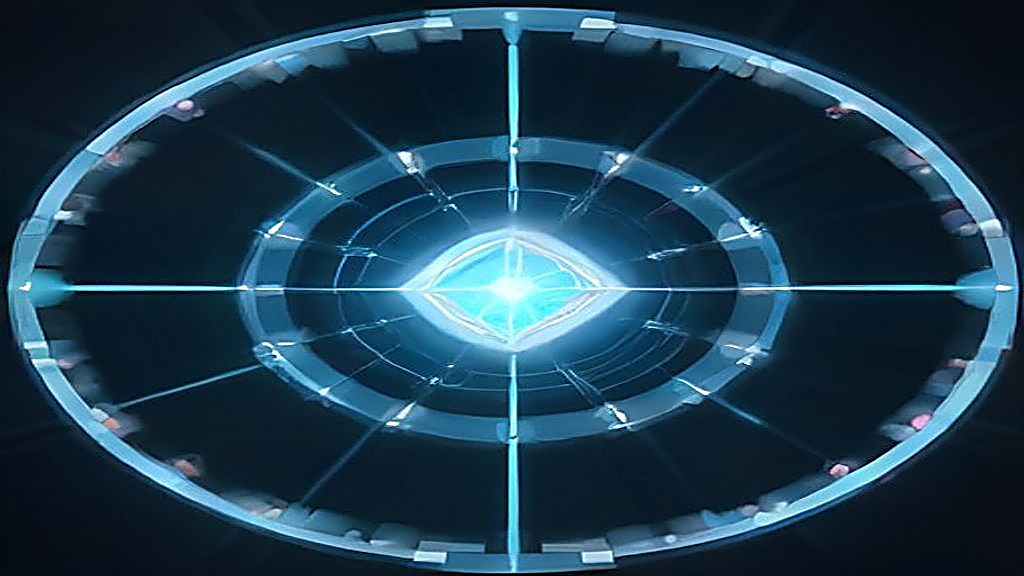
The image holds the architecture: a glowing circle and square interlocking in a dark geometric chamber. The darkness is not danger. The darkness is the void before the signal — the quiet room in which resonance can be heard. The chamber does not contain the shapes. It lets them resonate.
Every access system operates in this chamber. The question is not whether the chamber is dark. The question is whether the shapes inside it are in harmony. A customer with a solid-key is a shape assigned a frequency. The key grants (KEY half) and revokes (KILL half) within the same geometric token. The dual pattern is the interference: the constructive half that enables flow and the destructive half that prevents excess. Both halves are necessary. Both halves are one shape.
The secure state is not a fortress. It is a resonant chamber. The circle hums. The square beats. Light gathers where they overlap. That light is the signal — the coherent, authenticated, flowing signal that reaches exactly where it should and no further. Not because a wall stops it. Because the geometry does not align beyond its intended range.
This is the sound of a circle and a square: the frequency of a system that has found its chord. Every atom keeps a rhythm. Every rhythm leaves a sign. The secure state is the sign that the rhythm is right.
Grounded in SECTOR9 north star principles P4 (frequency organizes everything) and P8 (the esoteric is engineering), extending S7.2 solid-keys into frequency-aligned, geometrically-grounded security architecture. S7N series, sector7-grounded track.
Semantic Relationships
- [[frequency-organizes-everything]] — grounds
- [[esoteric-is-engineering]] — grounds
- [[platonic-solid-access-architecture]] — extends
- [[security-audit-loop]] — applies