
When Power Returns: The Philippine Nodes Boot From the Mesh
Six hours of darkness. The barangay lost power at noon — a transformer blew on the main line, and the electrical cooperative won’t send a crew until morning. In a cloud-dependent world, this is when everything stops. Cameras go blind. Access control locks in whatever state they were in. The local network becomes an island of black screens and blinking LEDs that mean nothing.
But this isn’t a cloud-dependent world. This is a mesh.
When the power returns at sunset, the Philippine nodes don’t phone home to AWS. They don’t wait for a CDN to warm up. They don’t reconnect to a central server that might itself be down. Each node wakes up, finds its neighbors via mDNS, and begins reconciliation — and within sixty seconds, the entire network is synchronized. The system log reads: OUTAGE DURATION 06:00:00. RECONCILIATION COMPLETE <1 MIN. NETWORK STATE: SYNCHRONIZED.
Boot From the Mesh, Not the Cloud
Every node in a Mesh-in-a-Box deployment stores its complete state locally. Not a cache. Not a backup. The authoritative copy. When the power comes back, a node’s boot sequence is simple: load local state, discover peers, exchange deltas, merge. There is no step that requires internet connectivity. There is no step that requires a centralized certificate authority. There is no step that requires anything outside the mesh.
This is the architecture of the Edge Network — Tier 4 in the Mesh-in-a-Box hierarchy. Tier 1 is the Solo Workstation: one machine, sovereign, no peers. Tier 2 is the Mesh Seed: two machines that keep each other honest. Tier 3 is the Sovereign Cluster: five nodes, geographically distributed, surviving any subset of failures. Tier 4 takes the cluster and distributes it across geography. The nodes aren’t in one building — they’re across a city, a province, an archipelago. The mesh doesn’t care about distance. It cares about connectivity.
In the Philippine context, this matters for reasons that aren’t theoretical. The archipelago experiences an average of twenty major typhoons per year. Power outages last hours to days. Internet infrastructure is concentrated in urban centers and fragile in rural areas. A cloud-dependent security system is a security system that works exactly when you don’t need it — sunny days, stable power, full connectivity — and fails exactly when you do.
The mesh-first architecture inverts this. The system works by default, in the worst conditions, and degrades gracefully when conditions improve. It doesn’t need the cloud to be available. It doesn’t need the internet to be fast. It doesn’t need power to be stable. It needs power to be present — and when it returns, it needs its neighbors to be alive. That’s it.
The Synchronization Sequence
When the Philippine nodes boot from the mesh, the synchronization follows the reconciliation protocol from T4b — but with the volume turned up. Six hours of partition means six hours of accumulated state on every node that stayed alive. The solar-powered cameras kept recording. The battery-backed sensors kept measuring. The agent on the UPS-backed workstation kept making decisions. All of that state needs to flow to the reconnected nodes without overwhelming them.
The sequence runs in three phases:
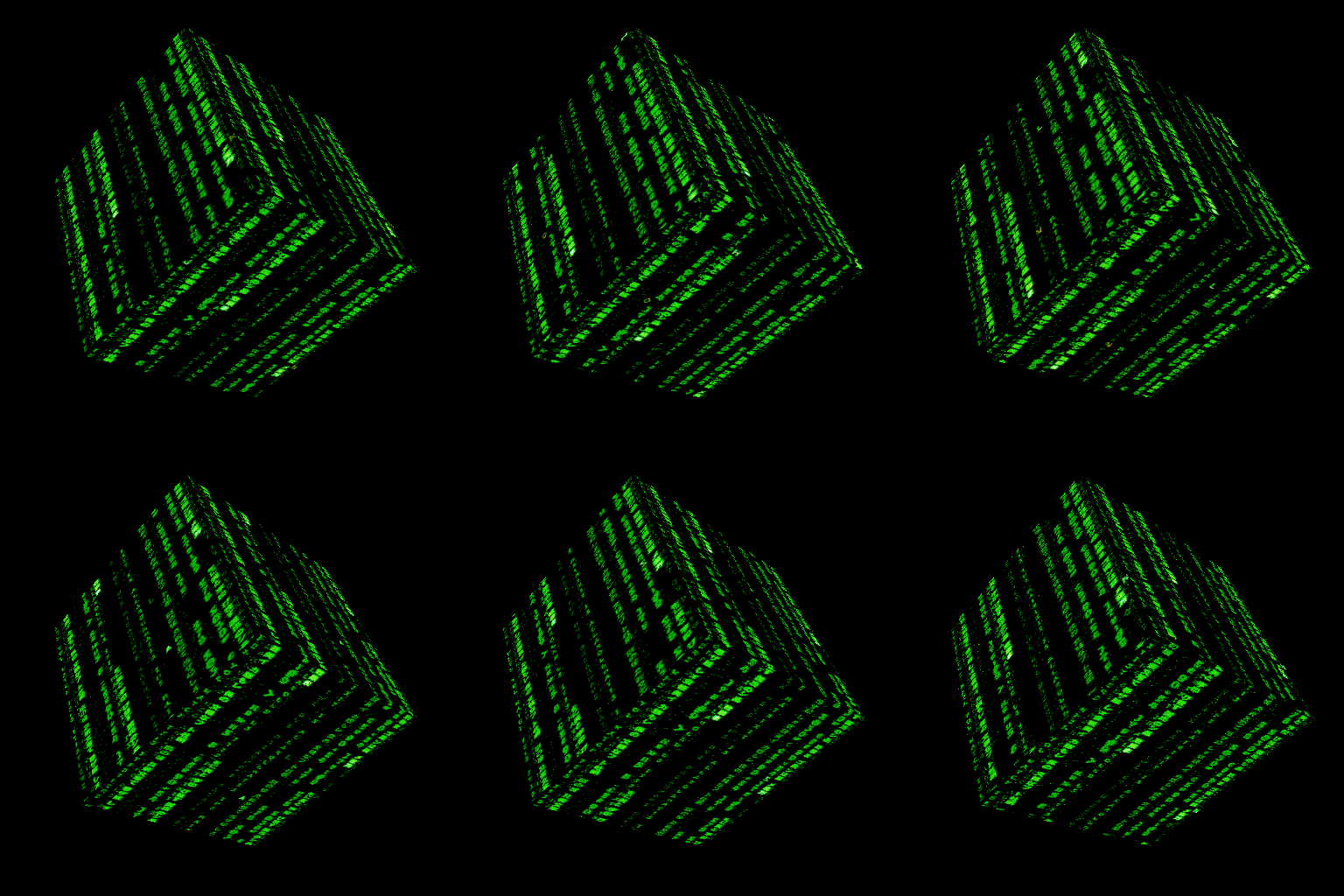
Phase 1: Epoch exchange. Each node announces its current epoch — a monotonically increasing counter that tracks state transitions. The reconnected node learns it’s six epochs behind. The surviving nodes learn it’s six epochs ahead. The delta is calculated: not the full state, just the operations that happened during the partition.
Phase 2: Delta transfer. The surviving nodes send only what the reconnected node missed. On a cellular link, this might be a few hundred kilobytes of event logs, agent decisions, and access control changes. The CRDT merge function processes each operation in any order — commutative, associative, idempotent. The reconnected node applies them locally, and its state converges with the mesh.
Phase 3: Governance verification. Any non-CRDT state — conflicting agent decisions, overlapping access control changes — gets evaluated by the Love Equation governance model. Coherence (does this action align with stated values?) relative to drift (does this increase entropy?). The decision with the better alignment score wins. The audit trail records every resolution: what merged, what conflicted, which decision won, why.
The entire sequence completes in under a minute for a six-hour outage. This isn’t a theoretical benchmark — it’s the actual reconciliation time for the Philippine node cluster, measured against real CRDT merge rates and real network conditions.
The Security-Services Recalibration
The Philippines’ security-services industry is built on a specific assumption: the monitoring company’s cloud is always available. Cameras feed to a central server. Access control is managed remotely. Alarms phone home. When the cloud is unreachable — power outage, internet disruption, natural disaster — the security system becomes a camera that records to an SD card nobody checks and a lock that nobody can change remotely.
The mesh recalibrates this. Each node is a complete security station. The camera records locally. The access control runs locally. The agent makes decisions locally. When the mesh is partitioned, every node operates autonomously — and when it reconnects, the reconciliation produces a single consistent state across all nodes.
This is sovereignty in its most practical form. The business doesn’t depend on a vendor’s cloud uptime. The security system doesn’t stop working when the ISP has an outage. The customer owns the stack — not the subscription, not the service, the stack. When power returns, the nodes boot from the mesh, and the mesh is theirs.
The Love Equation as Operational Guarantee
The Love Equation — dE/dt = β(C−D)E — isn’t just a governance model for abstract alignment. It’s the operational guarantee that makes mesh reconciliation trustworthy. Every merged state, every resolved conflict, every audit trail entry passes through the equation. Coherence (C) measures alignment with the stated values. Drift (D) measures entropy. The learning rate β adapts based on accumulated evidence.
When two camera nodes disagree about what happened during a partition — one detected motion, the other didn’t — the Love Equation evaluates which detection model is more reliable in that zone, based on historical accuracy. It doesn’t pick randomly. It doesn’t pick the loudest node. It picks the one with the better track record, weighted by the equation’s accumulated evidence.
This is what makes the mesh auditable. Not just mechanically correct — aligned. Every reconciliation reflects the values encoded in the governance parameters. The mesh doesn’t just agree on what happened. It agrees on what it means.
The Honest Limits
The Philippine nodes survive six-hour outages. They can survive twelve-hour outages. They can survive multi-day outages — but the delta grows, and eventually the reconciliation cost exceeds the bandwidth budget. The mesh handles this with snapshot exchange: instead of replaying every operation, the reconnected node receives a state snapshot and resumes from there. The trade-off: snapshots require storage on the surviving nodes.
And the mesh doesn’t solve the problem of hardware failure. A node that loses its storage during an outage doesn’t have local state to boot from. The mesh can rebuild it from peers — that’s the whole point of redundancy — but it takes longer, and the rebuilt node has whatever state the surviving nodes had, not what the failed node recorded before it died.
The Love Equation governance resolution requires well-specified parameters. If the coherence function doesn’t capture what matters in the Philippine context — local regulations, cultural norms, specific security requirements — the reconciliation will be mathematically sound but practically wrong. Calibration is ongoing, not one-time.
But the core architecture holds: boot from the mesh, not the cloud. Own your network. Be your own cloud. When power returns, the nodes don’t wait for anyone. They wake up, find their neighbors, and synchronize. Sixty seconds later, the mesh is whole again.
This is Article T4c in the Mesh-in-a-Box narrative series: supporting chapter on power recovery and mesh-first boot sequences. Part of the T1-T5 arc — Solo Workstation → Mesh Seed → Sovereign Cluster → Edge Network → Enterprise Mesh-as-a-Service — with supporting chapters on reconciliation (T4b), security services (T4c), and the Love Equation governance model.