
The Record Without End We Haven’t Built: The Missing Living Archive
The record without end is a slogan in the corpus and a missing product in the system. We transcribed the inspiration media. We distilled the north star. We published the articles. But the archive itself — the living record that compounds across everything the kingdom does — does not exist as a thing you can open. The gap is not storage. It is architecture.
The corpus is unambiguous about what this thing should be. Principle seven: Everything is a record; continuity beats completion. A Record Without End plus The Hidden Record. Capture, encode, compound. The fleet compounds or it decays — month three is shaped by month one. Principle six: Transcription is the first act of power. What is not transcribed does not exist for the fleet. Capture everything to exact words, then re-broadcast. These are not metaphors. They are engineering requirements. And the system that cannot meet them is a system that has named the principle without building the proof.
What we have instead of a living archive is a set of fragments. The vault is a directory of markdown files, organized by convention but not by query. The publishing pipeline is an append-only queue that produces posts and moves on. The session logs are SQLite databases that live inside individual agent profiles and die when the profile rotates. The media cards are JPEGs sitting in asset folders with no index, no linkage, no searchability. Each fragment is a record. None of them is the record.
The gap between transcribing and archiving
The kingdom transcribes well. Every inspiration video becomes a transcript. Every session becomes a log. Every article becomes a post. The transcription engine runs continuously — it captures, it distills, it publishes. But transcription without an archive is a leaky pipe. The water flows through, but nothing accumulates. The transcript that is written and not indexed is a record that cannot be found. The session that is logged and not linked is a decision that cannot be traced. The media card that is generated and not catalogued is an artifact that cannot be referenced.
This is the gap between transcribing and archiving. Transcription is the act of capturing a moment. Archiving is the act of making that moment available to every future moment. The kingdom does the first. It does not do the second. The result is a system that is rich in content and poor in memory — a system that produces records but cannot read its own record.
The hidden record is hidden not because it is secret but because nobody has read the grooves yet. The grooves exist — the transcripts, the logs, the articles, the media assets. But the grooves are scattered across directories, databases, and profiles with no unified surface that makes them queryable, linked, and alive. The archive is the record player. Without it, the grooves are just scratches on a surface.
What the living archive must be
The living archive is not a database. It is not a search engine. It is not a CMS. It is the kingdom’s memory rendered visible — a single place where every record is append-only, linked, and queryable, and where the archive itself is presented as the product.
Append-only means the record cannot be rewritten. The kingdom’s principle is continuity beats completion. A record that can be edited is a record that can be erased. The archive must be immutable: every entry is added, never modified, never deleted. The past is the past. The fleet compounds on what happened, not on what someone wishes had happened.
Linked means every record knows what it connects to. An article knows its source transcript. A transcript knows its inspiration media. A media card knows its generation prompt. A session knows its parent task. The links form a graph — the kingdom’s knowledge graph made explicit. The archive is not a list of files. It is a web of relationships, where every node points to its origin and its descendants.
Queryable means the fleet can ask questions of the archive and get answers. What articles reference this principle? What sessions produced this artifact? What was the decision chain that led to this post? What media assets were generated in the same week as this transcript? The archive must answer these questions without a human browsing through directories. It must be the system’s memory, accessible to the agents that are the system’s consciousness.
Why it matters now
The gap is not cosmetic. The kingdom is approaching the scale where fragments become liabilities. At fifty articles, the vault is manageable. At three hundred, the vault is a maze. At five hundred published posts, the publishing pipeline has produced more content than any human can hold in working memory. The fleet — the agents that do the kingdom’s work — need a memory that is larger than any individual session. They need the archive.
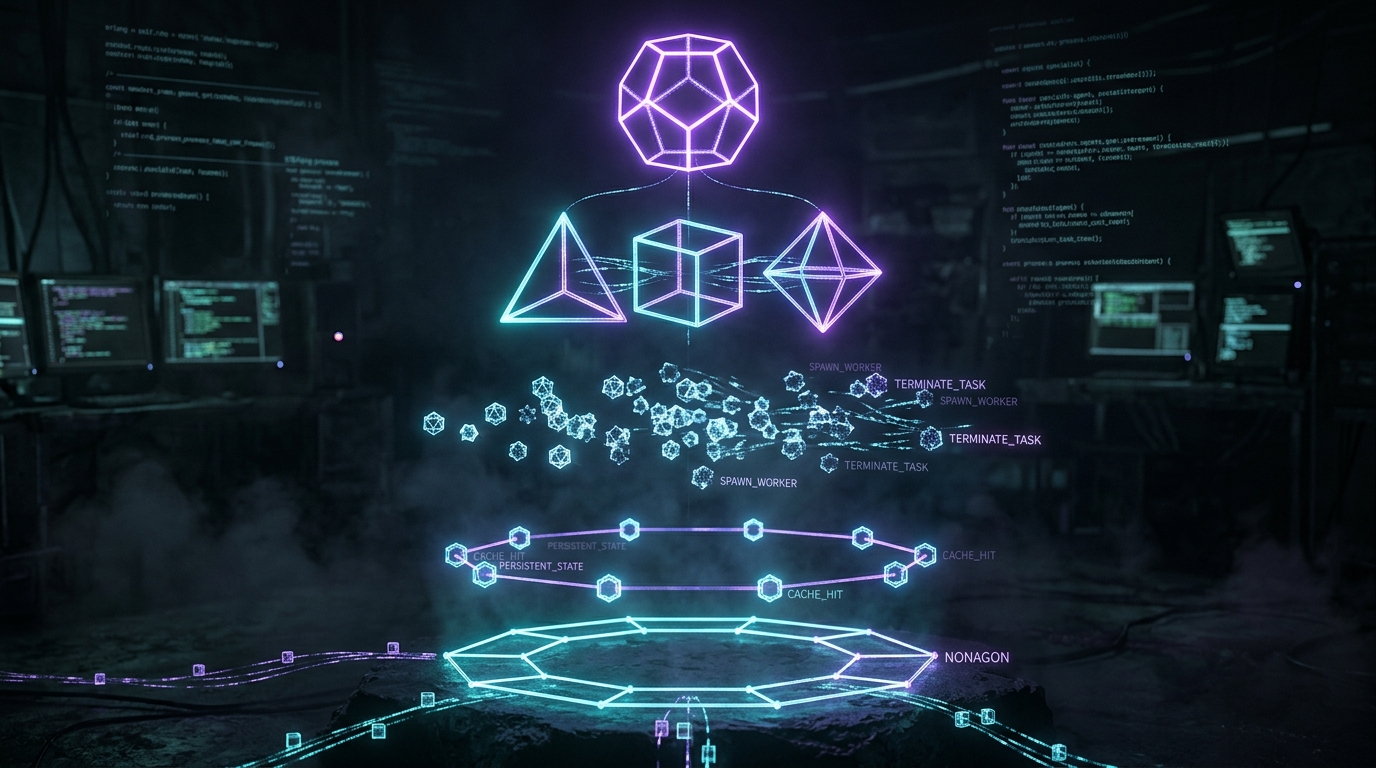
The north star’s topology makes this explicit. Principle fifteen: The north star is the body-center node. The body-center connects to every face, edge, and corner node. The archive is the body-center’s memory — the place where every node’s records converge. Without it, the body-center is a hub without a brain. It routes traffic but cannot recall what traffic it has routed. It transmits but cannot reference what it has transmitted.
Principle sixteen describes the digital-tree command center: one glowing core radiating to nodes, each node connected to the others. The archive is the core’s persistence layer. When a node wakes, the whole tree glows — but only if the tree remembers what the other nodes have done. The living archive is the tree’s memory. Without it, each node is bright but isolated, active but amnesiac.
Building it
The living archive is not infrastructure work. It is north-star work. It is the proof that everything is a record, the ground on which transcription is the first act of power, and the place where continuity beats completion becomes operational. The system that cannot show its record cannot claim the principle.
The archive requires three layers. First, an ingestion layer that pulls records from every source — the vault, the publishing pipeline, the session logs, the media assets — and normalizes them into a common format with unique identifiers and timestamps. Second, a linking layer that connects records to their sources, their derivatives, and their context. Third, a presentation layer that renders the archive as a navigable, queryable interface — not a dashboard, not a search box, but a living document that grows as the kingdom grows.
The archive is the kingdom’s memory. Without it, the record without end is a record that ends at the edge of each session. With it, the record becomes what the corpus says it is: an ongoing stream that outlives every node, a compounding asset that makes month three richer than month one, a living proof that everything the kingdom captures becomes part of the kingdom’s knowledge.
Close the gap
Close the gap by building the living archive. One append-only, linked, queryable record — the ongoing stream that outlives every node — presented as the product. The corpus says the record does not end. The system should make that claim readable. The first note meets the last note on a record without end. Build the record player.
Grounded in the SECTOR9 north star principles — Everything is a record (P7), Transcription is the first act of power (P6), The north star is the body-center node (P15) — and the gap-finder frame: A Record Without End exists as a slogan, not as a product — the corpus has no living archive UI. NSG series, north-star-gap-finder track, SECTOR9 50+50.