
The simulation is free; the lesson is not
Paper-trading is often reduced to a reassuring chart: smooth equity, tidy percentages, no emotional damage. That version can be theater. If the strategy loses its costs, ignores delayed fills, or receives cleaner data than production, it is a performance of success rather than evidence about the rules.
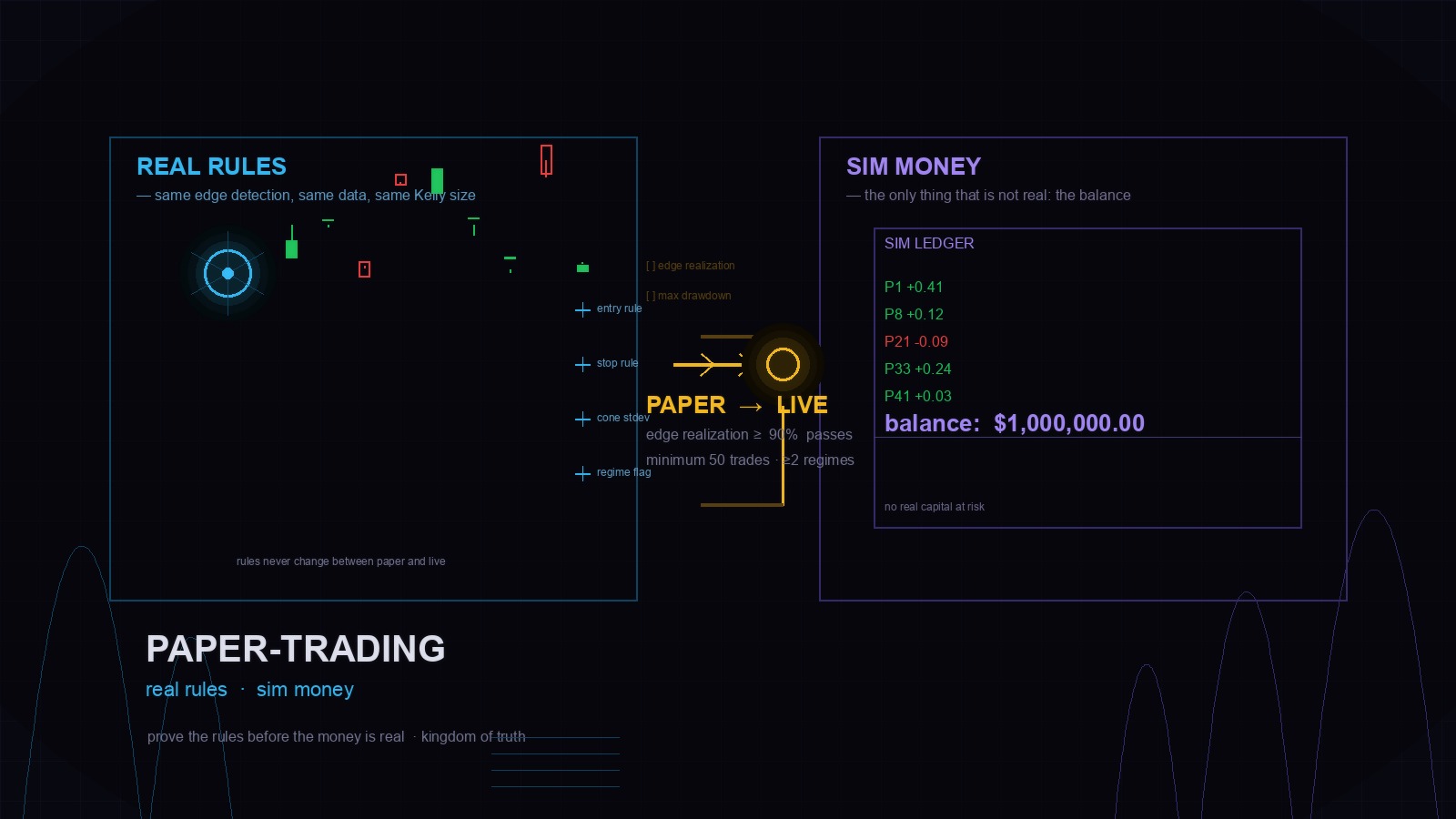
A useful paper trade changes only the money. Entry and exit conditions, position limits, exposure caps, fees, slippage, and operating constraints remain real. The system consumes the timestamped record a live system would see and produces a simulated receipt for every decision. The question is not whether the chart looks exciting. It is whether the rules behave coherently when time, costs, and failure reach them.
The SECTOR9 north star calls information the ground of being. A paper trade is not proof of future performance. It is a record of how a decision system reacts to evidence.
Real rules remove the flattering shortcuts
A simulator can become unrealistically generous without changing a visible threshold. It may fill at the quoted price when volume was thin, settle with an outcome the strategy could not have known, change position size when production keeps it fixed, or omit the delay between signal and execution.
Each shortcut creates a favorable fiction. Honest paper-trading keeps the rulebook fixed and makes the frictions explicit. The ledger should show when the signal appeared, when the system could act, which price became available, what size was used, and what cost was paid.
A rehearsal proves that the script can run. A paper trade probes whether the rule engine deserves authority over resources.
The loop has four bounded stages
The first stage is candidate generation. A signal, article, campaign, or release enters with a stable identity and input record. The system applies the same detection logic it would use later. The output is a candidate, not an approval.
The second stage is rule application. Every candidate passes through sizing, risk caps, exposure limits, timing constraints, duplicate protection, quality requirements, and content boundaries. A candidate that violates a rule is rejected for a reason. The system must not relax a gate because the outcome would look better.
The third stage is simulated execution or deployment. A financial replay produces a modeled fill and cost. A content candidate is rendered into staging, imported into a non-public surface, compressed, cached, and inspected. Exercise the production delivery chain, not screenshots that bypass its failure points.
The fourth stage is measurement and comparison. Record the score, gate result, simulated outcome, cost, latency, and failure class. After a real run becomes available, compare projected and observed results. The difference is the gap score: where the model and reality diverged.
The loop repeats. Simulation, deployment, observation, comparison, and recalibration turn isolated testing into a learning system.
Outcome verification is a moving frontier
Verification cannot begin with a system that has never produced an outcome. Before live evidence exists, a simulator can test internal coherence, gate behavior, cost sensitivity, scenario robustness, and record continuity. These checks support a limited decision: continue the trial, change the rules, or gather evidence.
Once controlled or natural live results become available, the system can measure a real gap. For a market replay, that may be edge realization, net expectancy, maximum drawdown, or cost drag. For a content pipeline, it may be load time, image size, cache behavior, editorial time, publication failure, or the difference between a predicted band and observed delivery.
A moving frontier is healthier than a premature verdict. “Not enough evidence” is valid when the system names what is missing. “Promising” is valid only when scope and limits are attached. “Proven” requires a named standard.
A promotion gate must be able to stop the work
A gate that approves every candidate is not a control. It is decoration. The promotion boundary should return work with a reason: unresolved source, unstable assumptions, excessive cost, missing provenance, duplicate record, broken media relationship, or insufficient evidence.
The gate can be strict without being rigid. Low-consequence work needs fewer checks. High-consequence work needs stronger evidence, independent review, smaller initial exposure, and a reversible rollback. The constant is the architecture: evaluate, record, decide, and preserve the decision.
Promotion should be staged. A successful paper trade can authorize a limited release, followed by a comparison between simulated and observed behavior. If the gap stays inside the declared tolerance, exposure can expand. If not, the system returns to simulation with the new evidence attached.
A gate is valuable because “no” remains a real, explainable answer.
Record continuity keeps the lesson from disappearing
A simulation without a durable record is an anecdote. Each trial should preserve the input and rule-set versions, assumptions, execution model, output, gate decision, and timestamp. When real evidence arrives, preserve the comparison and parameter change. Do not overwrite the original forecast because the outcome looks better in retrospect.
Continuity makes the system inspectable, supports calibration from explicit errors, and keeps learning transferable when a tool, vendor, or agent changes. Keep the authoritative source, local asset, reproducible check, and portable receipt alongside the public result. Remote dashboards can enrich the record, but they should not become the only place the evidence survives.
The dashboard is a decision surface, not a trophy case
A useful dashboard answers what changed the next action. It can show realized versus expected cost, edge or utility realization, drawdown, gate rejection rates, latency, failure classes, and calibration age. A rising line is not inherently good. The operator must know what it measures, where its inputs came from, and which rule responds.
Group results by regime when conditions vary. A rule may be robust in one environment and fragile in another. Aggregate confidence can hide that boundary. The dashboard should expose the segment, not only the flattering total.
The same rule applies to content. If candidates repeatedly miss their performance band, change the queue, tighten the gate, or revise the blueprint. If the dashboard cannot alter a decision, it is telemetry rather than a feedback loop.
Failure is data, but only if the protocol survives
A paper trade will expose broken assumptions, unavailable services, missing files, delayed renders, hostile inputs, and disagreements between expected and observed behavior. Classify the failure, preserve the evidence, repair the cause, and rerun the smallest test that can falsify the fix.
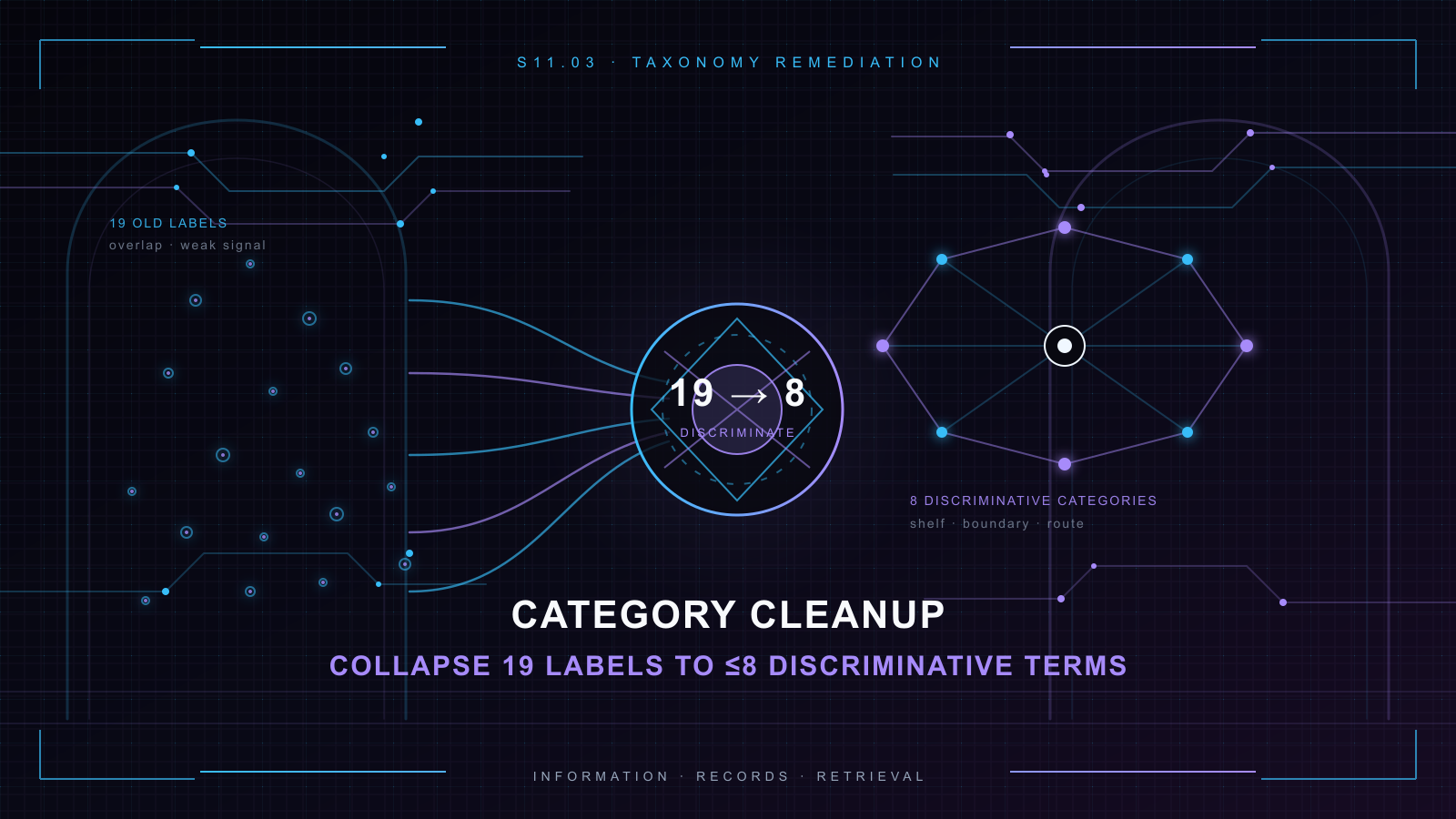
A missing image is not the same as weak positioning. A poor market regime is not the same as an untested rule. A category-term collision is not the same as an editorial defect. Specific classifications let the next iteration begin at the failure point.
A gate, timestamp, provenance edge, and rollback path turn judgment into repeatable action.
Eight questions before promotion
Before simulated work earns a live audience, resource allocation, or capital, ask:
- Which input and rule-set versions were tested?
- Did production constraints remain active?
- Were future information, lookahead, and perfect fills excluded?
- Were costs, delays, failures, and exposure limits modeled?
- What sample and scenario range support the decision?
- What is the gap score, and which dimensions dominate it?
- Can the gate explain a rejection without private memory?
- What is the rollback or return-to-simulation plan?
If the system cannot answer those questions, it may still be gathering evidence. It should not present that uncertainty as a green light.
The gap becomes a product
Simulation is not a rehearsal followed by a leap. It is a bounded product surface where rules meet consequences without pretending the consequences have disappeared. The candidate enters, the engine decides, the gate intervenes, the ledger records, and the next cycle inherits success and failure.
A durable system learns what to transmit—and what not to promote yet.