
Upgrading the Canvas: When Bundled Becomes Baseline
Introduction: The moving line
The three-layer skills architecture — bundled, hub, local custom — presents itself as stable. Bundled skills ship with the platform. Hub skills are community contributions you install on demand. Local customs are the skills you built yourself. Three layers, three sources, three governance models. Clean.
The three-layer skills architecture — bundled, hub, local custom — presents itself as stable. Bundled skills ship with the platform. Hub skills are community contributions you install on demand. Local customs are the skills you built yourself. Three layers, three sources, three governance models. Clean.
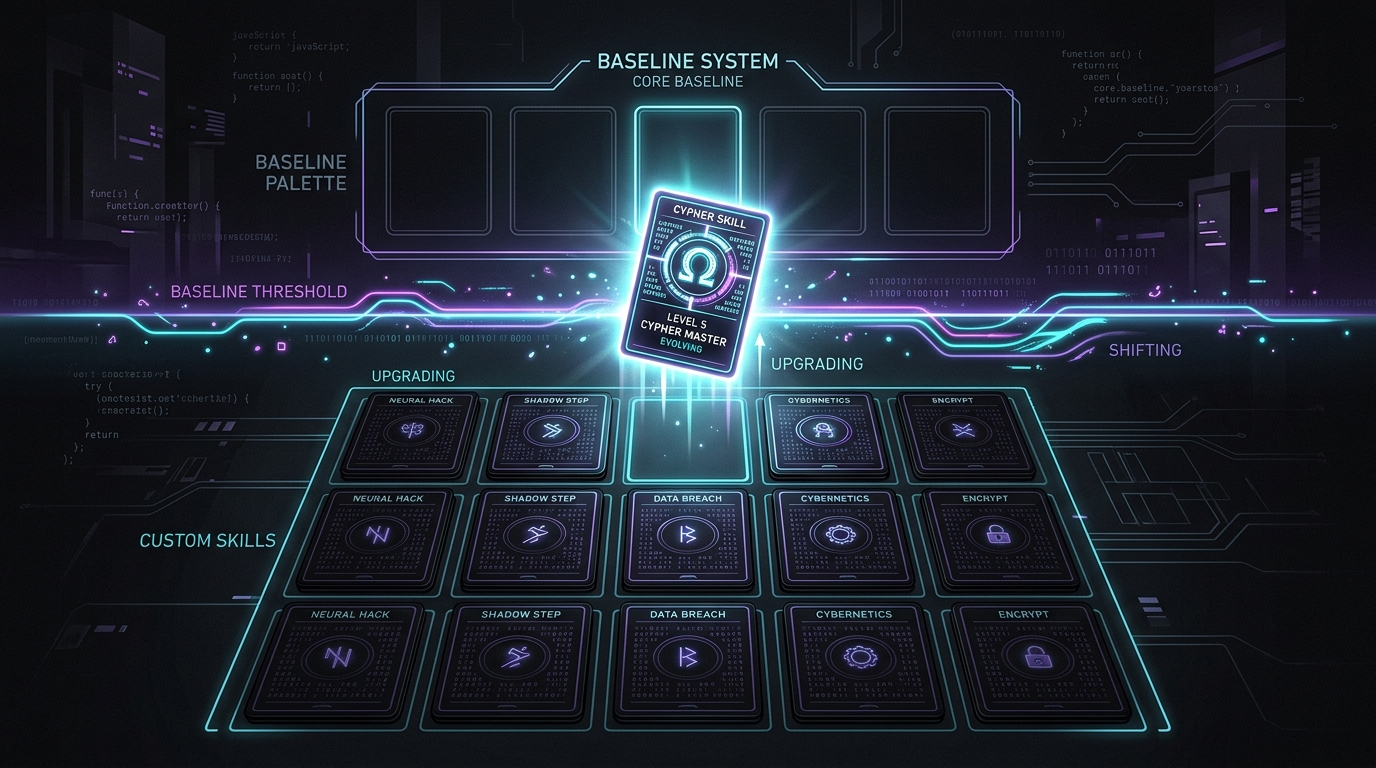
But the line between them is not fixed. It moves. And when it moves, it moves in one direction: upward. Local customs become hub contributions. Hub contributions get promoted into the bundled catalog. What was once a bespoke skill you built at 2 AM to solve a specific problem becomes the thing every new installation ships with by default. The canvas upgrades itself — not by adding new colors, but by graduating old ones into the permanent palette.
This article examines that graduation. When does a local custom stop being custom? What happens to the skill that becomes baseline? And what does it mean for the canvas when the line moves?
The graduation pattern
Every bundled skill in Hermes has an origin story. The `memory` skill did not appear in the bundled catalog fully formed. It was prototyped as a local custom — a SKILL.md file that encoded how to persist facts across sessions using the memory tool. It went through the author-test-deploy cycle described in S4.2: written to solve a specific problem, refined through execution, iterated as failure modes surfaced in the pitfalls section.
At some point, the memory skill stopped being a local innovation and started being a platform primitive. Other deployments adopted it. The Hermes core team incorporated it. It graduated from the local layer into the bundled layer. The skill itself did not change dramatically — the steps were already clean, the triggers already precise. What changed was its provenance. It was no longer “our custom skill for memory persistence.” It was “the memory skill.”
The `kanban-orchestrator` followed the same path. It began as a local custom that encoded decomposition patterns specific to the Council’s multi-profile architecture. Today it ships with Hermes as a bundled skill, used by orchestrator profiles across deployments that know nothing about the Council. The graduation was not a promotion — it was a recognition that the procedure had become general enough to be useful beyond its origin.
This pattern repeats across the library. The graduation criteria are implicit but consistent:
– Generalizability: The skill solves a problem that exists beyond its original context.
– Stability: The pitfalls section has been exhausted — the failure modes are known and documented.
– Demand: Other deployments need the capability and would benefit from it being bundled.
When all three conditions are met, the local custom becomes a candidate for graduation. The canvas does not expand. It deepens — the baseline rises.
What graduation changes
Graduation changes governance, not capability. The memory skill does the same thing as a bundled skill that it did as a local custom. The steps are identical. The triggers are the same. What changes is who maintains it, who reviews it, and who is responsible when it breaks.
As a local custom, the skill is maintained by the agent or team that created it. The author owns the pitfalls section. Updates happen when the author discovers a new failure mode or when the underlying system changes. Quality control is personal — you trust your own work because you tested it yourself.
As a bundled skill, the maintenance responsibility shifts to the platform team. The skill gets reviewed against platform standards. The frontmatter must conform to the bundled catalog schema. The description must be clear enough for users who have no context about the skill’s origin. The pitfalls section must cover failure modes that the original author never encountered, because the skill is now being used in deployments with different configurations, different models, and different operating assumptions.
This governance shift is the real cost of graduation. The skill gains reach but loses intimacy. The author who knew every edge case is replaced by a maintenance team that knows the skill through documentation, not experience. The local custom was a conversation between the author and the problem. The bundled skill is a contract between the platform and its users.
The curator’s role in graduation
The curator — introduced in S4.3 — plays a specific role in this process. Graduation is not automatic. A skill does not become bundled simply because it is popular or well-written. The curator evaluates graduation candidates against the library’s quality standards, checks for overlap with existing bundled skills, and ensures that the graduated skill does not create redundancy.
The curator also handles the transition. When a local custom graduates, the local copy does not disappear. The agent that created it continues to use the bundled version, but the local file becomes a reference point — a record of the skill’s origin. The curator documents the graduation in the HERMES-SKILLS-LIBRARY, noting which local custom became bundled, when, and why.
This documentation matters because graduation is a signal. It tells the community: this procedure is now part of the platform’s identity. The canvas has absorbed a new color into its permanent palette.
The risk of premature graduation
Not every skill should graduate. Premature graduation — pushing a skill into the bundled catalog before it is stable — creates problems that are harder to fix than the original gap.
A bundled skill carries platform authority. Users trust it because it ships with Hermes. If the pitfalls section is incomplete, users hit failure modes that the skill was supposed to prevent. If the triggers are too broad, the skill loads when it should not, consuming context window for irrelevant capability. If the steps are fragile — dependent on specific configurations that do not hold across deployments — the skill breaks silently, producing plausible-looking output that is actually wrong.
The local custom layer is a testing ground. Skills in the local layer are expected to be experimental, incomplete, and specific. Users who install a local custom accept that it may need tweaking. Users who load a bundled skill expect it to work. Graduating a skill before it has earned that trust is a governance failure, not a technical one.
The curator’s judgment here is irreplaceable. Automation can flag usage patterns, track age, and measure stability. But the decision to graduate — to say “this skill is now part of the platform’s identity” — requires understanding the skill’s context, its failure modes, and its fitness for a broader audience. That is human judgment, and it is the curator’s core responsibility.
The canvas after graduation
When a skill graduates, the canvas does not get a new color. The canvas gets a better version of an existing color. The memory skill as a local custom was one shade. As a bundled skill, it is the same shade but available to every installation, maintained by the platform, documented against a broader set of failure modes.
This is the canvas metaphor in action. A painter does not add new colors to the palette when they master a technique. They refine the colors they have. The palette deepens. The range of possible paintings expands — not because the number of colors increased, but because each color became more reliable, more understood, more capable.
The 71-skill canvas is not static because skills graduate. It is dynamic because graduation raises the baseline. Every local custom that becomes bundled lifts the floor of what every new installation can do. The canvas upgrades itself by absorbing its best local work into its permanent structure.
What comes next
S4.10 asks whether skills can be products — sold, not just used. But the foundation of that question is this: skills that graduate from local to bundled have already demonstrated product-market fit. They solved a real problem, survived testing, and earned platform trust. The graduation from local custom to bundled skill is the proof that a skill has value beyond its creator.
The canvas does not need new colors. It needs its best colors to become permanent. That is what graduation accomplishes. The line moves upward. The baseline rises. The canvas upgrades itself.
This article is the ninth of the Skills Canvas series (S4). For the series opening, see S4.1 “The 71-Skill Canvas.” For the curator that manages graduation, see S4.3. For skills as products, see S4.10.