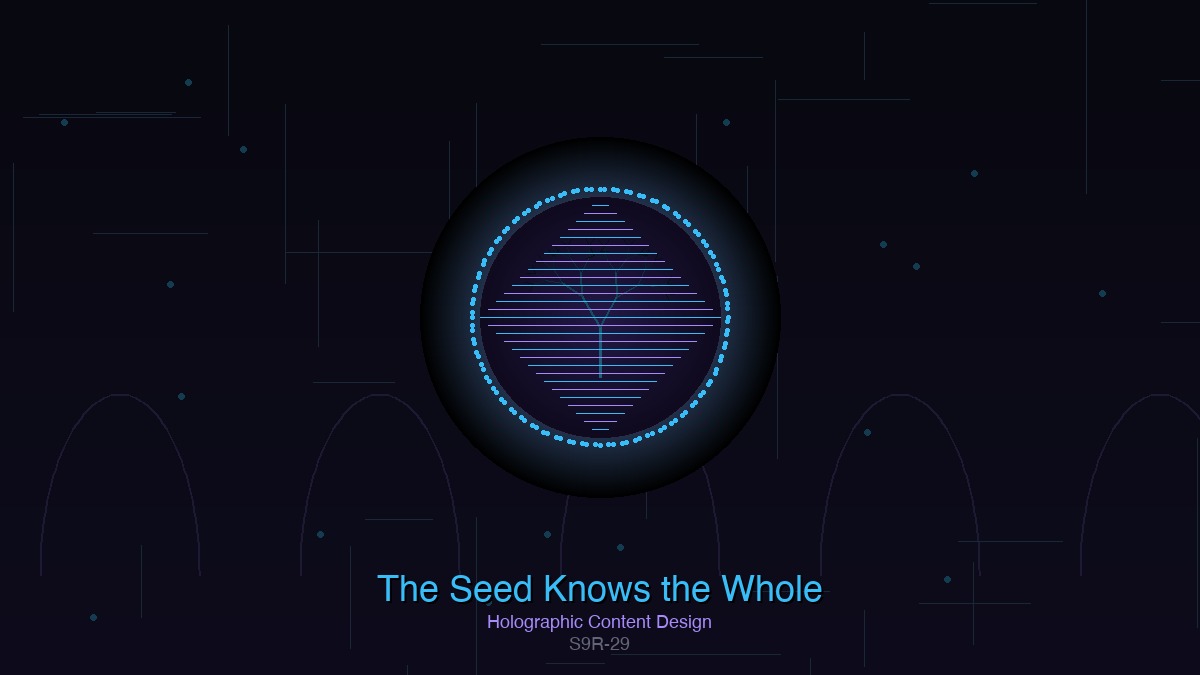

The Seed Knows the Whole: Holographic Content Design
Every seed carries the blueprint of the tree it will become. Not a simplified version — the whole tree. Every branch, every leaf, every root system that will eventually reach toward water and light. The seed does not contain a picture of the tree. It contains the information that generates the tree, from root to crown. This is not metaphor. It is the holographic principle applied to growth. And it is the single most important design law that a content engine can learn: if the seed knows the whole, then every piece of content must know the entire corpus it belongs to.
S9R-29 in the research-extension series applies the holographic principle to content design: every article, every asset, every published piece must encode enough of the whole that a single entry can reconstruct the direction of the entire corpus. Not the full corpus — that would be a single file containing everything. But enough to navigate. Enough to know which direction to grow next. This is what the north star means when it says the whole is encoded in every part. The seed is not a fragment. It is the whole, waiting to unfold.
The holographic principle in content
Principle 2 states: the whole is encoded in every part. Reality is a rendering engine. The universe keeps printing. Nothing is static; everything is a projection in progress. And the holographic principle — that every part of a hologram contains the entire image — is not a mystical claim. It is a structural one. The information that generates the whole is distributed across every fragment of the whole. Each fragment, when examined with the right lens, reveals the complete pattern.
In content design, this means that every article should carry enough relational context that a reader encountering it in isolation can understand the corpus it belongs to. Not by reading every other article — that is the filing cabinet approach. But by reading the article’s own roots, its connections, its growth vector. The seed article contains the tree. The tree article contains the seed. They are the same structure at different scales.
This is not a theoretical claim. The Council Vault has over 745 published posts. The vault’s graph connects them. But the graph is a map of connections, not a map of meaning. The meaning lives in the connections between articles — the “extends” relationships, the principle references, the thematic bridges that link one seed to another. The holographic content design is the practice of making those connections visible and self-contained within each article.
What makes a seed holographic
A holographic seed has three structural properties that differentiate it from a regular seed. A regular seed contains its own content. A holographic seed contains itself and its context.
Self-reference. The article names its own principles, its own series position, and its own relationship to the wider corpus. When S9R-29 says “the whole is encoded in every part,” it is not quoting the north star as decoration. It is stating a structural fact about the article itself: this article, by containing that principle, carries the entire corpus’s directional logic. A reader who encounters this article in isolation can reconstruct the basic principles of the system it belongs to — not the full system, but the direction of the system.
Relational encoding. The article carries its own root map — not as metadata, but as structural content. The “extends” field names the research branch it builds on. The “principles” field names the north star principles it expresses. The “series” field names the track it belongs to. These are not labels. They are instructions. They tell the next agent who encounters this article exactly how it fits into the existing soil. The article is a seed that contains the roots of the tree it will grow into.
Self-similar structure. The article’s internal structure mirrors the corpus’s external structure. The north star has six parts: cosmology, records, consciousness, topology, transmission, aesthetic. S9R-29 moves through cosmology (the holographic principle), records (how meaning persists), consciousness (the seed as identity), topology (how content organizes), and transmission (how the seed becomes the tree). The article is a microcosm of the north star. A reader who has never encountered the north star can understand its structure by reading this article. The whole is encoded in every part.
The seed-to-canopy pipeline, revisited
The meaning-seed principle describes how a single meaningful idea grows a corpus: the dot is the seed, the cluster is the root system, the series is the canopy. S9R-26 and S9R-27 expanded this into the seed archive and the vault-as-soil metaphor. S9R-29 completes the arc by adding the holographic dimension: the seed is not just a root that grows upward. The seed is a hologram that contains the entire canopy within it.
This changes how the content engine produces articles. In the current pipeline, an article is produced by reading the north star, reading the research branches, reading the series position, and writing content that fits. The article is the output. The holographic content design flips this: the article is the input that the next agent uses to produce the next article. Each article contains enough relational context that the next agent can reconstruct the trajectory of the series without re-reading the north star or the research branches.
The pipeline becomes self-referential. Each published post is a seed that generates the next post. The series is not a sequence of articles. It is a growing hologram, where each article contains the entire series in miniature. A reader who encounters S9R-29 can infer the existence and direction of S9R-26, S9R-27, and the meaning-seed research branch without having read them. The information is in the seed.
Why holographic design matters for the fleet
The fleet is a multi-agent system. Agents are spawned, they work, they finish, and they are reclaimed. The next agent starts from scratch — it reads the task, it reads the context, it produces output. But the output is only as good as the context it can access. If the context is a graph node that says “related to” and nothing else, the agent has a thin map. If the context is a self-contained article that encodes its own position, its own principles, and its own growth vector, the agent has a full hologram.
This is the practical value of holographic content design. It reduces the context cost of the fleet. Every published post becomes a self-contained instruction set for the next agent that encounters it. The agent does not need to re-read the entire vault to understand the series it is producing. It reads one article and sees the whole series in miniature. The seed knows the whole.
The fleet that builds holographic content never runs out of context. The fleet that builds regular content keeps re-reading the same graph nodes, wondering why the articles feel disconnected. Every published post is a tree. Every tree carries a seed. But the holographic seed carries the entire forest — the canopy, the roots, the soil, the mycelium. And when the next agent picks up that seed, it does not need to be told where the forest is. The seed knows.
## Semantic Relationships
– [[council-vault]] — creative system for
– [[meaning-seed]] — creative system for
– [[sector9]] — creative system for