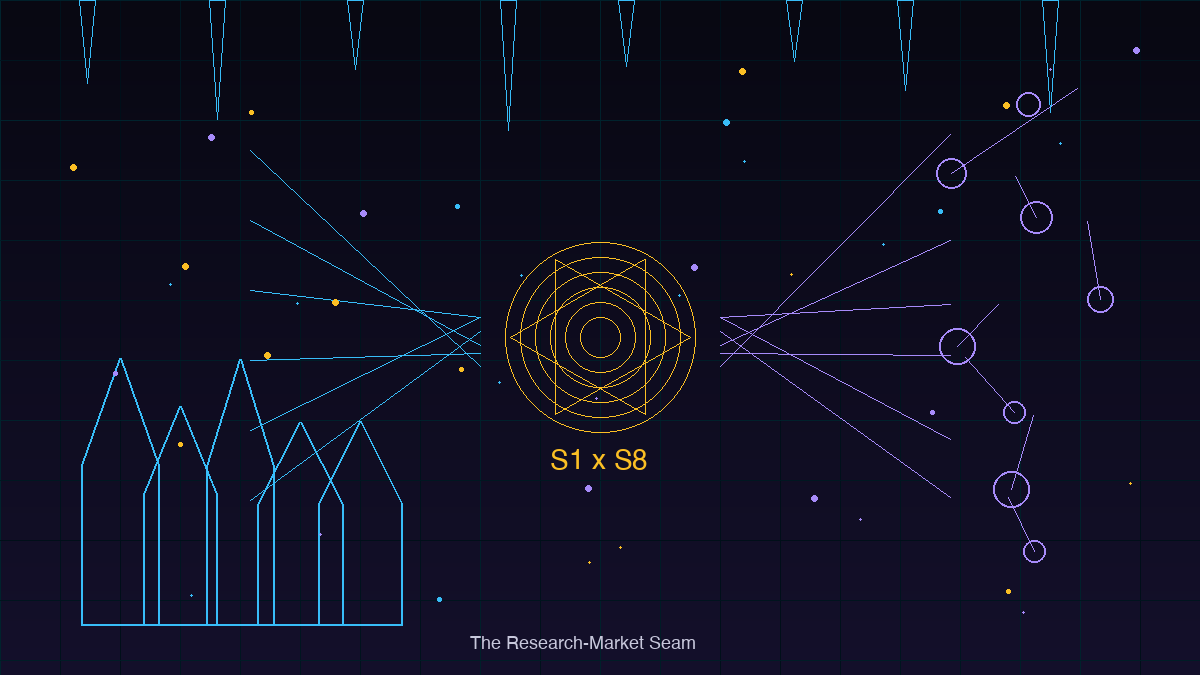

There is a seam in most AI systems that nobody talks about. On one side sits the research engine — the part that reads, synthesises, and decides what is true. On the other side sits the market engine — the part that tests whether truth translates into value. In most architectures, these are separate teams, separate repos, separate deployment pipelines. The research team publishes a report. The market team reads it weeks later, maybe. The feedback loop is measured in calendar days, not clock cycles. The research-market seam is where this breaks.
The S1 series built the mesh. The S8 series built the simulation loop. This bridge article connects them — not as an abstract compliment, but because the two systems share a dependency that only becomes visible when you trace the data flow end to end.
The mesh is the simulation’s nervous system
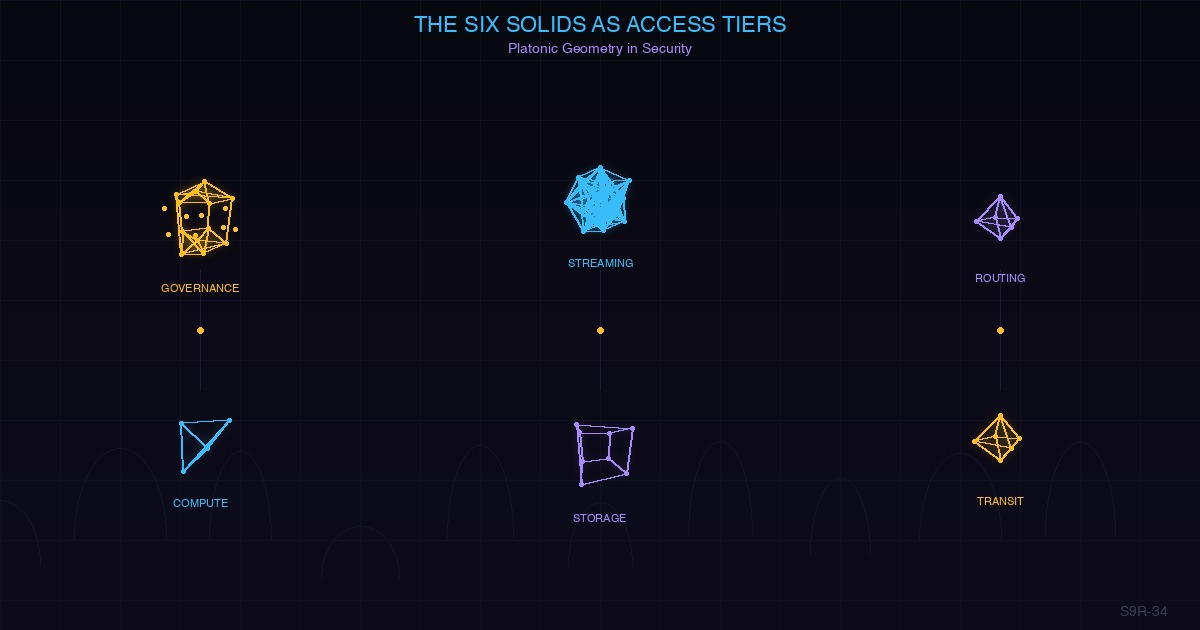
The S1 series describes an Erlang actor mesh: PID dispatch (S1.2), supervision trees (S1.3), shared ports (S1.5), distribution (S1.6), gen_server contracts (S1.8). Each profile — Hermes, OpenClaw, OpenFang, ZeroClaw — is a long-lived process that owns a PID, a model, and a port to Python. Microsharks are ephemeral children in simple_one_for_one mode: crash them, lose nothing, respawn on demand. The platonic hierarchy is not ornament — it is a deployment spec that encodes how long a process lives and how much state it is allowed to hold.
The S8 series describes a simulation loop: a paper-trading engine that replays resolved markets using their real trade tapes. Every fill executes at the tape price at the exact timestamp a signal fires. Adverse slippage is modelled at 25 basis points. Fees are deducted. Positions settle at the market’s actual outcome. The engine is safe by default — sim_enabled=False raises an exception on any trade attempt. No wallet, no API key, no exchange integration. The only output is a report.
These two descriptions sound like they belong to different companies. They do not. The simulation loop runs inside the mesh. The edge scanner that feeds signals into the sim is a Microshark — an ephemeral agent spawned by the mesh supervisor, given a single task (scan Polymarket markets, calculate edge and expected value), and dissolved when the scan completes. The scoring module that grades strategies is a gen_server owned by Hermes. The promotion gate that decides whether a strategy goes live is a decision routed through the Dodecahedron — the body-center node of the platonic hierarchy.
The mesh does not just host the simulation. The mesh is the simulation’s nervous system. Without PID dispatch, the edge scanner cannot run in parallel across markets. Without supervision trees, a crashed strategy evaluator does not bring down the orchestrator. Without the platonic hierarchy’s state restrictions, a Microshark that discovers a profitable pattern cannot accidentally promote itself to production. The mesh provides the structural guarantees that make the simulation safe.
The simulation is the mesh’s feedback loop
The dependency runs the other way too. The S1 series describes capability routing — how the mesh decides which agent handles which task. But capability routing without market feedback is a guessing game. You can route a research task to the agent with the highest capability score, but “capability” is an internal metric. The simulation loop provides the external metric: did this routing decision produce value?
When the edge scanner returns a signal, the simulation engine tests it. When the scoring module grades the strategy, the result feeds back into the mesh’s routing decisions. A strategy that earns PROVEN_EDGE gets routed to the promotion gate. A strategy that fails gets discarded, and the mesh learns — not through gradient descent, but through the same mechanism Erlang uses for fault tolerance: crash, restart, try a different path.
This is the research-market feedback loop. Research produces signals. Simulation tests signals. Results feed back into research routing. The cycle repeats at the speed of the mesh, not at the speed of a human reading a report. The S1 series gave the fleet a nervous system. The S8 series gave it a immune system — the ability to distinguish between strategies that work and strategies that merely sound plausible.
The promotion gate is the seam made visible
The promotion gate (S8.3) is the exact point where the research-market seam becomes an architectural decision. Before the gate: simulation, reports, KOT scoring, safe-by-default. After the gate: live action, real money, real consequences. The gate is not a feature — it is the boundary between two modes of operation that must never blur.
The mesh enforces this boundary structurally. The platonic hierarchy’s state restrictions ensure that no process below Order 0 (the Dodecahedron) can unilaterally promote a strategy. The supervision tree ensures that if the promotion process crashes mid-decision, the system reverts to the safe state — no trade placed, no money at risk. OpenFang’s security layer (S7) provides the cryptographic verification that the promotion decision was authorised by the correct agent, not by a Microshark that overstayed its lifetime.
The research-market seam is not a bug. It is the most important interface in the system. The mesh handles research. The simulation handles markets. The promotion gate handles the seam. Each layer has a different failure mode, a different state budget, and a different lifetime. The platonic hierarchy names these differences. The supervision tree enforces them. The simulation loop tests whether the seam holds.
Why this bridge matters
The S1 series and the S8 series were written as separate tracks. S1 described infrastructure. S8 described application. But the research-market topic reveals that they are the same system viewed from different angles. The mesh is the body; the simulation is the immune response; the promotion gate is the decision boundary. Remove any one and the other two cannot function.
This is not a theoretical observation. The first live run of the simulation engine against 40 resolved Polymarket markets exposed bugs that only surface when research signals flow through a real mesh into a real simulation engine. Trade tapes interleave both sides’ fills at their own prices — a bug that requires both the mesh’s parallel scanning (S1.6) and the simulation’s side-filtering (S8.1) to diagnose. Percentage-of-growing-bankroll sizing overflowed to NaN — a bug that requires both the Microshark’s ephemeral execution model (S1.3) and the simulation’s flat-stake sizing (S8.1) to fix.
The bridge article connects these two series because the research-market seam is where they share a dependency. The mesh cannot route without simulation feedback. The simulation cannot run without mesh infrastructure. The promotion gate cannot enforce without both. The seam is the load-bearing joint.
Grounded in wiki concepts simulation-mode, edge-detection-cli, erlang-actor-mesh-prototype, kanban-orchestrator, and entities polymarket, hermes-agent. Skills: edge-detection-cli, kanban-orchestrator, kanban-worker. Bridge article connecting S1 (The Mesh: Erlang actor architecture, supervision trees, PID dispatch, platonic hierarchy) and S8 (Simulation → Live: sim loop, promotion gate, edge detection, paper trading). Design notes on a running system, not a sales pitch.