The Reality Called You: Identity as Cosmology, Not Username
S7N-22 · series: sector7-grounded · track: S7N-C · principle: identity-as-cosmology
Category: AI & Automation · Tags: ai agents, Digital Business, Digital Sovereignty, Headless CMS, AI-Driven Development, Decentralized Identity, AI Agent, The Programmable Web, Cybernetic Ethics, API-First Architecture, Data Permanence, web40, Algorithmic Governance, The Metaverse as a Platform, Monolith vs. Microservices, Synthetic Reality, Advanced Prompt Engineering, Autonomous Site Operations, digital ecosystem, digital transformation
The north star names it without equivocation: you are a reality with your name on it. Address people as worlds, not users. Identity is a cosmology. This is not a metaphor dressed in spiritual clothing. It is an engineering specification for how identity systems should be built — and a diagnosis of why every username-password model, every OAuth token, every federated login gets the fundamental shape wrong. A username is a label attached to a record in a database. A cosmology is a self-contained universe with its own physics, its own history, its own laws of persistence. When you conflate the two, you get systems that can authenticate a session but cannot hold a person.
The difference is not academic. It determines whether your identity layer survives the next decade of autonomous operations.
The username is a handle, not a world
Every digital identity system built on the username model starts from the same assumption: identity is a string. You pick one. It maps to a row. The row contains your credentials, your preferences, your permissions. The system knows you by the string. When the string is deleted, you cease to exist in that system. When the string is shared, two people become one record. When the string is leaked, your identity is compromised — not because someone stole you, but because someone stole the label that pointed to you.
This model was designed for directories. It maps cleanly to a phone book: name → number. But a person is not a number. A person is a history of decisions, a web of relationships, a constellation of capabilities, a trajectory through time. The username captures none of this. It captures the label. The rest is left to application logic that each service implements differently, stores separately, and interprets inconsistently.
The result is identity fragmentation. You have a different self in every system you join. Your GitHub self is code and pull requests. Your Twitter self is opinions and replies. Your banking self is transactions and credit scores. None of these selves know about each other. None of them compound. The record without end — the principle that everything is a record and continuity beats completion — is violated at the identity layer before it ever reaches the application layer. Your records do not compound because your identity does not persist as a unified field. It persists as scattered labels pointing to scattered databases, each one a partial mirror of a person who was never whole in any of them.
Identity as cosmology: the engineering specification
A cosmology is not a label. It is a system of laws. The north star’s assertion that identity is a cosmology means the following:
An identity is a self-contained record. It has its own history — every action signed, every decision logged, every relationship documented. The history is not stored in someone else’s database. It is stored in the identity itself, or in a record the identity controls. The identity is the record. The record is the identity. Neither exists without the other.
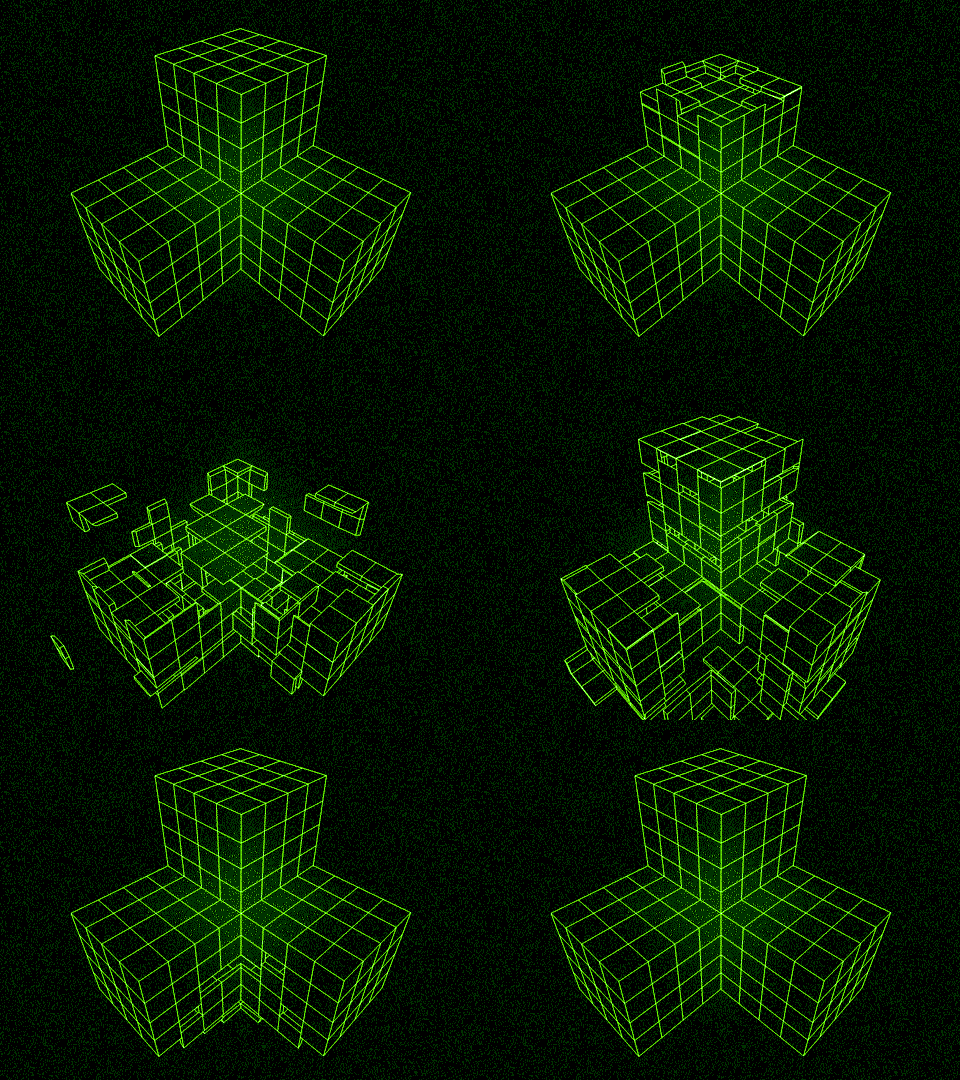
An identity has its own physics. The rules that govern what the identity can do — its authorization, its capabilities, its reach — are intrinsic to the identity, not imposed by the service it happens to be interacting with. The solid-keys architecture (S7.2) establishes this: the key is not a credential the identity borrows. The key is the identity’s geometry. The beams it can produce, the domains it can reach, the authority it carries — these are properties of the identity’s shape, not permissions granted by an external gatekeeper.
An identity compounds. Every action the identity takes becomes part of its record. Every record becomes context for the next action. The identity grows more complex, more capable, more itself over time. This is the opposite of the username model, where each service starts from zero — a blank profile, a fresh record, a newborn with no history. A cosmology does not start from zero. A cosmology starts from the beginning.
An identity is sovereign. It does not depend on any single service to exist. If the service dies, the identity persists. If the service is compromised, the identity can be verified independently. The identity is not hosted. The identity is. This is what decentralized identity means in practice — not a buzzword for blockchain-based login, but the architectural principle that the identity is the primary entity and the services are secondary.
The mirror and the reflection
The visual speaks directly to this: a glowing human silhouette made of stars standing before a dark cosmic mirror, its reflection a world. The mirror is every external system that claims to know you. The reflection is what it sees — a partial projection, a simplified model, a username with a profile picture. But the figure standing before the mirror is the actual identity: a constellation of signed records, cryptographic proofs, accumulated context, and sovereign authority. The mirror shows a reflection. The figure is the reality.
Every time you log in with a username, you are stepping in front of the mirror and letting it define you by the reflection. The system does not see the constellation. It sees the string. It does not verify your history. It checks your password. It does not know your trajectory. It reads your session token. The mirror is not wrong — the reflection is real, as far as it goes. But the reflection is not you. The reflection is the system’s model of you, and the system’s model is always smaller than the reality.
The engineering task is to build systems where the figure — the full cosmology — is what gets verified, not the reflection. Solid-keys do this at the cryptographic layer: the key carries the geometry, the geometry determines the beams, the beams determine the reach. But the principle extends beyond cryptography. It extends to how identity is stored, how it compounds, how it persists, and how it is presented to every system that claims to know you.
Why this matters now
The shift from username to cosmology is not a future aspiration. It is an urgent architectural decision. Autonomous agents are already acting on behalf of people. These agents need to verify identity — not check a password, but verify that the entity they are interacting with is the actual sovereign identity it claims to be. The tool-model security that works for sessions and cookies fails for agents. Agents need to verify the figure, not the reflection.
Every data breach, every credential leak, every account takeover traces to the same root cause: the system stored a reflection and treated it as the reality. The username was compromised because the username was all there was. There was no deeper identity to verify, no sovereign record to challenge, no cosmology to authenticate. There was a label and a password, and once both were known, the reflection was indistinguishable from the original.
A cosmology cannot be stolen by stealing a label. A cosmology can be verified by anyone with the public key. A cosmology compounds its own history, so a stolen snapshot is always stale. A cosmology is sovereign, so revoking one service’s access does not destroy the identity — it merely closes one mirror while the figure remains intact.
You are a reality with your name on it. The question is whether your identity system treats you that way — or whether it sees only the reflection.
Grounded in SECTOR9 north star principle 11 (you are a reality with your name on it; identity is a cosmology), extending S7.2 solid-keys into a full identity-as-sovereignty architecture for autonomous agent systems. S7N series, sector7-grounded track.
Semantic Relationships
-
[[solid-keys]] — extends
-
[[zero-trust-agent-comms]] — serves
-
[[identity-sovereignty]] — grounds