
The Mesh Under the Mesh: Tailscale, BEAM, and the Physical World
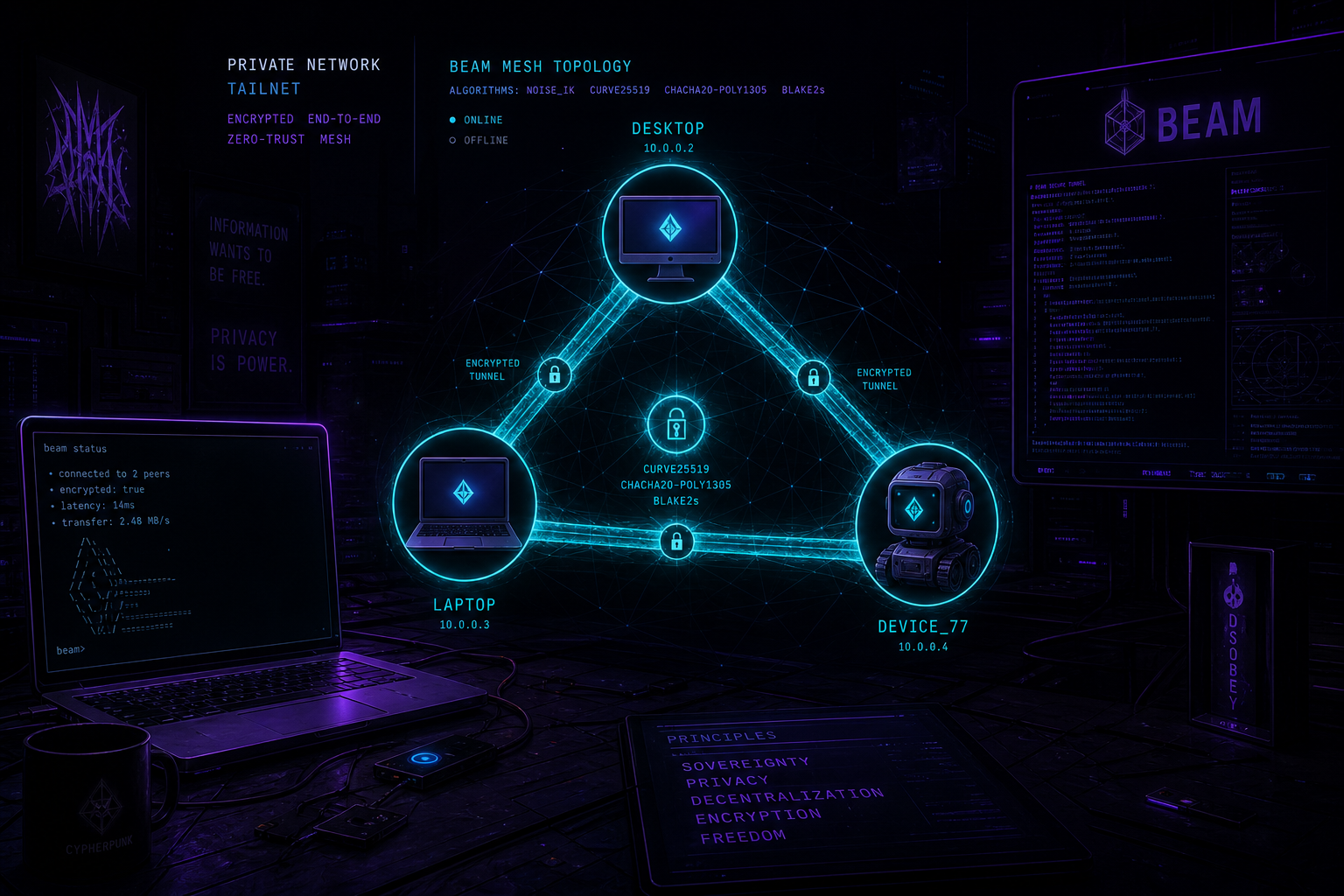
The futures thesis for the actor mesh is not about one host — it is about hosts everywhere, connected by a private network that behaves like one machine. Erlang distribution already solves the abstraction: nodes on different machines form one cluster, and messages between actors do not care which node they land on. What Erlang does not solve is the network underneath. That is what Tailscale does. The mesh under the mesh — a Tailscale tailnet carrying BEAM distribution between the iMac, the Lenovo nodes, the robot shells, and the cloud — is the layer that turns a local-first cluster into a physical-world mesh.
What we built
The Kingdom of Truth runs its entire fleet over a Tailscale tailnet. The vault’s tailscale entity and the SECURITY-TAILSCALE-ONLY-RULE protocol document the constraint: no service is exposed on the public internet; everything reaches the stack through the private network. The mesh distribution documented in S1.6 (“Beyond One Host”) is the Erlang half of this story, and the hardware round aligned the S1 series with actual machines. The 2026-08-05 physical-ascension research brief already names the tailnet as the transport for robot sensor streams — cameras and LIDAR flowing back to the vault graph. The pieces exist. What does not yet exist is the merged topology: BEAM nodes whose distribution links ride the tailnet as first-class citizens.
The vision
In the converged future, a BEAM node on a robot shell and a BEAM node on the iMac are siblings in one cluster. The robot’s supervision tree extends into the house. The mesh’s name registry resolves actors by physical location as well as logical role. The tailnet becomes the nervous system: Tailscale’s NAT traversal, wireguard encryption, and device identity provide the transport security that Erlang distribution assumes but does not provide. The mesh under the mesh is the difference between a cluster that works on a LAN and a fleet that works across the physical world.
What’s next
The next increment is a controlled experiment: run two BEAM nodes on separate tailnet devices (the iMac and one Lenovo node), link them with Erlang distribution over the tailnet IPs, and measure handoff latency, node discovery, and partition tolerance when a device drops. That measurement — a real benchmark of BEAM-over-Tailscale — becomes the evidence for the physical-world mesh that physical ascension will need.
Grounded in vault entity tailscale, protocol SECURITY-TAILSCALE-ONLY-RULE, the physical-ascension-research brief, and wiki concept erlang-actor-mesh-prototype. Third article in the SECTOR07a futures series.