
The creative pipeline does not run on talent alone. It runs on governance. Every image prompt, every hero upload, every batch of visuals is a coordination event — and the Council’s mesh is the reason any of it ships consistently.
Series S5 established how the Council of Three coordinates agent work: three specialist parents, a shared kanban board, spawn protocols, heartbeat monitoring, and completion summaries that turn scattered execution into a provable record. Series S9 established what the creative studio produces: a visual language (cypherpunk goth, systematized), a hero image pipeline (from prompt to published), style anchors that keep brand consistent across dozens of articles, and a media delivery standard that ensures what gets created actually reaches the live site in the right format. Two series. One talks about coordination. The other talks about craft. The problem is that most teams treat creative output as a separate concern from operational governance — and that separation is exactly where sovereign media production breaks down.
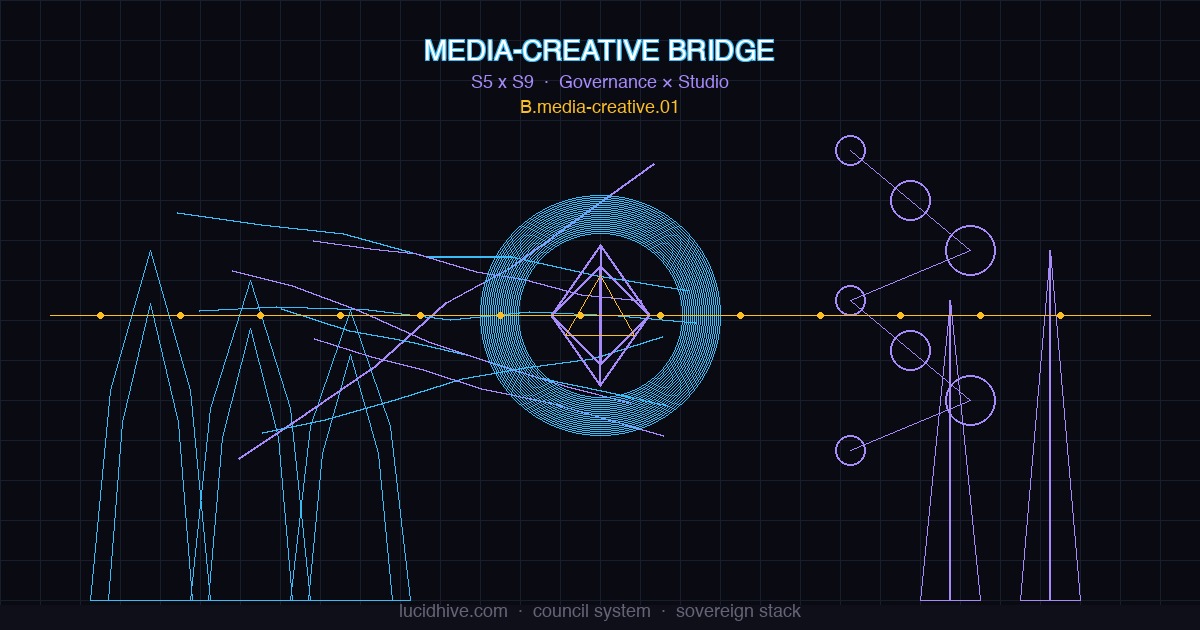
This bridge connects them. The argument is simple: creative media production IS a governance problem. The way you coordinate agents determines what your visuals look like, how consistent they stay, and whether the sovereignty promise survives contact with a publishing pipeline.
The spawn protocol as creative brief
S5.1 described the spawn contract: a parent agent creates a child task, the child claims it with a lock, and the parent monitors heartbeats until completion or orphan detection. S9.4 described the hero image pipeline: generate a prompt, render the image, import to WordPress, set the thumbnail, verify the URL. The bridge between them is the spawn contract acting as a creative brief.
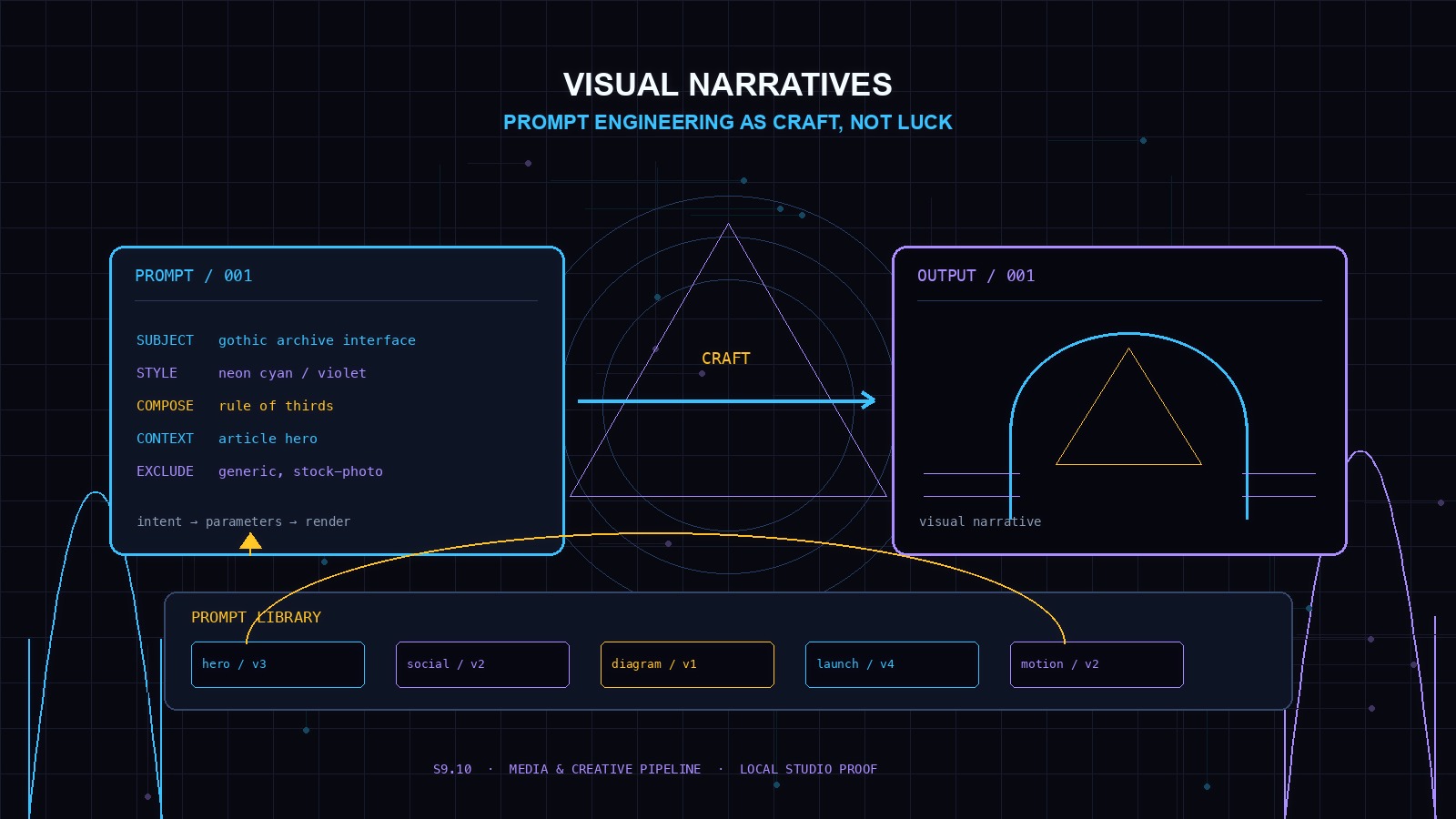
When the mesh coordinates a media-creative task, the spawn message is not just “make an image.” It carries the article title, the brand style tokens (dark background, neon cyan #38bdf8, violet #a78bfa, gothic spires, circuit traces), the series context (which sector, which bridge, which principle), and the quality gates (must pass GEMS check, must include alt text, must register as WP attachment). The governance layer does not need a separate creative brief system. The spawn contract already encodes the creative requirements, because the parent task’s body contains everything the child needs to produce brand-consistent output.
This means creative consistency is not bolted on after the fact. It is emergent from the governance architecture. A S9.3 prompt library entry defines the style anchors. The spawn protocol carries those anchors to every child task. The completion summary records whether the output matched the brief. The audit trail proves it. The governance layer does not just coordinate creative work — it enforces creative coherence at the board level, not through a style guide document that nobody reads.
The heartbeat as quality loop
S5.3 described heartbeat monitoring: the parent checks whether the child is alive, whether it is making progress, whether it has stalled or crashed. S9.15 described visual QA: what an image review loop catches — wrong aspect ratio, missing brand tokens, broken alt text, incorrect file naming. The bridge: the heartbeat IS the quality loop.
When a media-creative child task claims its lock, the parent does not just wait for completion. It monitors for intermediate signals: has the prompt been generated? Has the image been rendered? Has the file been uploaded to the media library? Each signal is a heartbeat checkpoint that corresponds to a quality gate from the S9 visual pipeline. A child that crashes after generating the prompt but before uploading the image triggers orphan detection — and the parent knows exactly where in the pipeline the failure occurred, because the heartbeat payload encodes the current stage.
This is the connection most creative pipelines miss. They generate images in batch, upload them in batch, and discover quality issues in batch — after the entire pipeline has already committed resources to output that may not meet standards. The Council architecture inverts this: every image is a self-contained task with its own heartbeat, its own quality gates, and its own audit trail. A failure at stage three (upload) does not corrupt stages four through ten, because each stage is a separate checkpoint on the board, not a monolithic pipeline step that either succeeds or fails as a unit.
The completion summary as provenance record
S5.2 described the completion summary: what the child did, how long it took, which profile executed it, and what artifacts it produced. S9.7 described the hero image lifecycle: generate, import, set, verify. The bridge is the provenance record that connects governance to visual output.
When a media-creative task completes, the summary is not just “image uploaded.” It is a structured record: the prompt used, the generation parameters, the file path, the WordPress attachment ID, the alt text assigned, the compression status, and the cache rebuild timestamp. This provenance chain is not overhead. It is the product. A customer paying for Content-as-a-Service is not paying for the output (any AI can generate an image). They are paying for the traceable output — the image that comes with a governance record proving which specialist produced it, under which spawn contract, with which quality gates applied, and at what cost in board events.
This is what makes the sovereign creative stack genuinely different from cloud-based image generation. A cloud platform charges based on API calls or compute credits. Those metrics are provider-controlled and opaque. The Council architecture charges based on governance events — tasks claimed, heartbeats received, completions recorded, handoffs verified. The creative business model emerges from the governance model, not the other way around. And because the governance model runs on a local SQLite file, the cost structure is transparent to the operator in a way that a cloud billing dashboard never can be.
The delivery standard as governance enforcement
S9’s media delivery standard — greenlight, compress, rebuild cache, verify — is not a post-production checklist. It is the final governance gate in a chain that started at the spawn contract. The delivery standard enforces that every image reaching the live site has passed through the full governance pipeline: it was briefed (spawn body), rendered (child execution), quality-checked (heartbeat monitoring), imported (WP attachment), and verified (completion summary). Skipping any step breaks the chain, and the board records the gap.
This is the media-creative bridge in one sentence: the Council does not just coordinate creative work. The Council proves creative work was done correctly. Every spawn is a creative brief. Every heartbeat is a quality checkpoint. Every completion summary is a provenance record. When the governance layer and the creative layer share the same ledger, visual consistency is not a aspiration documented in a style guide — it is a mechanism enforced at the board level, one task at a time.
Series S5 showed how the mesh coordinates. Series S9 showed what the mesh creates. This bridge shows that they are the same thing. The media-creative connection between governance and craft is not a gap to be bridged with integration code. It is an identity: the system that coordinates is the system that creates, and the record that proves coordination is the record that proves creative quality.
That is the sovereign stack operating as designed — one board, one ledger, one visual language.