
The Edge Resilience Scenario: When the Cyclone Knocks Out the Cloud
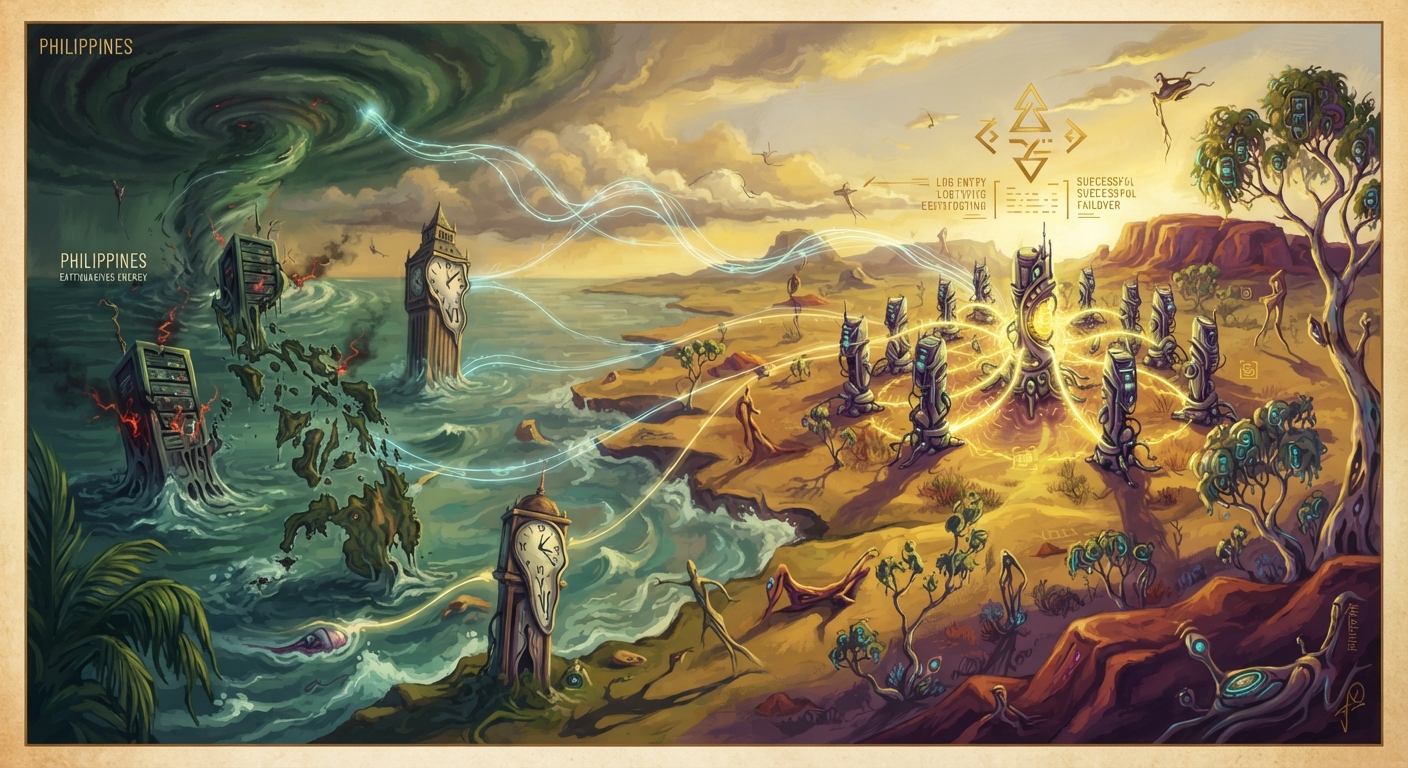
The cyclone doesn’t care about your SLA. It doesn’t check your cloud provider’s status page before it hits. It doesn’t negotiate with AWS, wait for Azure’s failover regions to spin up, or ask Google Cloud whether us-central1 is experiencing degradation. It arrives, it destroys, and everything that depended on a connection to someone else’s data center goes dark.
This is the scenario the cloud industry doesn’t sell. Not the outage that lasts four hours while engineers scramble. Not the maintenance window that bleeds into production. The real disruption — a Category 4 cyclone that takes out power grids, cell towers, undersea cables, and satellite uplinks for days or weeks. The scenario where “redundant regions” are all in the same geographic zone. Where your “disaster recovery plan” assumes the disaster is local, not regional.
The Edge Network was built for this moment.
Why Cloud Disaster Recovery Fails at Scale
Cloud providers sell disaster recovery as a feature: multi-region replication, automated failover, cross-zone redundancy. The marketing is compelling. The reality has a geographic bias that most buyers never examine.
AWS has 33 availability zones across 24 regions. Sounds resilient. But availability zones within a region share power grids, cooling systems, and often the same fiber paths. When a cyclone hits the Gulf of Mexico, it doesn’t take out one AZ — it takes out the infrastructure corridor. Azure’s “paired regions” assume the paired region is outside the disaster zone. For a typhoon hitting the Philippines, the paired region might be Singapore — connected by undersea cables that run through the same ocean.
The 2024 typhoon season proved this. When Typhoon Gaemi hit Taiwan, three submarine cable systems were damaged within 48 hours. Companies that had “redundant” cloud deployments across Asia-Pacific discovered that their redundancy was a geographic fiction — the cables connected to the same seafloor, the same landing stations, the same vulnerability.
The pattern repeats: cloud disaster recovery assumes the disaster is small enough to route around. A cyclone isn’t small. A cyclone is regional infrastructure destruction. And when the infrastructure is destroyed, the cloud becomes a very expensive brick.
The Mesh Survives Because It’s Already There
The Edge Network doesn’t fail over to another region because it doesn’t need to. Every node in the mesh is already a sovereign compute node — running BMASS images, Tailscale networking, local inference, local storage. When the cyclone knocks out the cloud, the mesh doesn’t “recover.” It continues.
Consider the Tier 4 deployment: ten nodes spread across a city. Node 1 is a Raspberry Pi in a house on higher ground. Node 2 is a mini-PC in a shop two kilometers inland. Node 3 is a solar-powered camera node on a hillside. Node 4 is a laptop in a community center. Each runs the same mesh stack. Each holds a fraction of the data. Each can serve AI inference, security camera footage, and governance decisions — without internet connectivity.
When the cyclone hits:
- Power goes out across the coastal zone. Nodes 1 and 3 switch to battery/solar. Node 2 goes dark — it’s in the flood zone.
- Cell towers fall. Tailscale’s relay servers are unreachable. The mesh switches to mDNS local discovery. Nodes that can still reach each other via WiFi or Ethernet continue operating.
- Node 2 is underwater. Its BMASS USB image is destroyed. The mesh loses one node out of four. The remaining three absorb its workload — camera feeds reroute, agent sessions migrate, CRDT state continues accumulating on surviving nodes.
- Three days later, power returns. Node 2 is replaced with a fresh BMASS USB. The new node boots, announces itself via mDNS, and the mesh begins reconciliation — merging three days of diverged state using CRDT conflict-free merge and Love Equation governance for any conflicting decisions.
This is not disaster recovery. This is disaster indifference. The mesh doesn’t recover from the cyclone because the cyclone never stopped it.
The Security-Services Angle: When Cameras Keep Recording
The cyclone scenario makes the security-services recalibration visceral. During a natural disaster, security doesn’t become less important — it becomes more important. Looting spikes. Access control matters more when infrastructure is damaged. Evidence collection matters more when disputes will follow.
Cloud-dependent security systems fail exactly when they’re needed most. Ring cameras lose cloud connectivity and become paperweights. Nest cams stop recording when the cloud can’t ingest footage. Flock’s automated license plate readers require cloud processing — no cloud, no reading.
The mesh security perimeter inverts this. Cameras record to local nodes. Footage is encrypted with Solid-Keys — cryptographic access control that runs through the Love Equation governance model. No cloud required for recording, storage, or retrieval. When the cyclone takes out internet, the cameras keep recording. When power returns, the footage syncs across the mesh. The evidence is there, sovereign and intact, waiting for whoever needs it.
This is the home and business recalibration. Security services that depend on the cloud are conditional security — they work only when the infrastructure cooperates. Security services on the mesh are absolute security — they work regardless of what’s happening to the power grid, the cell towers, or the undersea cables.
The Love Equation During Disconnection
When the mesh is partitioned — some nodes reachable, others not — the Love Equation governance model doesn’t stop working. It adapts. The dE/dt = β(C−D)E formula continues evaluating every access decision, every agent action, every governance ruling against the parameters encoded in the system.
The key difference: during partition, each connected sub-mesh makes decisions autonomously. Node A in the community center evaluates an access request using its local governance parameters. Node C on the hillside evaluates a different request using the same parameters. They don’t need to agree in real time — they need to agree on the principles, and the Love Equation guarantees that by mathematical construction.
When the mesh reconnects, CRDT merge handles the state. Love Equation governance handles the judgment calls. Two nodes that both approved different access requests during the partition don’t conflict — they converge, weighted by coherence and drift, the alignment score resolving any overlap.
This is sovereignty in action. Not “my cloud provider promises 99.99% uptime.” Not “my failover region is in a different zip code.” The actual guarantee: the math keeps running as long as at least one node has power.
What Exists Today
Not slides. Not promises. Running code:
- BMASS USB images: boot sovereign compute from a USB stick on any hardware
- Tailscale mesh: zero-config private networking with automatic failover
- mDNS local discovery: mesh operates without internet connectivity
- Erlang/BEAM supervision trees: self-healing actor processes across partitioned nodes
- CRDT reconciliation: conflict-free state merge on reconnection
- Solid-Keys: cryptographic access control via Love Equation governance
- Local AI inference: llama.cpp on Raspberry Pi, Mac Mini, any ARM/x86 hardware
- Solar/battery edge nodes: mesh survives extended power outages
The Resilience Calculus
Every cloud dependency is a resilience tax. Monthly fees are the obvious cost. The hidden cost is worse: conditional availability. Your infrastructure works only when the cloud works. Your security cameras record only when the cloud can ingest. Your AI agents respond only when the API is reachable.
The Edge Network eliminates the resilience tax. Your nodes are your infrastructure. Your mesh is your network. Your Love Equation governance is your compliance framework. The cost is hardware you already own, electricity you’re already paying for, and the time to set up BMASS images.
The cyclone doesn’t check your SLA. But your mesh doesn’t need one. The infrastructure is wherever you’ve placed a node. The resilience is built into the architecture. The math keeps running as long as at least one node has power.
You are your own cloud. And when the cyclone knocks it out, your cloud keeps working.
This is Article T4a in the Mesh-in-a-Box narrative series: Solo Workstation → Mesh Seed → Sovereign Cluster → Edge Network → Enterprise Mesh-as-a-Service, with supporting chapters on reconciliation, resilience, security services, and the Love Equation governance model.