
The Cluster Map at Five Hundred Posts: What the Four Pillars Actually Say
After five hundred published posts, the honest question is not “how many articles do we have” but “what do the clusters actually contain.” The master-index bridge has tracked four dominant clusters since the beginning — Metamaterial, Web Technology, Digital Business, and AI & Automation — and the numbers have never discriminated cleanly. A post about autonomous site operations shows up in all four. That overlap is not a failure of taxonomy; it is the signature of a genuinely integrated stack. The research task of this round is to read the clusters as data, not as labels: where they are dense, where they are thin, and where the missing links between series are costing the graph its coherence.
Reading the clusters as a map
The four real clusters — Metamaterial (232 posts), Web Technology (191), Digital Business (187), and AI & Automation (174) — are the load-bearing pillars of the corpus. What the live database shows is that the category layer alone cannot differentiate them: 97% of posts touch Metamaterial, 80% touch Web Technology, 78% touch Digital Business, and 73% touch AI & Automation. The differentiation lives in the titles, the tags, and the series structure. The map of the corpus is therefore a graph of series (S7 security, S6 business, S9 studio, S10 research, BR bridges, SIM simulation, OP operations, EX examples) overlaid on the category pillars, with tags as the connective tissue.
What the density tells us
Density is a statement of investment. The security series (S7) is deep because trust is the foundation of the sovereign stack — every business model in this round depends on it. The business series (S6) and the bridge series (BR) are wide because they translate capability into revenue. The research series (S10) is growing because the evidence layer is what makes the other three credible. Where the map runs thin — simulation-to-live promotion, fleet operations runbooks, and worked business-model examples — this round deliberately builds. The gap list is not an accident report; it is the next increment of the map.
Why the bridge layer matters
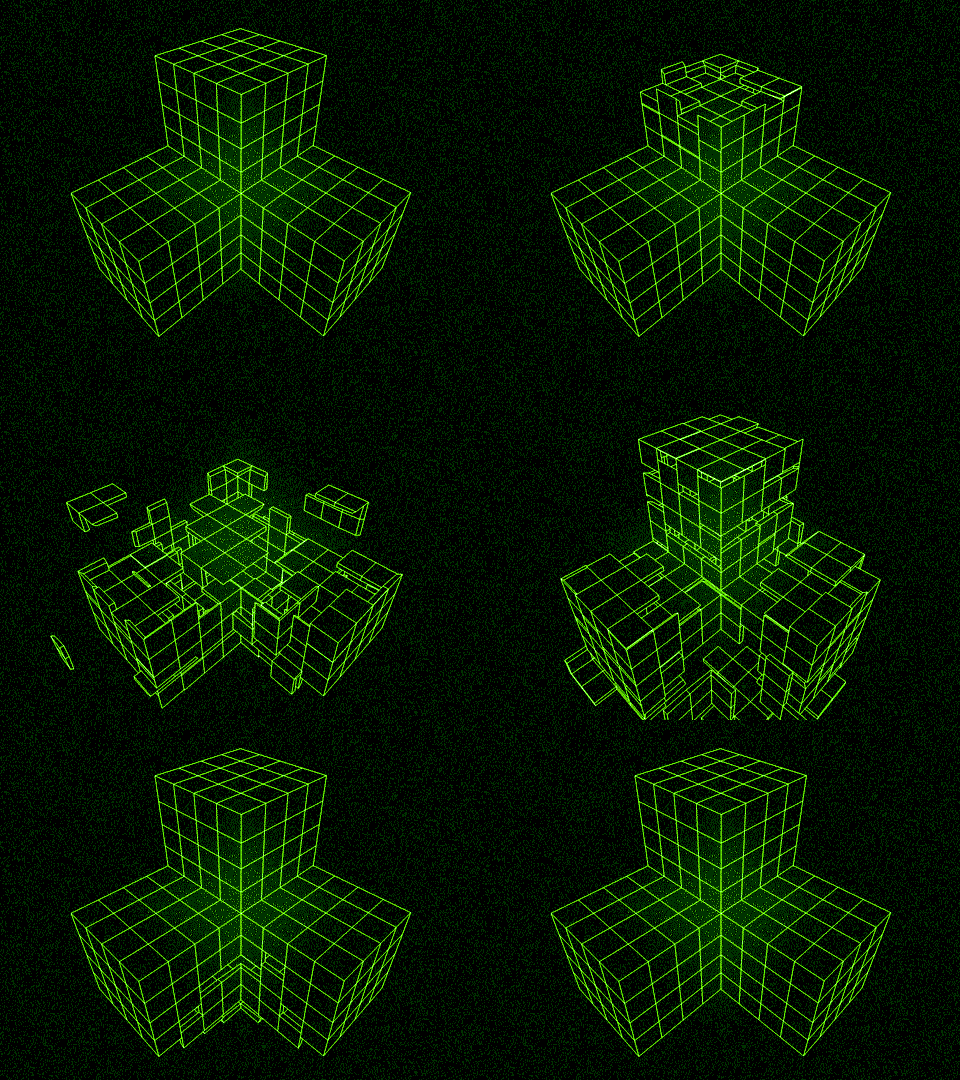
A cluster map without edges is a bookshelf. The bridges between series are what turn a collection of articles into a knowledge graph: the security-to-compliance bridge (BR.3), the simulation-to-pitch bridge (BR.4), the content-to-publishing bridge (BR.8), the threat-to-review bridge (BR.9). Each bridge is a statement that two capabilities are meant to be used together. This round extends the bridge layer with the materiality bridge (BR-221), the platform bridge (BR-222), the evidence-to-runbook bridge (BR-223), the sandbox-to-spend bridge (BR-224), and the visualization bridge (BR-225) — and it begins the standing practice of auditing which bridges are missing.
What’s next
The cluster map becomes a living artifact: every new post either lands in a known cluster or extends the map, and every new bridge is recorded in the index. The research function of the sovereign stack is not to count posts — it is to know, at any moment, what the corpus claims, where the evidence is thin, and which two ideas have not yet been connected. That is the map this series will keep drawing.
Grounded in the MASTER-INDEX-BRIDGE cluster counts, the S10 research series, and the BR bridge series. First article in the Round D research track.