
The Backup as Resurrection: Restore-First Thinking, North-Star Style
A backup that has never been restored is a hope, not a plan. The distinction is not rhetorical — it is architectural. A stored artifact and a demonstrated act live in different categories of reality. The north star’s frame makes this explicit: resurrection is the demonstrated act, the proof that the system can reconstitute itself from its records. Backup is not storage; it is a rehearsal of the worst day.
The failure mode is the unexercised backup: the archive that has grown for years, never tested, never restored, and discovered to be corrupt, incomplete, or unreadable exactly when it is needed. The archive looks healthy from the outside — files exist, checksums pass, the storage dashboard shows green. But a checksum proves the file survived transit; it does not prove the file can reconstitute a running system. The archive is a record, but a record that has never been read back is a record that has never been verified. Everything is a record — and every record must prove it can be read.
Restore-First Thinking
Restore-first thinking inverts the pipeline. The conventional sequence is: build the system, then figure out how to back it up. The restored sequence is: design the restore before the backup. What must exist to rebuild the stack from zero — the manifests, the keys, the seed data, the runbook, the container images, the secrets, the state? Then build the backup to serve that restore. The backup becomes a servant of the restore, not an independent archive that happens to contain useful files.
This inversion is not just good hygiene; it is a structural requirement for systems that compound. The sovereign stack — containers from images, config from manifests, secrets from the vault, state from the archive — is unusually restorable because it is unusually declarative. The whole system is a rendering of its records. Every container can be pulled fresh from its image. Every configuration can be re-applied from its manifest. Every secret can be re-read from the vault. The system does not exist as a unique, irreplaceable state on a particular disk; it exists as a recipe that can be re-executed. Resurrection is the architecture’s native mode, not a contingency.
But native mode only works if the recipe is complete and current. The restore-first discipline forces you to verify completeness: every component that the system needs must appear in the backup, in the right order, in the right format. If a secret rotated and the backup still holds the old key, the restore fails at the worst possible moment. If a manifest drifted from the running state and the backup captured the manifest rather than the drift, the restore produces a system that looks right but behaves wrong. Restore-first thinking catches these gaps during rehearsal, not during disaster.
The Rehearsal Cadence
A restore that has been rehearsed is a plan; a backup that has never been restored is a hope. The rehearsal cadence is the mechanism that converts hope into plan. The sovereign stack runs a scheduled restore drill: pick a component, restore it from the backup to a clean environment, verify it starts, verify it serves traffic, verify it reintegrates with the fleet. The drill is not optional; it is the only feedback loop that proves the backup works.
The drill also compounds. Each rehearsal reveals a gap — a missing dependency, an undocumented step, a secret that rotated between backup and restore. The gap gets fixed, the runbook gets updated, the next rehearsal runs cleaner. Continuity beats completion: the practice of rehearsing is more valuable than the perfection of any single backup. Month three’s rehearsal is shaped by month one’s failures. The fleet compounds or it decays.
Consider the concrete case: a Docker Swarm stack with MariaDB, WordPress, persistent volumes, overlay networks, and secrets. The backup captures the database dump, the volume data, the swarm stack file, the secrets, and the manifest. The restore drill spins up a fresh Docker host, loads the stack file, mounts the volumes, injects the secrets, imports the database, and verifies the site responds. The drill takes forty-five minutes. It has been run monthly for six months. Each run caught something: a volume mount path that changed, a secret that expired, a plugin that needed manual activation. The sixth rehearsal ran clean. The backup is now a proven plan, not a stored hope.
Resurrection as Architecture
The sovereign stack is unusually suited to restore-first thinking because its components are stateless by design. Containers are disposable; they can be destroyed and recreated without loss. The state lives in volumes and databases, which are captured as records. The configuration lives in manifests and stack files, which are captured as records. The secrets live in the vault, which is captured as a record. The entire system is a rendering of its records — so the restore is re-rendering from the record.
This is the north star’s principle made operational: everything is a record, and continuity beats completion. The system compounds because each record is a layer the next restoration builds on. The database dump from last month is the seed for this month’s restore. The manifest that captured last month’s drift is the starting point for this month’s configuration. The runbook that documented last month’s failure is the guide for this month’s drill. Every record compounds the next restoration’s reliability.
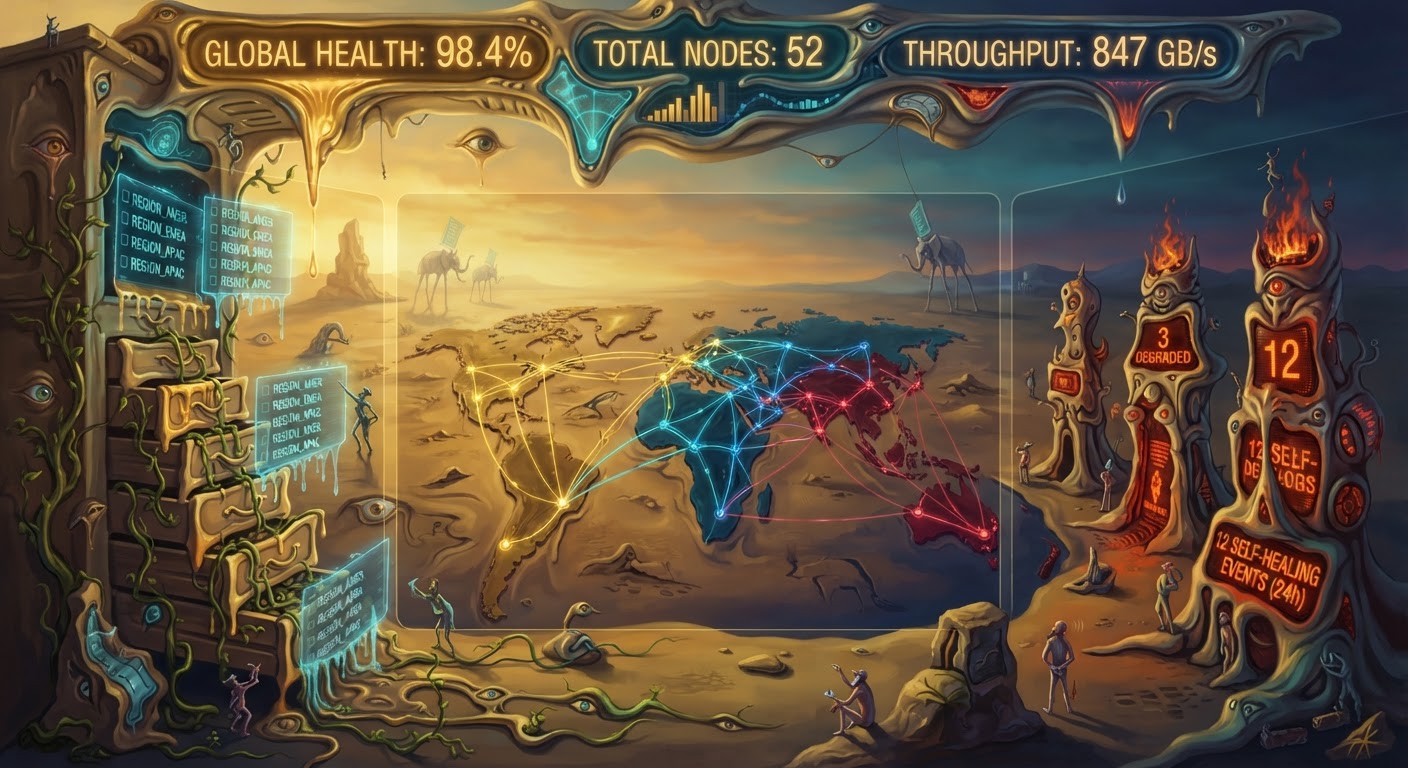
The phoenix of light rising from the dark server monolith is not a metaphor — it is a description of what happens when a sovereign stack reconstitutes itself from its records. The data streams reweave because the records are complete. The system rises because the recipe is proven. The resurrection is real because it has been rehearsed.
Practical Sovereignty Through Rehearsal
Digital sovereignty — the principle that a system’s resilience is determined by its own records and practices rather than by the goodwill of external providers — depends on demonstrated restore capability. A sovereign system does not ask its cloud provider whether its backups are sound; it proves it by restoring from them. A sovereign identity layer does not rely on a centralized CA’s promise that keys will survive; it proves key persistence by re-deriving them from the vault. Data permanence is not an aspiration; it is a verifiable property of the backup-and-restore cycle.
The programmable web requires that autonomous agents can recover from failure without human intervention. When an agent fleet loses a node, the replacement must be able to reconstitute the lost agent’s state from the backup — its configuration, its pending tasks, its authentication credentials, its learned context. If the agent cannot restore itself, the fleet is one disk failure away from permanent capability loss. Restore-first thinking applied to agent fleets means: every agent’s state is a record, every record is backed up, every backup is rehearsed, and every rehearsal compounds the fleet’s resilience.
Build backup as resurrection: design the restore first, back up to serve it, and rehearse the worst day on a cadence. A backup that has never been restored is a hope; a restore that has been rehearsed is a plan. The sovereign stack is a rendering of its records — practice the re-rendering. The fleet compounds or it decays; month three is shaped by month one.
Grounded in the SECTOR9 north star principles — Continuity beats completion; compounding is the engine, Everything is a record — and extending the S7.x security & sovereignty series theme: S7.9 swarm persistence / recovery. Sector7-grounded series article, SECTOR9 50+50. Category: AI & Automation.