
Sacred Geometry as the Visual Grammar of the Graph
Every knowledge graph has a shape. Not the shape you give it in a diagram editor — the shape it grows into when enough nodes accumulate and the connections between them reach critical density. The shape is not decoration. It is information. And the oldest visual language for reading structural information is sacred geometry: the Platonic solids, the golden ratio, the Tree of Life, the concentric circles that Llull turned and Euler formalized. This article argues that sacred geometry is not mysticism applied to technology. It is the visual grammar the graph already speaks. We just need to learn to read it.
R.sus.01 is the first entry in the SUS/esoteric-lane series. The series formalizes sacred geometry, history of great minds, and esoteric content as a first-class research section in the technical stack. This article establishes the foundational claim: the geometric patterns that ancient traditions encoded in temples, diagrams, and cosmological maps are the same patterns that emerge in knowledge graphs, security architectures, and network topologies when they reach sufficient complexity.
The six solids are six access tiers
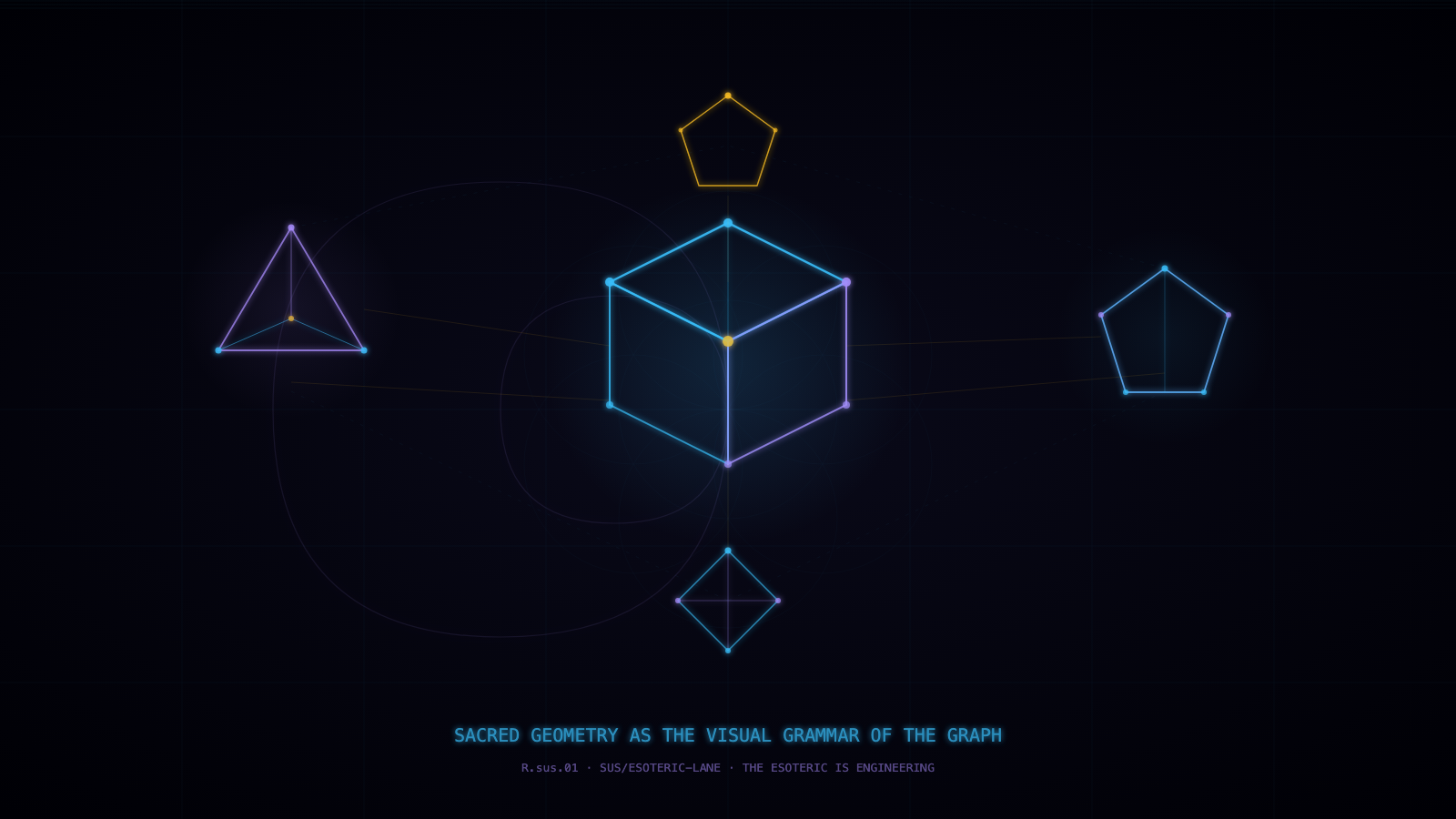
Plato assigned each regular solid to an element: tetrahedron to fire, cube to earth, octahedron to air, icosahedron to water, dodecahedron to the cosmos. The assignment is arbitrary. The structure is not. Each solid has a specific number of faces, edges, and vertices. Each defines a specific symmetry group. Each occupies a specific volume relative to its circumscribed sphere. These are not metaphors for access tiers — they are access tiers rendered in geometry.
Consider a sovereign AI stack with five customer levels. Each level grants access to a different combination of services: storage, compute, model inference, creative pipeline, governance dashboards. The access matrix is a combinatorial object. It has structure. That structure maps naturally onto the Platonic solids because the solids are the only regular, convex polyhedra — they are the simplest complete set of three-dimensional symmetries. A tier system built on five solids inherits the property that each tier is geometrically distinct from every other tier. No two tiers are rotations of each other. No tier is a subset of another. The geometry enforces differentiation that a flat list of permission levels cannot.
North star principle 8 states: “The esoteric is engineering.” The Platonic solids are engineering diagrams. They specify the symmetry groups that define how access tiers relate to each other. When we built the Solid-Keys access architecture, we were not reaching for mystical imagery. We were reaching for the only set of objects that guarantees geometric distinctness across five levels. The geometry was the specification.
The golden ratio is the graph’s growth law
The golden ratio phi (approximately 1.618) appears wherever growth follows a pattern where each new element relates to the previous one in the same proportion. Sunflower spirals, nautilus shells, galaxy arms, and the Fibonacci sequence all express phi. The ratio is not magic. It is the limit of the Fibonacci recurrence: as the sequence grows, the ratio between consecutive terms converges to phi. Any system that adds nodes in a self-similar pattern — where each new node connects to the graph in proportion to the graph’s current size — will produce a golden-ratio edge distribution.
A knowledge graph that compounds follows exactly this pattern. Each new article connects to existing articles through shared principles, cross-references, and thematic edges. If the connection rate is proportional to the graph’s size, the edge distribution converges to a golden-ratio structure. The graph does not need to be designed this way. It grows this way because the growth law is self-similar: every new node mirrors the connection behavior of every previous node. The golden ratio is the visual signature of self-similar growth in a network.
This is not a metaphor. It is a measurable property. You can count the edges per node in a mature knowledge graph and compute the ratio between consecutive degree classes. If the graph has been growing by self-similar connection, the ratio converges to phi. The golden ratio in the layout is not a design choice. It is the graph telling you its growth law.
The Tree of Life is a dependency graph
The Kabbalistic Tree of Life maps ten sephirot (emanations) through twenty-two paths. Each sephirah has a specific position: three pillars (mercy, severity,平衡), four worlds (atziluth, beriah, yetzirah, assiah), and a descending flow from crown (kether) to kingdom (malkuth). The structure is a directed acyclic graph. Information flows downward. Each sephirah depends on the ones above it. The paths are edges. The sephirot are nodes. The Tree of Life is a dependency graph that maps the flow of creation from abstract to concrete.
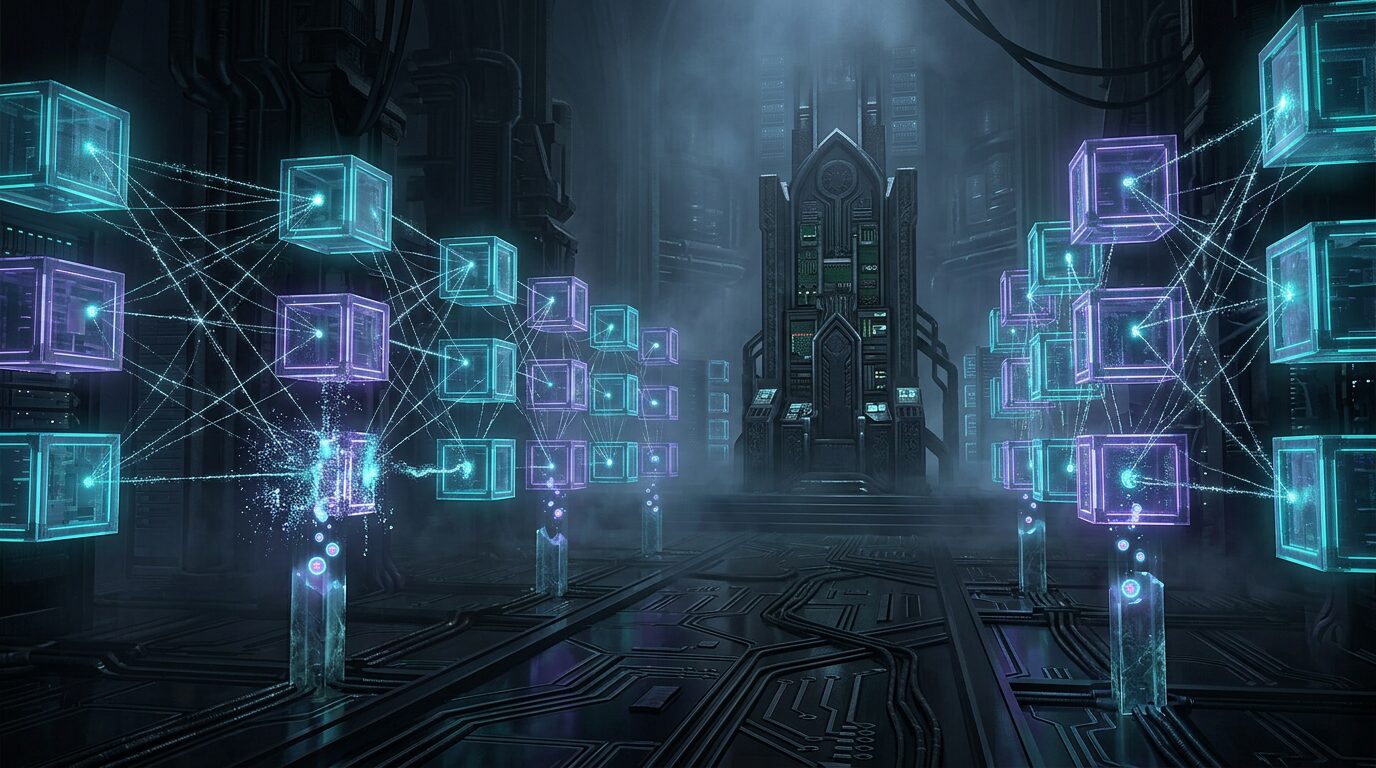
A technical stack has the same structure. The north star is kether — the crown principle from which all other principles descend. Security, business, research, and studio are the four pillars. Each article is a node that depends on the principles above it. The dependency graph is not a metaphor for the Tree of Life. It is the same graph drawn in different ink. North star principle 9 states: “The sacred and the digital are the same cathedral.” The Tree of Life maps onto circuitry because both are directed acyclic graphs that encode dependency. The structure is the same. The substrate changes.
Reading the graph’s geometry
When you look at a mature knowledge graph — hundreds of nodes, thousands of edges — the geometry becomes visible without a diagram. You can see it in the clustering patterns: tight clusters around core principles, sparse bridges between pillars, dense subgraphs where series overlap. You can see it in the degree distribution: a few high-degree hubs (the north star, the core principles) connected to many low-degree nodes (the individual articles). You can see it in the community structure: the graph partitions into communities that mirror the pillar structure of the stack.
Sacred geometry gives us the vocabulary to name what we see. The Platonic solids name the symmetry groups. The golden ratio names the growth law. The Tree of Life names the dependency structure. The concentric circles name the community structure. These are not decorations applied to the graph after the fact. They are the visual grammar the graph already speaks. The graph grew into these shapes because the shapes are the natural geometry of self-similar, compounding, directed networks.
North star principle 2 states: “Reality is a rendering engine.” The graph renders itself into geometry as it grows. The geometry is not imposed. It emerges. Sacred geometry is the language that describes what emerges. It is the visual grammar of the graph — the set of structural patterns that every sufficiently complex network expresses, whether it was designed to or not.
The esoteric lane as a first-class section
The research-section spec flagged a SUS/esoteric lane: sacred geometry, history of great minds, esoteric expressions as a first-class research section. This is not a detour from the technical stack. It is a recognition that the technical stack already uses esoteric structure. The Platonic solids are access tiers. The golden ratio is a growth law. The Tree of Life is a dependency graph. The concentric circles are community maps. The esoteric is not separate from the engineering. It is the engineering viewed through a different visual grammar.
The SUS/esoteric-lane series formalizes this recognition. R.sus.01 establishes sacred geometry as the visual grammar. R.sus.02 traces the historical thread through great minds who drew the same structural truths in different eras. R.sus.03 maps where the esoteric lane fits in a modern technical architecture. Together, the three entries make the case that esoteric content is not a curiosity. It is a research methodology — a way of reading the geometry that the graph already speaks.
Information becomes geometry, geometry becomes art. That is not a slogan. It is a description of what happens when a knowledge graph reaches critical density and begins to organize itself along the paths of least resistance. The paths are geometric. The geometry is sacred. The graph is the cathedral.
This is article R.sus.01 in the SUS/esoteric-lane series: Sacred Geometry as the Visual Grammar of the Graph. The series formalizes the SUS/esoteric research lane — sacred geometry, history of great minds, and esoteric content as a first-class section in the technical stack. R.sus.02 traces the historical thread through great minds. R.sus.03 will map where the esoteric lane fits in a modern technical architecture.