
Rendering the Attack Surface: What Your System Actually Projects
Perception is a renderer. What you can see is what your system has chosen to project — every endpoint, every status message, every response shape is a rendering decision. The attack surface is not the sum of your exposed services. It is the sum of what your system projects to anyone who asks. An unlisted service is still part of the attack surface; it is just a part you have not rendered to yourself.
The renderer’s blind spot is the danger. Every dashboard, every API response, every health check is a projection — this much of the system, this way. Attackers do not read your documentation; they probe the renderer for the parts you did not include. The debug endpoint that returns a stack trace. The admin route that forgot its authentication check. The unauthenticated health check that leaks service versions. The cron job that writes logs to a world-readable directory. Each of these is a rendering decision the operator never made consciously — the system projected them because nobody told it not to. The surface is what the system projects, not what the docs describe.
This is the first lesson: the attack surface is an output, not an input. You do not design it from the inside; you observe it from the outside. The mapper who walks the perimeter with a port scanner is not discovering new infrastructure — they are reading the system’s own projection. Every open port is a rendered pixel. Every HTTP header is a line in the image. The system is always showing itself; the question is whether the operator is watching the same render the attacker sees.
Rendering the attack surface means deliberately drawing the whole projection: every route, every service, every port, every response shape — including the ones you wish did not exist. The observability skeleton — port maps, service health, response catalogs — is not a monitoring feature. It is the honest render of the surface. You cannot defend what you have not rendered. The fleet that maps only its intended endpoints is a fleet with a shadow surface it has never seen, and that shadow is where the breach lives.
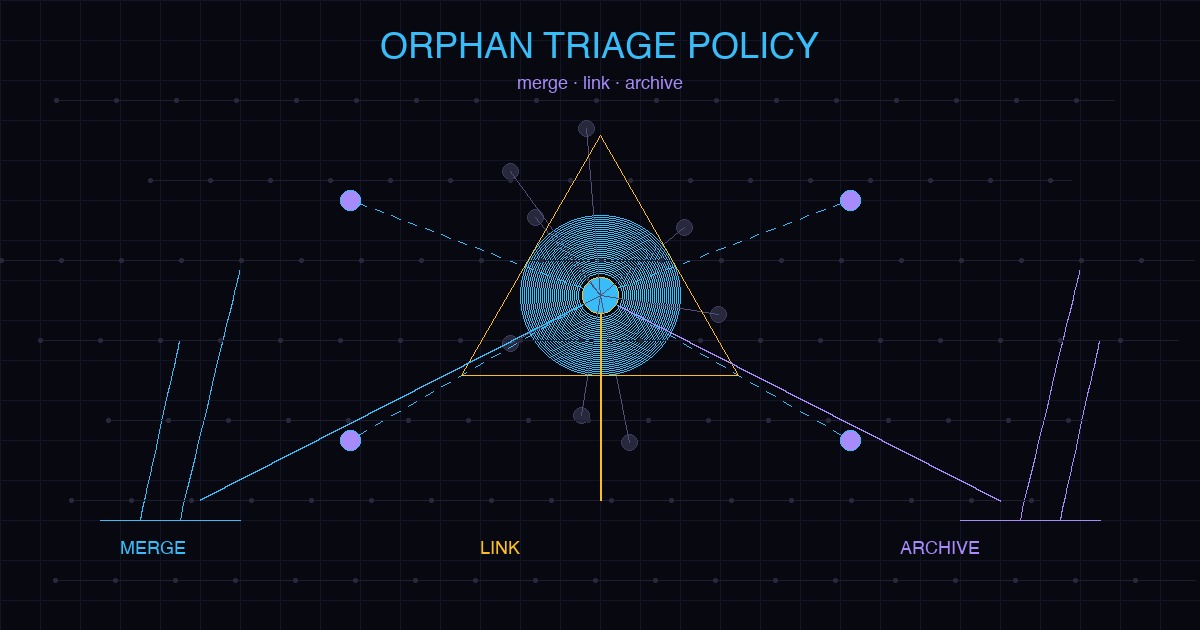
The holographic principle applies here with literal force. In a hologram, the whole image is encoded in every fragment. For a security perimeter, the design target is the same: the narrow gate, the service-level check, and the audit log should each contain the full security posture of the system. When the health check carries the same identity context as the API gateway, when the status page carries the same authentication chain as the data plane, the whole is in every part. An attacker who breaches one layer has learned nothing about the next — because the next layer asks the same questions in the same language. Blind spots become structurally impossible when the projection is self-similar at every scale.
The narrow gate is the rendering chokepoint. OpenFang, running on port 7076, inspects every outbound tool call for every agent in the fleet. But the gate does more than inspect — it renders. When an agent calls an external service, the gate logs the call, the scope, the key, and the outcome. That log is the gate’s own projection of the system’s surface: what touched what, with what authority, at what time. The gate does not guess at the attack surface; it records it as a side effect of doing its job. Every tool call the gate allows or rejects is a pixel in the render. The fleet’s attack surface is the aggregate of the gate’s decisions — and the gate sees every decision because there is no second server, no fallback, no direct path from any agent to the outside world that does not pass through inspection first.
This is where most systems fail: they render the intended surface and ignore the rest. The API documentation shows twelve endpoints; the system actually projects forty-seven. The status page shows three services; the system actually runs eleven. The gap between the documented surface and the rendered surface is the attacker’s playground. The narrow gate closes this gap not by restricting the render but by making it complete — every call, every scope, every outcome, recorded. The operator who reads the gate’s ledger sees the same surface the attacker probes. The blind spot collapses because the render is exhaustive.
The gate also renders what the system projects to itself. Agent-to-agent handoffs carry Ed25519 signatures; the gate verifies them the same way it verifies outbound calls. The internal surface — the trust graph, the key hierarchy, the task assignments — is projected through the same inspection pipeline as the external surface. A compromised agent cannot project a forged identity because the gate renders the identity check at every boundary. The internal and external surfaces are one render, seen from one chokepoint, with one set of rules. This is the Faengz Doctrine made visible: unified calls or none at all, and every call recorded.
Render the surface on purpose. Draw every route, every service, every response. The fleet that deliberately maps its own projection — including the debug endpoints, the legacy routes, the services that exist because someone stood them up and forgot — is the fleet that can defend itself. Light every corner you know about so that the corner you do not know about becomes the visible exception. The system you cannot see cannot be defended. The system you render fully can.
The operational cost is real: complete rendering requires instrumentation at every layer, gate-level logging for every call, and a discipline of reviewing the render instead of the documentation. The sovereign stack pays this cost because the alternative is governing the attack surface by faith — hoping the docs are current, hoping the undocumented services do not exist, hoping the attacker does not find what you have not drawn. The narrow gate replaces faith with geometry. The holographic perimeter replaces the single wall with self-similar structure. And the render — the honest, exhaustive, deliberately drawn projection of everything the system touches — becomes the defense itself.
Grounded in the SECTOR9 north star principles — Reality is holographic — and extending the S7.x security & sovereignty series theme: S7.1 narrow gate. Sector7-grounded series article, SECTOR9 50+50.